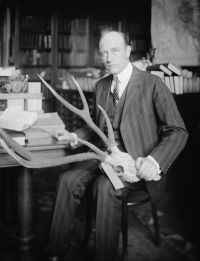
Roy Chapman Andrews

Roy Chapman Andrews

Summary

Portrait of Roy Chapman Andrews Roy Chapman Andrews Camps and Trails in China (1918)

The glorious days in our beloved East are gone, and yet, to us, the Orient seems not far away, for the miles of land and water can be traversed in a thought. Again we stand before our tent with the fragrant breath of the pines about us, watching the glistening peaks of the Snow Mountain turn purple and gold in the setting sun; again, we feel the mystic spell of the jungle, or hear the low, sweet tones of a gibbon's call. We have only to shut our eyes to bring back a picture of the bleak barriers of the Forbidden Land or the sunlit streets of a Burma village.
Source: Gutenberg

Portrait of Roy Chapman Andrews Roy Chapman Andrews Camps and Trails in China (1918)

We pitched our tents on a broad terrace beside the stream at the edge of the spruce forest. Above us towered the highest peak of the mountain, with a glacier nestling in a basin near its summit, and the snow-covered slopes extending in a glorious shining crescent about our camp. The moon was full, and each night as we sat at dinner before the fire, the ragged peaks turned crimson in the afterglow of the sun, and changed to purest silver at the touch of the white moonlight. We have had many camps in many lands but none more beautiful than the one at the "White Water."
Source: Gutenberg

Portrait of Roy Chapman Andrews Roy Chapman Andrews Camps and Trails in China (1918)

No matter how long one has lived in China one remains in a condition of mental suspense unable to decide which is the filthiest city of the Republic. The residents of Foochow boast that for offensiveness to the senses no town can compare with theirs, and although Amoy and several other places dispute this questionable title, we were inclined to grant it unreservedly to Foochow. It is like a medieval city with its narrow, ill-paved streets wandering aimlessly in a hopeless maze. They are usually roofed over so that by no accident can a ray of purifying sun penetrate their dark comers.
Source: Gutenberg

Get perspective with Kwize: daily news enlightened by great literature