Summary

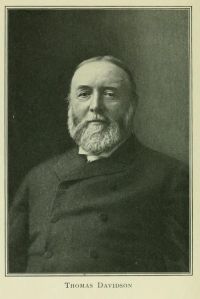
Portrait of Thomas Davidson Thomas Davidson Chambers's Twentieth Century Dictionary 1908… (1908)

Molecule, mol′e-kūl, n. one of the minute particles of which matter is composed: the smallest mass of any substance which retains the properties of that substance.—adj. Molec′ular, belonging to, or consisting of, molecules.—n. Molecular′ity.—Molecular attraction, attraction acting on the atoms or molecules of a body, as distinguished from attraction of gravitation.
Source: Wikisource

Portrait of Thomas Davidson Thomas Davidson Chambers's Twentieth Century Dictionary 1908… (1908)

Moral law, a law or rules for life and conduct, founded on what is right and wrong: the law of conscience; Moral philosophy, the science which treats of the qualities of actions as being right or wrong, and the duty of mankind with regard to such actions; Moral sense, that power of the mind which knows or judges actions to be right or wrong, and determines conduct accordingly
Source: Wikisource

Portrait of Thomas Davidson Thomas Davidson Chambers's Twentieth Century Dictionary 1908… (1908)

Mon′archise, to rule over, as a monarch: to convert into a monarchy.—ns. Mon′archism, the principles of monarchy: love of monarchy; Mon′archist, an advocate of monarchy: a believer in monarchy; Monarch′o (Shak.) , a fantastic Englishman who assumed Italian airs, any fantastic person; Mon′archy, a state or a people ruled over by one person: a kind of government of which the chief power is in the hands of a monarch: the territory of a monarch. [Fr. monarque, through L., from Gr. monarchēs—monos, alone, archein, to rule.]
Monastery, mon′as-tėr-i, n. a house for monks: an abbey: a convent.—adjs.
Source: Wikisource

Get perspective with Kwize: daily news enlightened by great literature