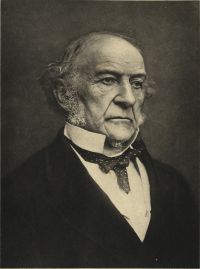
W. E. Gladstone

W. E. Gladstone

Summary

Portrait of W. E. Gladstone W. E. Gladstone Chapter of Autobiography

In theory at least, and for others, I am myself a purist with respect to what touches the consistency of statesmen. Change of opinion, in those to whose judgment the public looks more or less to assist its own, is an evil to the country, although a much smaller evil than their persistence in a course which they know to be wrong. It is not always to be blamed. But it is always to be watched with vigilance; always to be challenged, and put upon its trial. The question is one of so much interest, that it may justify a few remarks.
Source: Gutenberg

Portrait of W. E. Gladstone W. E. Gladstone Chapter of Autobiography

But when, either by some Revolution of institutions from their summit to their base, or by a silent and surer process, analogous to that which incessantly removes and replaces the constituent parts of the human body, the State has come to be the organ of the deliberate and ascertained will of the community, expressed through legal channels—then the inculcation of a religion can no longer rest, in full or permanent force, upon its authority.
Source: Gutenberg

Portrait of W. E. Gladstone W. E. Gladstone Chapter of Autobiography

But in the mean time individuals, by their partial and occasional efforts, bore witness to a principle broader than any which they formally announced. That principle—the application of a true religious equality to Ireland—was biding its time.
No one, in my opinion, was bound to assert, by speech or vote, any decisive opinion upon so great and formidable a question until he should think, upon a careful survey of the ground and the time, of the assisting and opposing forces, that the season for action had come.
Source: Gutenberg

Get perspective with Kwize: daily news enlightened by great literature