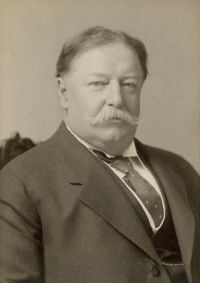
William Howard Taft

William Howard Taft

Summary

Portrait of William Howard Taft William Howard Taft Truax v. Corrigan/Dissent Brandeis… (1921)

It is for the legislature to say-within the broad limits of the discretion which it possesses-whether of not the remedy for a wrong shall be both criminal and civil and whether or not it shall be both at law and in equity.
A state is free since the adoption of the Fourteenth Amendment, as it was before, not only to determine what system of law shall prevail in it, but also by what processes legal rights may be asserted, and in what courts they may be enforced.
Source: Wikisource

Portrait of William Howard Taft William Howard Taft Truax v. Corrigan/Dissent Brandeis… (1921)

It was urged that the real motive in seeking the injunction was not ordinarily to prevent property from being injured nor to protect the owner in its use, but to endow property with active, militant power which would make it dominant over men; in other words, that under the guise of protecting property rights, the employer was seeking sovereign power. And many disinterested men, solicitous only for the public welfare, believed that the law of property was not appropriate for dealing with the forces beneath social unrest
Source: Wikisource

Portrait of William Howard Taft William Howard Taft Truax v. Corrigan/Dissent Brandeis… (1921)

The employer has, of course, a legal right to carry on his business for profit, and incidentally the subsidiary rights to secure and retain customers, to fix such prices for his product as he deems proper, and to buy merchandise and labor at such prices as he chooses to pay. This right to carry on business-be it called liberty or property-has value, and he who interferes with the right without cause renders himself liable.
Source: Wikisource

Get perspective with Kwize: daily news enlightened by great literature