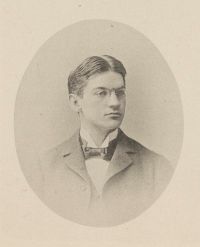
William Lyon Phelps

William Lyon Phelps

Summary

Portrait of William Lyon Phelps William Lyon Phelps Essays on Russian Novelists

In reading him we feel that what he says is true, it is life indeed; but we also feel an inexpressible charm. It is the mysterious charm of music, that makes our hearts swell and our eyes swim. He saw life, as every one must see it, through the medium of his own soul. As Joseph Conrad has said, no novelist describes the world; he simply describes his own world. Turgenev had the temperament of a poet, just the opposite temperament from such men of genius as Flaubert and Guy de Maupassant. Their books receive our mental homage, and deserve it; but they are without charm.
Source: Gutenberg

Portrait of William Lyon Phelps William Lyon Phelps Essays on Russian Novelists (1911)

Throughout the heat of the conflict, Tolstoi felt its utter absurdity, really holding the same views of war that he held as an old man. "And why do not Christian people," he wrote in Sevastopol in May, "who profess the one great law of love and self-sacrifice, when they behold what they have wrought, fall in repentance upon their knees before Him who, when He gave them life, implanted in the soul of each of them, together with the fear of death, a love of the good and beautiful, and, with tears of joy and happiness, embrace each other like brothers?"
Source: Wikisource

Portrait of William Lyon Phelps William Lyon Phelps Essays on Russian Novelists (1911)

The garden scene between Lisa and Lavretsky is the very ecstasy of passion, although, like the two characters, it is marked by a pure and chaste beauty of word and action, that seems to prove that Love is something divine. Only the truly virtuous really understand passion — just as the sorrows of men are deeper than the sorrows of children, even though the latter be accompanied by more tears. Those who believe that the master passion of love expresses itself by floods of words or by abominable imagery, will understand Turgenev as little as they understand life.
Source: Wikisource

Get perspective with Kwize: daily news enlightened by great literature