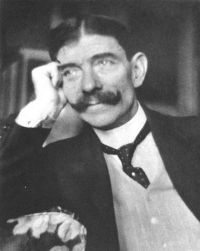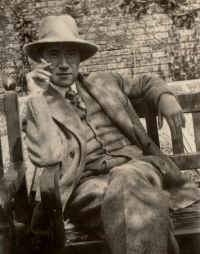
André Gide

Definition and stakes

Portrait of André Gide André Gide,  The Vatican swindle (1925)

“ He was sitting all alone in a compartment of the train which was carrying him away from Rome, and contemplating—not without satisfaction—his hands in their grey doeskin gloves, as they lay on the rich fawn-coloured plaid, which, in spite of the heat, he had spread negligently over his knees. Through the soft woollen material of his travelling-suit he breathed ease and comfort at every pore; his neck was unconfined in its collar which without being low was unstarched, and from beneath{206} which the narrow line of a bronze silk neck-tie ran, slender as a grass-snake, over his pleated shirt. ”
Source: Gutenberg

Portrait of André Gide André Gide,  Oscar Wilde, a study

“ I know him so well. He writes to me every day. I also am of opinion that he ought to finish his play first, but after that he will come back here. He has never done anything good in solitude; he needs to be constantly drawn out of himself. It is by my side that he has written all his best work. Besides, just look at his last letter.'
He thereupon read it to me. In it Wilde begged —— to let him finish his Pharaoh in [Pg 78] peace, but, in effect, the letter implied that as soon as his play was written he would come back, he would find him again
”
Source: Gutenberg

Portrait of André Gide André Gide,  Oscar Wilde, a study

“ He accuses the others of having changed me—but one must never take up the same existence again. My life is like a work of art. An artist never begins the same work twice, or else it shows that he has not succeeded. My life before prison was as successful as possible. Now all that is finished and done with.'
He lighted a cigarette and went on: 'The public is so dreadful that it knows a man only by the last thing he has done. If I were to go back to Paris now, people would see in me only the convict. I do not want to show myself again before I have written a play.
”
Source: Gutenberg

Get perspective with Kwize: daily news enlightened by great literature