“ BECALMED AT AULIS. A pleasant wind from the west sprang up, and drove the great fleet out into the sea. Not a single one of the thousand ships was lost or left behind; and after a quick and happy voyage, they came in sight of a fruitful land and a great city with high towers and pleasant dwellings."The gods have favored us, even beyond what we asked!" cried the Hellenes.Achilles and his Myrmidons landed first, and without waiting for the other ships to come up, they rushed across the plain, and began an assault upon the town. ”
Aulis
Definition and stakes
Aulis, a coastal location in ancient Greece, holds crucial significance in both myth and history as the gathering place for the Greek expedition to Troy. Euripides’ Iphigenia in Aulis portrays the fleet's halt caused by unfavorable winds, presenting Iphigenia's sacrifice as a dire requirement for divine approval. Aeschylus references this rite, emphasizing its ethical implications, while historians such as H.
A. Guerber and P. V. N. Myers place Aulis as a key center for Greek warriors assembling for battle. The site’s connection to Artemis’s temple, as observed by Frazer, highlights its function as a meeting ground of legend and human endeavor, illustrating the entwined destinies of heroes and deities in the Trojan saga.
Quotes about “Aulis”
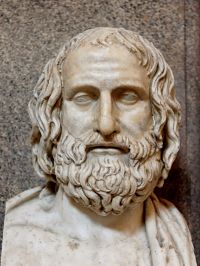 Euripides,
Iphigenia in Aulis
(1858)
Euripides,
Iphigenia in Aulis
(1858)
“ But it behooves not a man who has met with great fortune to change his manners, but then chiefly to be firm toward his friends, when he is best able to benefit them, being prosperous. I have first gone over these charges against thee, in which I first found thee base. But when thou afterward camest into Aulis and to the army of all the Greeks, thou wast naught, but wast in stupefaction at the fortune which then befell us from the Gods, lacking a favorable breeze for the journey. But the Greeks demanded that you should dismiss the ships, and not toil vainly at Aulis. ”
Euripides,
Iphigenia in Aulis
(1858)
“ Would [90] for me that Aulis had never received the poops of the brazen-beaked ships into these ports, the fleet destined for Troy, nor that Jove had breathed an adverse wind over Euripus, softening one breeze so that some mortals might rejoice in their [expanded] sails, but to others a pain, to others difficulty, to some to set sail, to others to furl their sails, but to others to tarry. In truth the race of mortals is full of troubles, is full of troubles, and it necessarily befalls men to find some misfortune. ”