“ I thought it best to pause there and take breath. "Bagley," I said, "there is something about these ruins I don't understand. It is there I am going. Keep your eyes open and your wits about you. Be ready to pounce upon any stranger you see,—anything, man or woman. Don't hurt, but seize—anything you see." "Colonel," said Bagley, with a little tremor in his breath, "they do say there's things there—as is neither man nor woman." There was no time for words. "Are you game to follow me, my man? that's the question," I said. Bagley fell in without a word, and saluted. ”
Quotes about “Bagley”
Anonymous, Charles Peace, or The Adventures of a Notorious Burglar
“ Bagley—not a bit altered since I last saw you—not a day older.”“Ah, Master Ashbrook, I be older, and, what be more, I find it out. My back is so weak at times that I hardly know how to hold myself up; but I haven’t any great reason to complain, all things considered.”“You are happy and contented—that’s the chief thing.”“Well I do hope as I never was one of the complaining sort, poor dear Bagley used to say.”“Oh,” thought the farmer, “if I once let her loose on that string, we shall have to listen to her for heaven knows how long.” ”
 Arlo Bates,
The Diary of a Saint
Arlo Bates,
The Diary of a Saint
“ Bagley in a sort of professional tone, "now don't go to gettin' excited and rampageous. You know she brought you some rippin' flannel for the baby. Them pious folks has to talk, but, Lord, nobody minds it, and you hadn't ought ter. They don't really mean nothing much." ”
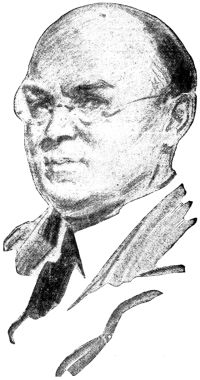 Edwin Balmer,
Resurrection Rock
(1920)
Edwin Balmer,
Resurrection Rock
(1920)
“ But of course it was some one who arrived at the Rock after Bagley had shut you out and you had followed him to Wheedon's." "Yes; I think that's pretty clear," Barney agreed. "But who was he?" "Do you suppose Bagley knows? I mean, do you think Bagley knew that some one else was coming to the Rock last night?" "Perhaps," Barney considered doubtfully. "It's possible, but when I think over the way Bagley acted, I don't believe it's probable; that is, Bagley is the sort of man who's square to the fellow who pays him ”
Percy Keese Fitzhugh, Roy Blakeley's roundabout hike (1927)
“ Bagley, I said, “Are you one of the people that wouldn’t sell it to Temple Camp?”He said, “Oh, goodness no!” just like that. He said those were the heirs and there were a lot of them. But he said anyway, he was the real heir. Jiminies, I felt sorry for him. He was mighty nice, just sitting there and talking to us like that. He said he liked boys, especially Scouts, and he said only for a tragedy that happened, Temple Camp would have all that land.Oh boy, you should have seen Pee-wee’s eyes open—that’s his middle name, tragedies. He eats them alive. ”
Edwin Balmer,
Resurrection Rock
(1920)
“ Ethel telephoned to Considine and reported to him the lack of result from her visits; he said he had no other suggestions to offer, but if Bagley communicated with the office, Considine agreed to inform her. She put an advertisement in the newspapers asking for information about D. A. Bagley, who recently had come from the upper peninsula; then she took a car again to the north side and, leaving it at Division she walked, carrying her suit case, into the district of those who are not dependent upon street cars, where is Scott Street. ”
Edward Sylvester Ellis, The Wilderness Fugitives
“ A glance at the painted warriors showed they were Iroquois, who were following so vigilantly the fugitives that had managed to elude them thus far. Bagley emerged from the house and shook hands with Worrell, the two at once entering into a hurried conversation, while the Indians, in accordance with their nature, stood apart, saying nothing to each other, but satisfied to wait till the time should come for them to act in obedience to the orders of their leader. ”
Annie Randall White, The Blue and the Gray; Or, The Civil War as Seen by a Boy
“ Let her come—it's getting pretty warm here.” They were the last orders this brave and grand young officer ever gave. The next moment the bursting of one of the enemy's shells sent Ensign Bagley to his last home. May his life be an incentive to the young, to do their duty in all situations and in all places as nobly and faithfully as did this brave boy. ”
Edwin Balmer,
Resurrection Rock
(1920)
“ He had stopped at Wheedon's in the afternoon, as Ethel had supposed, and there had learned that the man named Bagley, who had never been seen in the neighborhood before, had arrived a day earlier and exhibited a letter from Marcellus Clarke which authorized him to obtain the keys to the house on Resurrection Rock. ”
Edwin Balmer,
Resurrection Rock
(1920)
“ Wheedon had furnished him with the keys and, at Bagley's request, Wheedon and his wife had accompanied Bagley to the Rock where they had opened the house. The Wheedons then had returned, apparently after filling Bagley with the neighborhood gossip and superstition about Resurrection Rock. Bagley stayed at the house, having brought a supply of food; he built fires and had everything ready when Barney arrived. He proved to be a steward sort of person—a man about forty-five, accustomed to obey orders without inquiring into reasons. He did things for Mr. ”
George Gordon Hastings, The first American King (1904)
“ Captain Bagley bowed low, maintaining a respectful silence.“Your orders are these,” continued Lord Ashley: “At fifteen o’clock to-day you will proceed to a point in the park where you can observe the summer-house upon Antler Hill. Conceal yourself from observation among the trees, or bushes. At about fifteen and three-quarters o’clock you will observe an escaped prisoner walking along the Stag Walk toward Antler Hill. That escaped prisoner will be Captain Stanley Mortimer. ”
Charles King, Rancho Del Muerto, and Other Stories of Adventure
“ Not a whisper escaped the motionless assembly as the young man slowly brought his weapon into position. “Crack!” sounded the rifle out of a balloon-shaped cloud of blue smoke. “Missed centre, board, tree an' all!” cried out Bagley, in a tone of deep regret. “I seed yore lead plough up the dirt away out tother side; it's powerful hard to hold a steady han' when you are fust called on.” “Next is Taylor Banks!” announced the referee; and as a middle-aged man advanced and toed the mark, Lawson was heard to say, with a loud laugh; “Fust one missed the tree ”
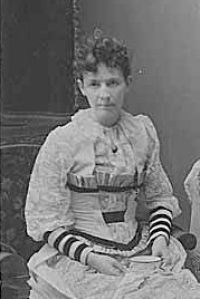 Emily Inez Denny,
Blazing the Way; Or, True Stories…
Emily Inez Denny,
Blazing the Way; Or, True Stories…
“ At night when the streets of your cities and villages shall be silent and you think them deserted they will throng with the returning hosts that once filled and still love this beautiful land. The white man will never be alone. Let him be just and deal kindly with my people, for the dead are not altogether powerless.’”Concerning the well-known portrait of Sealth, Clarence Bagley has this to say:“It was in the early summer of 1865 that the original picture which is now so much seen of the old chief was taken. ”
Self-made man, A corner in corn; or, How a Chicago boy did the trick (1905)
“ The upper floors were divided into supper rooms for ladies and their escorts, and it was quite a fad among the upper crust of Kansas City aristocracy to drop in there after the theater.Mr. Bagley himself, rotund and red-faced, lounged in a big easy chair behind the cashier’s desk near the entrance.The room was nearly crowded at that hour, and while Vance was surveying the place with much interest a waiter approached Dudley and handed him a card.“We’ll go upstairs, Vance,” said the dapper gentleman gaily. “I’ll introduce you to a friend of mine.” ”
 Robert Neilson Stephens,
The Mystery of Murray Davenport…
Robert Neilson Stephens,
The Mystery of Murray Davenport…
“ Whereat he grinned benignly at Turl, who acknowledged with a courteous “Thank you.” “You never forget a face,” said Bagley, “and yet you don't remember this one. Make allowance for its having undergone a lot of alterations, and look close at it. Put a hump on the nose, and take the dimples away, and don't let the corners of the mouth turn up, and pull the hair down over the forehead, and imagine several other changes, and see if you don't make out your old acquaintance—and my old friend—Murray Davenport.” ”
William C. Bagley, Craftsmanship in Teaching
“ And yet, so deeply implanted was this ideal of self-reliance that New England scarcely thought of asking aid of the mother country and would have protested to the last against the permanent establishment of a military garrison within her limits. For a period extending over fifty years, New England protected her own borders. She felt the terrors of savage warfare in its most sanguinary forms. And yet, uncomplaining, she taxed herself to repel the invaders. The people loved their own independence too much to part with it, even for the sake of peace, prosperity, and security. ”
William C. Bagley, Craftsmanship in Teaching
“ Should we not ourselves subscribe an undying fidelity to those great ideals for which teaching must stand,—to the ideal of social service which lies at the basis of our craft, to the ideals of effort and discipline that make a nation great and its children strong, to the ideal of science that dissipates the black night of ignorance and superstition, to the ideal of culture that humanizes mankind? ”
William C. Bagley, Craftsmanship in Teaching
“ Some day our people will awake to the possibilities that inhere in these palpable expressions of the impalpable things for which our country stands. We shall come to recognize the vast educative importance of perpetuating, in every possible way, the deep truths that have been established at the cost of so much blood and treasure. ”
William C. Bagley, Craftsmanship in Teaching
“ Is it not the specific task of education to represent in each generation the human experiences that have been tried and tested and found to work,—to represent these in the face of opposition if need be,—to be faithful to the trusteeship of the most priceless legacy that the past has left to the present and to the future? ”
William C. Bagley, Craftsmanship in Teaching
“ A mere fact has never yet had a profound influence over human conduct. A principle that is accepted by the head and not by the heart has never yet stained a battle field nor turned the tide of a popular election. Men act, not as they think, but as they feel, and it is not the idea, but the ideal, that is important in history. ”
William C. Bagley, Craftsmanship in Teaching
“ Above all, let me protest against the incidental theory of teaching pupils how to study. To adopt the incidental policy in any field of education,—whether in arithmetic, or spelling, or reading; whether in developing the power of reasoning or the memory, or the art of study,—is to throw wide open the doors that lead to the lines of least resistance, to lax methods, to easy honors, to weakened mental fiber, and to scamped work. ”
William C. Bagley, Craftsmanship in Teaching
“ The nineteenth century left us a glorious heritage in the great discoveries and inventions that science has established. These must not be lost to posterity; but far better lose them than lose the spirit of free inquiry, the spirit of untrammeled investigation, the noble devotion to truth for its own sake that made these discoveries and inventions possible. ”
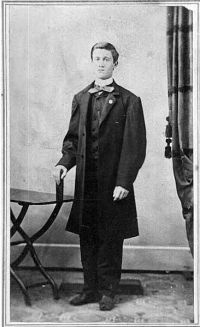 Clarence Booth Bagley,
Washington Historical Quarterly
(1906)
Clarence Booth Bagley,
Washington Historical Quarterly
(1906)
“ While I am no apologist for the hideous wrongs perpetrated upon the natives of the New World by the Spaniards, they at least protected their own people by sending out a garrison with every colony, which took good care that there were not enough of the native population left to be a menace to the settlers. It is often said the English did better than the Americans with the Indians, and had less trouble with them. ”
William C. Bagley, Craftsmanship in Teaching
“ He has seen the rouge on the cheeks that seem to blush with the bloom of youth and beauty and innocence, and has caught the cold glint in the eyes that, from the distance, seem to languish with tenderness and love. Why, he asks, should we create an illusion that must thus be rudely dispelled? Why revamp and refurbish the old platitudes and dole them out each succeeding year? Why not tell these young people the truth and let them be prepared for the fate that must come sooner or later? ”
William C. Bagley, Craftsmanship in Teaching
“ Let our country cease in its work of education, and these United States must needs pass through the reverse stages of their growth until another race of savages shall roam through the unbroken forest, now and then to reach the shores of ocean and gaze through the centuries, eastward, to catch a glimpse of the new Columbus. Like the moving pictures of the kinetoscope when the reels are reversed, is the picture that imagination can unroll if we grant the possibility of a lapse from civilization to savagery. ”
William C. Bagley, Craftsmanship in Teaching
“ All of which seems to indicate to me that he has abandoned, for the while at least, his intention to turn quite all the pages of the world's great book, and is content to live true to the ideal that was born in the log schoolhouse—the conviction that the true life is the life of service, and that the love of wandering and the lure of gold are only siren calls that lead one always toward, but never to, the promised land of dreams that seems to lie just over the western range where the pink sunset stands sharp against the purple shadows. ”
William C. Bagley, Craftsmanship in Teaching
“ The artist or the scientist who has an itching palm, who prostitutes his craft for the sake of worldly gain, is quickly relegated to the oblivion that he deserves. He loses caste, and the caste of craft is more precious to your true craftsman than all the gold of the modern Midas. ”
William C. Bagley, Craftsmanship in Teaching
“ And just as youth and hope and the gift of gladness are the eternal verities on one side of the picture, so the spirit of service, the spirit of sacrifice, is the eternal verity that forms their true complement ”
William C. Bagley, Craftsmanship in Teaching
“ The sunlight and the shadows bring their old beauty and waken the old heart-strains at morning, noon, and even-tide; the little children are still the symbol of the eternal marriage between love and duty; and men still yearn for the reign of peace and righteousness—still own that life to be the best which is a conscious voluntary sacrifice. ”
William C. Bagley, Craftsmanship in Teaching
“ His career stands for and illustrates the greatest of our national principles,—the principle of equality,—not the equality of birth, not the equality of social station, but the equality of opportunity. ”
William C. Bagley, Craftsmanship in Teaching
“ This is the factor that keeps the toiler free from the deadening effects of mechanical routine. It is the factor that keeps the farmer at his plow, the artisan at his bench, the lawyer at his desk, the artist at his palette. ”
William C. Bagley, Craftsmanship in Teaching
“ Whenever an artist has been able to say, 'I came, I saw, I conquered,' it has been at the end of patient practice. Genius, at first, is little more than a great capacity for receiving discipline. Singing and acting, like the fine dexterity of the juggler with his cup and balls, require a shaping of the organs toward a finer and finer certainty of effect. ”
William C. Bagley, Craftsmanship in Teaching
“ The grave defect in our American life is not that we are hero worshipers, but rather that we worship but one type of hero; we recognize but one type of achievement; we see but one sort of genius. For two generations our youth have been led to believe that there is only one ambition that is worth while,—the ambition of property. Success at any price is the ideal that has been held up before our boys and girls. ”
William C. Bagley, Craftsmanship in Teaching
“ They come through more impalpable and hidden channels,—now through stately buildings with vine-covered towers from which the past speaks in the silence of great halls and cloistered retreats; now through the unwritten and scarcely spoken traditions that are expressed in the very bearing and attitude of those to whom youth looks for inspiration and guidance; now through a dominant and powerful personality, sometimes rough and crude, sometimes warm-hearted and lovable, but always sincere. ”
William C. Bagley, Craftsmanship in Teaching
“ It is the privilege of the teaching craft to represent more adequately than any other calling the conditions for remaining young. There is time for living out-of-doors, which some of us, alas! do not do. And youth, with its high hope and lofty ambition, with its resolute daring and its naive wonder, surrounds us on every side. And yet how rapidly some of us age! How quickly life seems to lose its zest! How completely are we blind to the opportunities that are on every hand! ”
