“ Because these ancient foundations link with the past, because of all they may mean to the present and to the future, the way to them should be made broad enough to admit the living stream of Greater Britain's children, who by dint of gifts and industry have proved their fitness to meet their peers in these delectable cities, where the very air breathes the romance of British culture. ”
British culture
Definition and stakes
The theme of “British culture” has been addressed by authors such as Matthew Arnold, Willard Huntington Wright, Cecil Rhodes, Ralph Waldo Emerson and Edmund Yates. It is often associated with terms like England, English, people, Britain and society.
Quotes about “British culture”
 Willard Huntington Wright,
Misinforming a Nation — Chapter I: Colonizing America
(1917)
Willard Huntington Wright,
Misinforming a Nation — Chapter I: Colonizing America
(1917)
“ It is necessary only to look through British newspapers and critical journals to discover the contemptuous and not infrequently venomous tone which characterizes the discussion of American culture.At the same time, England grasps every opportunity for foisting her own artists and artisans on this country. She it is who sets the standard which at once demolishes our individual expression and glorifies the efforts of Englishmen. ”
 A. Cleveland Coxe,
Impressions of England; or, Sketches of English Scenery and Society
A. Cleveland Coxe,
Impressions of England; or, Sketches of English Scenery and Society
“ The nobility, the clergy, the gentry, the literati, the professional classes, and then the people—after all, in England they are one; “shade unperceived and softening into shade,” and joined and knit together by habits, tastes, alliances, and interests, in a wonderful order. Much yet remains to be done, and will be done, to smooth down remaining asperities between rank and rank; but the British aristocracy may be said, even now, to be a genuine one, identified with everything great and good in the nation, and, on the whole, presenting a wholesome example to other classes in the State. ”
The Assault: Germany Before the Outbreak and England in War-Time
“ If you were an impulsive, excitable, sentimental American and thought you were mildly rebuking your British friends when you ventured to wonder at the extraordinary naturalness of life in the West End, or at Walton Heath golf links, or at Chelsea football grounds, or at the Newmarket race-course, you found yourself unconsciously paying a tribute to "British character." ”
 Edmund Yates,
Black Sheep: A Novel
Edmund Yates,
Black Sheep: A Novel
“ You will store your mind in experience, you will see all sorts and varieties of men and as you have nothing particular to bind you to England, you could thoroughly enjoy your freedom, and return with a valuable stock of ideas for the future benefit of the British reading public. ”
 Ralph Waldo Emerson,
English Traits — Land
(1856)
Ralph Waldo Emerson,
English Traits — Land
(1856)
“ England has inoculated all nations with her civilization, intelligence, and tastes; and, to resist the tyranny and prepossession of the British element, a serious man must aid himself, by comparing with it the civilizations of the farthest east and west, the old Greek, the Oriental, and, much more, the ideal standard, if only by means of the very impatience which English forms are sure to awaken in independent minds. ”
Ralph Waldo Emerson,
English Traits — Land
(1856)
“ The practical common-sense of modern society, the utilitarian direction which labor, laws, opinion, religion take, is the natural genius of the British mind. ”
William James, Talks To Teachers On Psychology…
“ The strength of the British Empire lies in the strength of character of the individual Englishman, taken all alone by himself. And that strength, I am persuaded, is perennially nourished and kept up by nothing so much as by the national worship, in which all classes meet, of athletic outdoor life and sport. ”
of the Bank of England John Francis, Chronicles and characters of the stock exchange (1850)
“ When the intelligence reached England, that the nation whose tongue was classic, whose statuary was regarded with despairing wonder, whose records formed one of the finest pages of history, was, after centuries of subjugation, striving to obtain freedom, a genuine enthusiasm pervaded English society. ”
John Richard Green, History of the English People, Volume I
“ Even the national temper was fully formed. Civilization, letters, science, religion itself, have done little to change the inner mood of Englishmen. That love of venture and of toil, of the sea and the fight, that trust in manhood and the might of man, that silent awe of the mysteries of life and death which lay deep in English souls then as now, passed with Englishmen to the land which Englishmen had won. ”
“ I much prefer the condition of an English gentleman of the better class, to that of any potentate in Europe,--whether for travel, or for opportunity of society, or for access to means of science or study, or for mere comfort and easy healthy relation to people at home.Such, as we have seen, is the wealth of England, a mighty mass, and made good in whatever details we care to explore. The cause and spring of it is the wealth of temperament in the people. The wonder of Britain is this plenteous nature. Her worthies are ever surrounded by as good men as themselves ”
Edward Parrott, The Pageant of British History
“ Priests, judges, magicians, and instructors of youth, they rule the Britons with a rod of iron. Their altars and idols are set deep in the gloomy shades of dense forests amidst the gnarled and twisted stems of aged oaks. The secrets of their cruel creed are close locked in their bosoms, and over all their words and works they cast a dread mystery that chills the heart of the boldest Briton in the land. Their word is law, their curse is death. Their richest treasures go unguarded save for the awe which they inspire. ”
Ralph Waldo Emerson,
English Traits — Ability
(1856)
“ The Universities galvanize dead languages into a semblance of life. Their church is artificial. The manners and customs of society are artificial; – made up men with made up manners; – and thus the whole is Birminghamized, and we have a nation whose existence is a work of art; – a cold, barren, almost arctic isle, being made the most fruitful, luxurious and imperial land in the whole earth.Man in England submits to be a product of political economy. On a bleak moor, a mill is built, a banking-house is opened, and men come in, as water in a sluice-way, and towns and cities rise. ”
by Henry James, The Suburbs of London
“ To the contemplative stranger who permits himself not only to talk sentimental nonsense, but to think it, it seems as if, somehow, all England had been gathered up into such a place—-as if nothing less than her glorious past, her wealth, her power, her honour, her uninvaded centuries, had been needed to produce it. ”
 Nathaniel Parker Willis,
Famous Persons and Places
Nathaniel Parker Willis,
Famous Persons and Places
“ The class of society, in a country, with which simple and proud genius finds itself most at home, is its superior and true nobility; and, that England’s circles of high rank are so preferred, and so honored and brightened, by spirits like Jane Porter, is, we think, the evidence that proves most for England’s present civilization and glory. ”
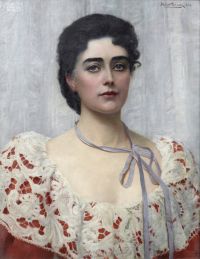 Mrs. Alec-Tweedie,
Thirteen Years of a Busy Woman's Life
Mrs. Alec-Tweedie,
Thirteen Years of a Busy Woman's Life
“ Forty years of constant communication with, and work amongst, British-speaking people has moulded him along British lines, and although the French manner and charm remain, British determination, doggedness, clear sight, and broad views are dominant. ”
John Richard Green, History of the English People, Volume I
“ In the quiet quaintly-named streets, in town-mead and market-place, in the lord's mill beside the stream, in the bell that swung out its summons to the crowded borough-mote, in merchant-gild, and church-gild and craft-gild, lay the life of Englishmen who were doing more than knight and baron to make England what she is, the life of their home and their trade, of their sturdy battle with oppression, their steady, ceaseless struggle for right and freedom. ”
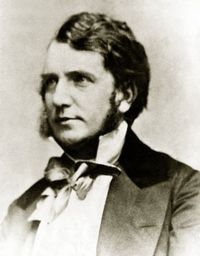 Joseph Sheridan Le Fanu,
Wylder's Hand
Joseph Sheridan Le Fanu,
Wylder's Hand
“ I often thought if one of those artists who photograph language and thought—the quiet, clever 'reporters,' to whom England is obliged for so much of her daily entertainment, of her social knowledge, and her political safety, were, pencil in hand, to ensconce himself behind the arras, and present us, at the close of the agreeable banquet, with a literal transcript of the feast of reason, which we give and take with so much complacency—whether it would quite satisfy us upon reconsideration. ”
 Fanny Kemble,
Journal of a Residence in America
Fanny Kemble,
Journal of a Residence in America
“ I not only hear the voice of England in the language of this people, but I recognise in all their best qualities, their industry, their honesty, their sturdy independence of spirit, the very witnesses of their origin—they are English; no other people in the world would have licked us as they did; nor any other people in the world built up, upon the ground they won, so sound, and strong, and fair an edifice. ”
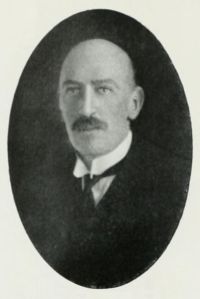 Maurice Baring,
A year in Russia
(1907)
Maurice Baring,
A year in Russia
(1907)
“ Hence England is the paradise of snobbery, social and intellectual. There is a mad race to be ‘in the swim’ socially and ‘in the know’ intellectually, and to read the right books and admire the right pictures. ”
Recent Developments in European Thought
“ Full of love and appreciation for the old order in England—the contentment and humours of the country-side, the difference of classes, the respect for religion—she was carried by the evolutionary philosophy of her time into thoughts of an eternal and world-wide order, the growth of humanity, the kinship of man with the universe, the social nature of duty. ”
Samuel Smiles, Self Help; with Illustrations of Conduct and Perseverance
“ One of the most strongly-marked features of the English people is their spirit of industry, standing out prominent and distinct in their past history, and as strikingly characteristic of them now as at any former period. It is this spirit, displayed by the commons of England, which has laid the foundations and built up the industrial greatness of the empire. ”
 Margaret Fuller,
Life Without and Life Within; or…
Margaret Fuller,
Life Without and Life Within; or…
“ England—ah! who can resist visions of phalansteries in every park, and the treasures of art turned into public galleries for the use of the artificers who will no longer be unwashed, but raised and educated by the refinements of sufficient leisure, and the instructions of genius. England must glide, or totter, or fall into revolution; there is not room for such selfish elves, and unique young dukes, in a country so crowded with men, and with those who ought to be women, and are turned into work-tools. ”
 John Cassell,
Cassell's Illustrated History of England
(1865)
John Cassell,
Cassell's Illustrated History of England
(1865)
“ And then England, to the imposing material and intellectual spectacle which she offers to the world, may add a third still more striking, and undoubtedly the fairest that can be seen under the heavens—namely, the moral spectacle of a nation that depends upon herself alone. ”
Horace Greeley, Glances at Europe
“ Then will the artisans, the cultivators, the laborers, not of London only, but to a considerable extent of Great Britain, flock hither by tens of thousands to gaze on this marvellous achievement of Human Genius, Skill, Taste, and Industry, and be strengthened in heart and hope by its contemplation. ”
Samuel Warren, Ten Thousand a-Year. Volume 2
“ With some sad exceptions, I think that Great Britain has reason to be proud of her aristocracy. I do not speak now of those gaudy flaunting personages, of either sex, who, by their excesses or eccentricities, are eternally obtruding themselves, their manners, dress, and equipage, upon the offended ear and eye of the public; but of those who occupy their exalted sphere in simplicity, in calmness, and in unobtrusive dignity and virtue. I am no flatterer or idolater of the nobility. ”
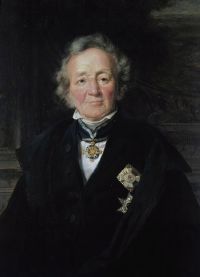 Leopold von Ranke,
A history of England principally in the seventeenth century…
Leopold von Ranke,
A history of England principally in the seventeenth century…
“ They are extremely instructive for the internal relations of English society. They show wide observation and calm wisdom, and, like his philosophical works, are a treasure for the English nation, whose views of life have been built upon them. ”
Various, New York Times Current History…
“ With wonder and veneration, have we watched the English people, that combines the greatest idealism with the most marvellous creative genius, that constantly transforms words into deeds, aspirations into actions, thoughts and feelings into institutions, go onward, from step to step, reaching out into the heavens, yet never relinquishing the earth, higher and higher along its triumphant road, still onward in its work of creating the life of England. ”
John Richard Green, History of the English People, Volume VII
“ The growing consciousness in the people at large of a new greatness, its instinctive prevision of the coming of a time when England was to play a foremost part in the history of the world, the upgrowth of a nobler and loftier temper which should correspond to such a destiny, all were alike unintelligible to him. ”
 Victor Hugo,
The Man Who Laughs: A Romance of English History
Victor Hugo,
The Man Who Laughs: A Romance of English History
“ You are the nation which eats other nations—a magnificent function! This suction of the world makes England preeminent. As politicians and philosophers, in the management of colonies, populations, and industry, and in the desire to do others any harm which may turn to your own good, you stand alone. The hour will come when two boards will be put up on earth—inscribed on one side, Men; on the other, Englishmen. I mention this to your glory, I, who am neither English nor human, having the honour to be a bear. Still more—I am a doctor. ”
Thomas K. Hervey, The Book of Christmas
“ The revels of merry England are fast subsiding into silence, and her many customs wearing gradually away. The affectations and frivolities of society, as well as its more grave and solemn pursuits,—the exigences of fashion, and the tongue of the pedagogue,—are alike arrayed against them; and, one by one, they are retreating from the great assemblies [25] where mankind "most do congregate," to hide themselves in remote solitudes and rural nooks. ”
John Anderson, The course of creation (1851)
“ Great Britain, freed from the connection, can well afford to repose in peaceful majesty on her own shores, improving the arts, extending her commerce, and communicating, as the most noble and renowned nation the blessings of religion to the remotest parts of the globe. ”
Maria Mitchell, Maria Mitchell: Life, Letters, and Journals
“ At the same time England has a class to which we have happily no parallel in our country—a class to which even English gentlemen liken the Sepoys, and who would, they admit, under like circumstances be guilty of like enormities. But the true Englishman shuts his eyes for a great part of the time to the steps in the social scale down which his race descends, and looks only at the upper walks. ”
 Isabella Lucy Bird,
The Englishwoman in America
(1856)
Isabella Lucy Bird,
The Englishwoman in America
(1856)
“ Since my return to England I have frequently been asked the question, "What is society like in America?” This word society is one of very ambiguous meaning. It is used in England by the titled aristocracy to distinguish themselves, their connexions, and those whose wealth or genius has gained the admission into their circles. ”
 Harriet Beecher Stowe,
Sunny Memories of Foreign Lands
(1854)
Harriet Beecher Stowe,
Sunny Memories of Foreign Lands
(1854)
“ In broad contrast to this, all the modern popular movements in England are based upon the recognition of the equal value of every human soul. The Times, the most aristocratic paper in England, publishes letters from needlewomen and dressmakers' apprentices, and reads grave lectures to duchesses and countesses on their duties to their poor sisters. One may fancy what a stir this would have made in the courtly circles of the reign of George II. Fashionable literature now arrays itself on the side of the working classes. ”
 H. G. Wells,
The New Machiavelli
H. G. Wells,
The New Machiavelli
“ And a hundred times when I have thought of England as our country might be, with no wretched poor, no wretched rich, a nation armed and ordered, trained and purposeful amidst its vales and rivers, that emotion of collective ends and collective purposes has returned to me. ”
 George Gissing,
The Private Papers of Henry Ryecroft
George Gissing,
The Private Papers of Henry Ryecroft
“ It is easy to understand that common judgment of foreigners regarding the English people. Go about in England as a stranger, travel by rail, live at hotels, see nothing but the broadly public aspect of things, and the impression left upon you will be one of hard egoism, of gruffness and sullenness; in a word, of everything that contrasts most strongly with the ideal of social and civic life. And yet, as a matter of fact, no nation possesses in so high a degree the social and civic virtues. ”
 Washington Irving,
Bracebridge Hall, or The Humorists
Washington Irving,
Bracebridge Hall, or The Humorists
“ To pens more powerful than mine, I leave the noble task of promoting the cause of national amity. To the intelligent and enlightened of my own country, I address my parting voice, entreating them to show themselves superior to the petty attacks of the ignorant and the worthless, and still to look with dispassionate and philosophic eye to the moral character of England, as the intellectual source of our rising greatness ”
“ It is not without interest to remember that most of the salient figures of English society during the present century—and English society means, or rather has hitherto meant, in a large degree, English history—have bobbed in the saddle between Apsley House and Queen’s Gate. You may call the roll if you care to, and the air will be thick with dumb voices and dead names, like that of some Roman amphitheatre. ”