
“ Even if we do not happen to be acquainted with the actual biography, we can build up in our minds on reading the essays of Elia a life story not far removed from actuality, though it would be wanting in any hint of tragedy. It is this intimacy which at once attracts and repels readers, attracts all those who are, in however small a degree, kindred spirits, and repels, perhaps, others. The quaintness, oddity, flippancy, are wrought together with deep thought, poetry, and feeling to a wonderful degree. ”
Essays of Elia
Definition and stakes
The theme of “Essays of Elia” has been addressed by authors such as Charles Lamb, Walter Jerrold, Various, William Hazlitt and Augustine Birrell. It is often associated with terms like Elijah, Elisha, Elias, Charles and lamb.
Quotes about “Essays of Elia”
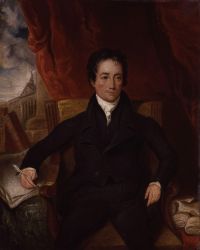 Charles Lamb,
The Works of Charles and Mary Lamb…
Charles Lamb,
The Works of Charles and Mary Lamb…
“ This is indeed to have him within ourselves; to know him intimately; such participation is methinks unitive, as the old theologians phrase it."—Last Essays of Elia.Elia presents his acknowledgments to his "Correspondent unknown," for a basket of prodigiously fine game. He takes for granted that so amiable a character must be a reader of the Athenæum. Else he had meditated a notice in The Times. Now if this friend had consulted the Delphic oracle for a present suited to the palate of Elia, he could not have hit upon a morsel so acceptable. The birds he is barely thankful for ”
Various, Blackwood's Edinburgh Magazine…
“ If the poems are read by few, the Essays of Elia have been perused by all. Who is not familiar with what is now a historic fact—the discovery of roast pig in China? This, and many other touches of humour, it would be useless here to repeat. His letters, as being latest published, seem alone to call for any especial observations, and from these we shall cull a few extracts to enliven our own critical labours.What first strikes a reader, on the perusal of the letters, is their remarkable similarity in style to the essays. ”
Charles Lamb,
The Works of Charles and Mary Lamb…
“ Although the "Bachelor's Complaint of the Behaviour of Married People," "Valentine's Day," and "On the Acting of Munden," were all written before this essay, it is none the less the first of the essays of Elia. I have remarked, in the notes to a small edition of Elia, that it is probably unique in literature for an author to find himself, as Lamb did, in his forty-fourth year, by recording impressions gathered in his seventeenth; but I think now that Lamb probably visited his brother at the South-Sea House from time to time in later years, and gathered other impressions then. ”
William Hazlitt, The Spirit of the Age; Or, Contemporary Portraits
“ He gains ground in the opinion of others, by making no advances in his own. We easily admire genius where the diffidence of the possessor makes our acknowledgment of merit seem like a sort of patronage, or act of condescension, as we willingly extend our good offices where they are not exacted as obligations, or repaid with sullen indifference.—The style of the Essays of Elia is liable to the charge of a certain mannerism. ”
Charles Lamb,
The Works of Charles and Mary Lamb…
“ Well, indeed, would it be for the world if such extraordinary virtues as he possessed were often found in company with so very few faults.In all modern editions of Lamb the "Confessions of a Drunkard" are included with the Last Essays of Elia. But Lamb did not himself originally place them there. Apparently his intention was not to reprint them after their appearance in the London Magazine in 1822. When, however, the Last Essays of Elia was published, in 1833, the paper called "A Death-Bed" was objected to by Mrs. Randal Norris, as bearing too publicly upon her poverty. ”
 Augustine Birrell,
In the Name of the Bodleian, and Other Essays
Augustine Birrell,
In the Name of the Bodleian, and Other Essays
“ Elia, the gentle Elia, as it is the idiotic fashion to call a writer who could handle his 'maulies' in a fray as well as Hazlitt himself, has told us how he could never see well-bound books he did not care about, but he longed to strip them so that he might warm his ragged veterans in their spoils. My copy of Hannah More was in full calf, but never once did it occur to me—though I, too, have many a poor author with hardly a shirt to his back shivering in the dark corners of the library—to strip her of her warm clothing. ”
“ It is only possible in one small section of a small volume such as this to indicate a portion of the wealth in the Elia series, so varied are the themes which inspired the essayist: the delicious drollery of the "Dissertation upon Roast Pig"; the immortal characterization of "Mrs. Battle's Opinions upon Whist"; the pleasant personal touches in a score of the essays; the cry of stifled affection in "Dream Children"; the whimsicality of "Popular Fallacies" ”
“ The essay includes three or four admirable examples of Elia's felicity in drawing typical characters with just that touch of oddity that makes them live as individuals. The theatre which we have seen always made its triple appeal to Lamb—from the study, from the front, and from the boards—inspired the next three essays, "Stage Illusions," "To the Shade of Elliston," and "Ellistoniana." ”
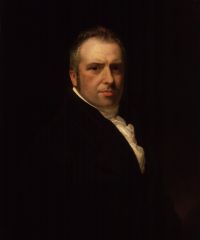 William Hone,
The Every-day Book and Table Book…
William Hone,
The Every-day Book and Table Book…
“ ELIA, AND JEM WHITE’S FEAST TO THE SWEEPS.Elia, the noble heart of Elia, responds to these humble claimants upon humanity; they cry and have none to help them; he is happy that a personal misfortune to himself can make one of them laugh; he imagines “all the blood of all the Howards” in another; he conceives no degradation by supping with them in public at “Bartlemy Fair.” Kind feelings and honesty make poets and philosophers. ”
Charles Lamb,
The Works of Charles and Mary Lamb…
“ Phantom cloud of Elia. The speculations in the paragraph that ends with these words were fantastical at any rate to one reader, who, under the signature "A Father," contributed to the March number of the London Magazine a eulogy of paternity, in which Elia was reasoned with and rebuked. "Ah! Elia! hadst thou possessed 'offspring of thine own to dally with,' thou wouldst never have made the melancholy avowal that thou hast 'almost ceased to hope!'" Lamb did not reply. ”
Various, The Knickerbocker, Vol. 10, No…
“ We have here, too, the first germs of those delicate children of his brain, which have rarely been equalled, and never surpassed. We see the sources whence sprang the dainty thought, the charming image; and we may mark the daily creation and circumfusion of those felicitous conceits with which the name of 'Elia' is inseparably associated. What a reader was he; and how the ferreted beauties of the old worthies 'slid into his soul!' Upon the fertile suggestions of a creative, observant spirit, were inoculated and grafted the rich treasures of the elder intellects. ”
Various, The Atlantic Monthly, Volume 03…
“ It was this strong sympathy with human character which made Elia rather a contemner of the worship of Nature. He liked things that were as definite as the works of men, and found great difficulty in sympathizing with a landscape. ”
George Paston, Little Memoirs of the Nineteenth Century
“ The conversation was very local, but perhaps in this way I saw more of the author, for his manner of speaking of their mutual friends, and the quaint humour with which he complained of one, and spoke well of another, was so completely in the vein of his inimitable writings, that I could have fancied myself listening to an audible composition of new Elia. Nothing could be more delightful than the kindness and affection between the brother and sister, though Lamb was continually taking advantage of her deafness to mystify her on every topic that was started. ”
 John Cowper Powys,
Visions and Revisions: A Book of Literary Devotions
John Cowper Powys,
Visions and Revisions: A Book of Literary Devotions
“ Certain sentences in "Dream-children," too, have a beauty that takes a natural man's breath completely away. Touches of far-off romance, terrible and wistful as "anonymous ballads," alternate with gestures of Rabelaisian humour, such as generous souls love. Elia's style is the only thing in English prose that can be called absolutely perfect. Compared with the rich, capricious, wilful, lingering by the way of Lamb's manner, Pater's is precise, demure and over-grave, Wilde's fantastic and over-provocative, Ruskin's intolerably rhetorical. ”
Francis Jacox, Scripture texts illustrated by general literature (1871)
“ Dickens says of the faint image of Eden which is stamped upon our hearts in childhood, that it “chafes and rubs in our rough struggles with the world, and soon wears away; too often to leave nothing but a mournful blank remaining.” Elia, the essay writer, is no way backward to own the demerits and even delinquencies of himself as Elia, the middle aged man ”
Charles Lamb,
The Works of Charles and Mary Lamb…
“ Among his papers were found the following "Reflections," which we have obtained by favour of our friend Elia, who knew him well, and had heard him describe the train of his feelings upon that trying occasion almost in the words of the MS. Elia speaks of him as a man (with the exception of the peccadillo aforesaid) of singular integrity in all his private dealings, possessing great suavity of manner, with a certain turn for humour. As our object is to present human nature under every possible circumstance, we do not think that we shall sully our pages by inserting it.—Editor. ”
 William J. Long,
Outlines of English and American Literature
William J. Long,
Outlines of English and American Literature
“ These oddities reappear in his own style to such an extent that even when he speaks a large truth, as he often does, he is apt to give the impression of being a little harebrained. Yet if you examine his queer idea or his merry jest, you may find that it contains more cardinal virtue than many a sober moral treatise. [Illustration: THE LAMB BUILDING, INNER TEMPLE, LONDON] On the whole Elia is the quintessence of modern essay-writing from Addison to Stevenson. There are probably no better works of the same kind in our literature. Some critics aver that there are none others so good. ”
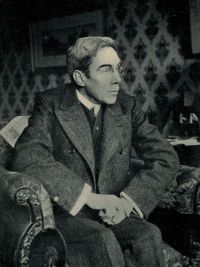 Henry Harland,
The Yoke of the Thorah
Henry Harland,
The Yoke of the Thorah
“ Elias, whose chief sentiment for her, a short while ago, had been one of half contemptuous amusement, felt an emotion very like genuine respect begin to stir within his bosom. It astonished him, it awed him a little, to find that a young lady who, in the commoner relations of life, appeared so crude and so prosaic, was possessed of such superb and consummate genius for a noble art. ”
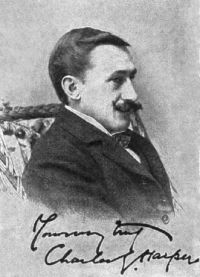 Charles G. Harper,
The Cambridge, Ely, and King's Lynn Road…
Charles G. Harper,
The Cambridge, Ely, and King's Lynn Road…
“ Dingy, twittering little London sparrow that he was, diligent digger-up of Elizabethan archaisms with which to tune his chirpings, he seems often to have inspired the warmest of personal admiration. As the "gentle Elia" one finds him always referred to, and a halo of romance has been thrown about him and his doings to which neither he nor they can in reality lay much claim. Romance flies abashed before the picture of Lamb and his sister diluting down the poet of all time in the Tales from Shakespeare: Charles sipping gin between whiles, and Mary vigorously snuffing. ”
William Hazlitt, Table-Talk (1822)
“ I will, however, admit that the said Elia is the worst company in the world in bad company, if it be granted me that in good company he is nearly the best that can be. He is one of those of whom it may be said, Tell me your company, and I’ll tell you your manners. He is the creature of sympathy, and makes good whatever opinion you seem to entertain of him. He cannot outgo the apprehensions of the circle; and invariably acts up or down to the point of refinement or vulgarity at which they pitch him. He appears to take a pleasure in exaggerating the prejudice of strangers against him ”
 Frank Lewis Nason,
The Vision of Elijah Berl
Frank Lewis Nason,
The Vision of Elijah Berl
“ Others selected with unclouded judgment the grains of Elijah's enthusiasm from the chaff of his fanaticism. Others had not a woman's heart; Helen had. She was not conscious of it, of how it was blinding her judgment, of where it was leading her. This consciousness was dimly suggesting itself to her, not from herself but from Elijah. Let him arouse that consciousness to active life, then she would know, then she would act! ”
Henry Harland,
The Yoke of the Thorah
“ Yes, indeed: the period, long or short, during which first love holds sway over our hearts, tyrant though the ruler be, is notoriously our golden age, never to come but once. In this respect history does not repeat itself. Elias felt that each of his five senses had been sharpened, and that, moreover, he had acquired a sixth sense, a super-sense. The homeliest things, the most familiar sights, the commonest occurrences, took on a beauty, a significance, a suggestiveness, undreamed of until now. ”
Various, The Strand Magazine (1891)
“ It is probable that many attentive and earnest admirers of Elia, if they were to be told that that admirable man and writer was entitled to a place among those who may be considered the modern disciples of Apicius, would ask a little time to consider and refer, before they agreed with such a proposition. In his earlier and poorer days, Lamb, so far as we can make out, had few opportunities of indulging in the pleasures of the table and the palate. ”
Earl of Beaconsfield Benjamin Disraeli, The Infernal Marriage
“ Whatever they did, the Elysians were careful never to be vehement; a grand passion, indeed, was unknown in these happy regions; love assumed the milder form of flirtation; and as for enmity, you were never abused except behind your back, or it exuded itself in an epigram, or, at the worst, a caricature scribbled upon a fan. There is one characteristic of the Elysians which, in justice to them, I ought not to have omitted. They were eminently a moral people. If a lady committed herself, she was lost for ever, and packed off immediately to the realm of Twilight. ”
W. Ewing, Arab and Druze at home (1907)
“ This latter was the city known to Elijah and Elisha, not yet ancient in their time, for the inhabitants of which the waters of this lovely spring were miraculously healed. One of the “schools of the prophets” existed here; and here Elijah had his last interview with the youth, the hope of Israel, ere he went forth to yonder lonely tracts eastward, to be parted from the faithful Elisha by the chariot of fire, and caught away to heaven in the whirlwind. The fertility of the plains of Jericho was almost proverbial in later days, when its rich revenues were farmed by Herod from Cleopatra. ”
 Charles Reade,
The Cloister and the Hearth: A Tale of the Middle Ages
Charles Reade,
The Cloister and the Hearth: A Tale of the Middle Ages
“ But when Elias whispered "Sit wider!" says she, "Ay! the table will soon be too big for the children: and you thought it would be too small:" and having delivered this with forced calmness, she put up her apron the next moment, and wept sore."'Tis the best that leave us," sobbed she, "that is the cruel part.""Nay! nay!" said Elias, "our children are good children, and all are dear to us alike. Heed her not! What God takes from us still seems better than what he spares to us: that is to say, men are by nature unthankful—and women silly." ”
Matthew Henry, Matthew Henry's Commentary on the Whole Bible… (1700s)
“ That is, First, He shall be such a man as Elias was, and do such work as Elias did,—shall, like him, preach the necessity of repentance and reformation to a very corrupt and degenerate age,—shall, like him, be bold and zealous in reproving sin and witnessing against it even in the greatest, and be hated and persecuted for it by a Herod and his Herodias, as Elijah was by an Ahab and his Jezebel. He shall be carried on in his work, as Elijah was, by a divine spirit and power, which shall crown his ministry with wonderful success. ”
 Alexander Maclaren,
Expositions of Holy Scripture
Alexander Maclaren,
Expositions of Holy Scripture
“ Elisha's answer begins with the solemn adjuration which we first hear from Elijah. In its use here, it not only declares the unalterable determination of Elisha, but reveals its grounds. To a man who feels ever the burning consciousness that he is in the presence of God, all earthly good dwindles into nothing. How should talents of silver and gold, and changes of raiment, have worth in eyes before which that awful, blessed vision flames? ”
 Dwight Lyman Moody,
Bible Characters
Dwight Lyman Moody,
Bible Characters
“ It is a noticeable circumstance, which repeats itself even in our own day, that Elisha was in many respects the exact counterpart of Elijah.By choosing all kinds of character and capacity to represent the divine kingdom, God shows His infinite wisdom in a way which even the dullest understanding can hardly fail to appreciate. He is not dependent upon one particular aspect of genius, or one particular aspect of eloquence ”
Alexander Maclaren,
Expositions of Holy Scripture
“ Possibly they had drawn near the eastern hills, and were out of sight of the fifty curious gazers on the other hank. Elijah at last spoke the truth which both knew. How true to nature is that reticence kept up till the last moment, and then broken so tenderly!—'Ask what I shall do for thee, before.' Probably he did not mean any supernatural gift, but simply some parting token of love; for he is startled at the response of Elisha. A true disciple can desire nothing more than a portion of his master's spirit. ”
