Eurybiades

Definition and stakes

Mary Macgregor,  The Story of Greece: Told to Boys and Girls

“ Then turning to Eurybiades he said, ‘By remaining here, thou wilt show thyself a brave man. By going away, thou wilt destroy all Hellas, for with the war on land the Athenians have nothing more to do. If thou wilt not stay, we will sail away with our two hundred ships and build a city in the west, where the Persians will not trouble us.’
Then Eurybiades grew afraid, for he knew that without the help of the Athenians the Greeks need not hope to conquer the enemy, so he agreed to stay to fight at Salamis.
”
Source: Gutenberg

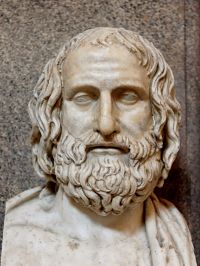
Portrait of Plutarch Plutarch,  Plutarch's Lives (1864)

“ Eurybiades, by reason of the greatness of Sparta, was admiral of the Greek fleet, but yet was faint-hearted in time of danger, and willing to weigh anchor and set sail for the isthmus of Corinth, near which the land army lay encamped; which Themistocles resisted; and this was the occasion of the well-known words, when Eurybiades, to check his impatience, told him that at the Olympic games they that start up before the rest are lashed; "And they," replied Themistocles, "that are left behind are not crowned." ”
Source: Wikisource

Portrait of Plutarch Plutarch,  Parallel Lives (c. 100 AD)

“ These expressions of Themistocles made Eurybiades suspect that if he retreated the Athenians would fall off from him. When one of Eretria began to oppose him, he said, "Have you anything to say of war, that are like an ink-fish? you have a sword, but no heart." Some say that while Themistocles was thus speaking things upon the deck, an owl was seen flying to the right hand of the fleet, which came and sat upon the top of the mast; and this happy omen so far disposed the Greeks to follow his advice, that they presently prepared to fight. ”
Source: Gutenberg

Get perspective with Kwize: daily news enlightened by great literature