“ CHAPTER XI WHEREIN BOYD EMERSON IS TWICE AMAZED Nearly a month had elapsed when Emerson at last expressed to George the discouragement that for several days had lain silently in both men's minds."It looks like failure, doesn't it?""Sure does! You've played your string out, eh?""Absolutely. I've done everything except burglary, but I can't raise that hundred thousand dollars. From the way we started off it looked easy, but times are hard and I've bled my friends of every dollar they can spare. In fact, some of them have put in more than they can afford." ”
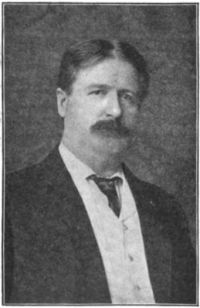
George Emerson
Definition and stakes
Quotes about “George Emerson”
Oliver Wendell Holmes, Our Hundred Days in Europe
“ So much of George Herbert's intellectual and moral character repeat themselves in Emerson that if I believed in metempsychosis I should think that the English saint had reappeared in the American philosopher. Their features have a certain resemblance, but the type, though an exceptional and fine one, is not so very rare. I found a portrait in the National Gallery which was a good specimen of it; the bust of a near friend of his, more intimate with him than almost any other person, is often taken for that of Emerson. ”
George William Curtis,
From the Easy Chair, Volume 2
“ To talk of Emerson, even if the talker were not of the circle of his intimate friends, is to raise the flood-gate of happy and inspiring recollections. It is one of the tenderest of the thoughts that hover around his memory, as the low winds sigh through the pine-trees over his grave, that, as with Longfellow, there are no excuses to be made for grotesque eccentricities of genius, nor for a life at any point unworthy of so great a soul. ”
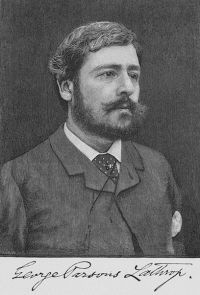
George Parsons Lathrop,
Appletons' Cyclopædia of American Biography
(1900)
“ The doctrine of the “many in one,” which he incessantly taught, is exemplified in himself and his works. The best extant accounts of Emerson are “Ralph Waldo Emerson, his Life, Writings, and Philosophy,” by George Willis Cooke (Boston, 1881) ; “Ralph Waldo Emerson,” by Oliver Wendell Holmes (Boston, 1884) ; “Emerson at Home and Abroad,” by Moncure D. Conway; “Biographical Sketch,” by Alexander Ireland; “The Genius and Character of Emerson, Lectures at the Concord School of Philosophy,” edited by F. B. Sanborn (Boston, 1885) . See, also, F. B. Sanborn's “Homes and Haunts of Emerson.” ”
George William Curtis,
From the Easy Chair, Volume 2
“ Those who recall Emerson when he was a clergyman in Boston remember a singular spiritual beauty in the man, and an indescribable charm of manner in his public speech. But apparently he impressed his earlier associates with the purity and refinement of his mind and life, his lofty intellectual tastes and sympathy, and his literary accomplishment, rather than by the peculiar force of a genius which was to give the most powerful spiritual impulse of the generation to American thought. ”
“ I'll pack a 'thirty-thirty' from now on, and I bet they don't get within hailing distance without an iron-clad."The more calmly Emerson regarded the incident, the more he marvelled at the good-fortune that had saved him. "We had better wake up," he said. "We have been asleep so far. If Marsh planned this, he will plan something more.""Yes, and if he puts one wallop over we're done for," George agreed, pessimistically. "I'll keep a watchman aboard the scows hereafter. That's our vital spot." ”
George William Curtis,
From the Easy Chair, Volume 2
“ So is Emerson associated with the tranquil landscape of the old Middlesex town—the gentle hills, the long sweep of meadowland, the winding river, the woodland, and the pastures under the ample sky. The broad horizon and rural repose were the fitting home of the lofty and beneficent genius whose life and word perpetually illustrated the supreme worth and beauty of truth, purity, and morality. ”
George William Curtis,
Early Letters of George Wm. Curtis to John S. Dwight…
“ Emerson had no friend who was a more welcome or frequent guest than George Bradford, who came to look after the vegetable garden and to trim the trees, and in long walks to Walden Pond or Fairhaven Hill to discuss with his host philosophy and poetry and life. The small gains of a teacher were enough for the simple wants of the scholarly gentleman, and after middle life he went often to Europe, and few Americans have ever gone more admirably equipped. ”
Willis George Emerson,
The Treasure of Hidden Valley
“ The winning of the one treasure meant the winning of the other—the making of both his own. As he dreamed of wealth unbounded, there was always singing in his heart the name of Stella Rain. Next day he was aboard a westbound train, booked for Rawlins, Wyoming, where, as his father’s letter had directed, he was likely to find the old frontiersman, Jim Rankin; perhaps also the other “cronies” referred to by name, Tom Sun and Boney Earnest At Omaha a young westerner boarded the train, and took a seat in the Pullman car opposite to Roderick. ”
“ At this time the progressive and spiritually minded young people used to meet for discussion and help in Boston, among them George Ripley, Cyrus Bartol, James Freeman Clarke, Alcott, Dr. Hedge, Margaret Fuller, and Elizabeth Peabody. Perhaps from this gathering of friends, which Emerson attended, came what is called the Transcendental Movement, two results of which were the Brook Farm Community and the Dial magazine, in which last Emerson took great interest, and was for the time an editor. Many of these friends were frequent visitors in Concord. ”
George William Curtis,
From the Easy Chair, Volume 2
“ But nothing could veil the pure and steadfast and unwearying devotion to the well-being of other men. Kindly but firmly he protected his own seclusion, and he permitted no man, in Emerson's phrase, to devastate his day. The freshness of feeling which keeps the heart young was unwasted to the end. ”
“ Why, there ain't nobody at Uyak. It's more of that damned Company business. They own this whole country, and run it to suit themselves.""She ain't my boat," said Petellin. "You'd ought to have got here a few days sooner.""My God! I'm sorry we waited at the Pass," said Emerson. "The weather couldn't have been any worse that first day than it was when we came across."Detecting in this remark a criticism of his caution, Big George turned about and faced the speaker; but as he met Emerson's eye he checked the explosion, and, seizing his cap, bolted out into the cold to walk off his mad rage. ”
George Parsons Lathrop,
Appletons' Cyclopædia of American Biography
(1900)
“ The seeming want of technical skill in his verse is frequently due to a more subtile art of natural melody which defied conventional rules of versification. The irregular lines, the flaws of metre and rhyme, remind us of the intermittent breathings of an Æolian harp. Emerson's poetic instrument may have been a rustic contrivance, but it answered to every impulse of the winds and the sighs of human feeling, from “Monadnoc” to the “Threnody” upon the death of his child-son. ”
George William Curtis,
From the Easy Chair, Volume 2
“ Emerson looked at him with regret and almost pain, and said to him, gravely: "My boy, I am very sorry; you have lost what you can never recover, and what you will regret to the last day of your life."But those who heard his own Divinity School address, or the Cambridge or Dartmouth oration, or the Emancipation address, would not exchange that recollection even to have heard the Olympian orator in Faneuil Hall. "Tell me," said a Senator famous for his oratory, to a friend in Washington, "what do you call eloquence? ”
Willis George Emerson,
Buell Hampton
“ Hugh started from his concealment, but Captain Osborn laid a restraining hand on his arm. “You think, Dan, that we can handle them all right, do you?” asked the same rich voice that had spoken before. “Bet yer life we kin,” ejaculated Dan Spencer, “an’ speakin’ plenty perlite to you’ns, I’m cal-kalatin’ in four days’ time we’ll have ‘em in the St. Louis market, same as t’other time, an’ we’ll do it sure, or I’ll git plenty hostile.” “Well, Kinneman,” said the master voice, “as soon as the last steer is across the ford, order your assistants to return at once, and you go with them. ”
Willis George Emerson,
Buell Hampton
“ Fact is, if every man was to get rich who believes he knows how, we’d have no paupers.” “Say, Jedge, we’re goin’ to hev hot winds, ain’t we?” asked Dan Spencer, grinning. “Thet’s what you’ve bin preachin’ fur the last three years, ain’t it, boys?” “Gee whillikens!” exclaimed the judge, “did you feel that? That’s a hot wind, sure as you’re born.” “Oh, no, Judge,” said Captain Osborn, “that could hardly be called a hot wind. Still, it is rather warm.” ”
George Parsons Lathrop,
Appletons' Cyclopædia of American Biography
(1900)
“ Any end pursued for itself, by the practical faculty, must become an offence. The end should be “inapprehensible to the senses”; then it would always be a good, always giving health. Briefly, it was Emerson's mission not to do practical work for reforms, but to supply impulses and a high inspiration to the workers. In 1841 he lectured on “The Conservative,” and the next year on " The Transcendentalist," saying that “transcendentalism ” was simply modern idealism, and that the “new views” were the oldest of thoughts cast in a new mould. ”
George Parsons Lathrop,
Appletons' Cyclopædia of American Biography
(1900)
“ It is certainly the best analysis of the English people that has been written by an American, and probably the best produced in any country. The style is succinct and exact, sown with epigram, as in most of Emerson's writings; but, the purpose being more objective than that of his essays, the saving common sense that underlies all of his thinking is here brought constantly and predominantly into view. Previously to this publication he had given seven lectures in Freeman place chapel, Boston, and another in New York, and had also made addresses before the Anti-slavery society in both cities. ”
George William Curtis,
From the Easy Chair, Volume 2
“ I am tasting the self-same life—its sweetness, its greatness, its pain—which I so admire in other men." The temptation to complete the splendid passage is almost irresistible. But in every page you are drawn on as in a stately symphony of winning music.This passage is from the Dartmouth College address, and it has all the flowing cadence of a discourse written to be spoken. Yet Emerson had little of the orator's temperament save the desire of an audience, and an earnestness which was pure and not passionate. But no orator in the country has exercised a deeper or more permanent influence. ”
George Parsons Lathrop,
Appletons' Cyclopædia of American Biography
(1900)
“ Much question has been made whether Emerson was rather a poet than a philosopher, or whether he was a philosopher at all. An exact philosopher he was not; but all that he wrote and said was based upon philosophic ideas. He was an intellectual rather than an emotional mystic, an idealist who insisted upon the application of idealism to the affairs of daily life. He believed that “Nature is the incarnation of a thought. ”
Willis George Emerson,
The Treasure of Hidden Valley
“ A great big cinnamon bear—a regular whale.” “No, no,” said the Major decisively, again glancing at the sky. “We must press on.” “I’d like a hug all right,” laughed Roderick, “but not from a cinnamon bear in a snowdrift.” “Gee, but I’m sorry I left my dogs at Dillon,” remarked Grant regretfully. “The last thing I said to Scotty Meisch was to look after the dogs even if the printing press burned. There’s no friend like a good dog, Major.” “Rather a doubtful compliment,” replied Buell Hampton with a smile. “Present company always excepted,” laughed the editor adroitly. “Well, well ”
George Parsons Lathrop,
Appletons' Cyclopædia of American Biography
(1900)
“ It will fast enough gather beauty, music, picture, poetry.” While he thus advanced in viewing science, he advanced also in viewing all other subjects; but it was from the point of view of intuition and oneness with what he called the Over-Soul. Everything that he said must be looked at in the light of his own remark, “Life is a train of moods.” But his moods rest upon the certainty, to him, of his own intuition. Emerson's presentation of his views is generally in a large degree poetic. His poems sum up and also expand his prose. ”
George Parsons Lathrop,
Appletons' Cyclopædia of American Biography
(1900)
“ The address, pronounced with strong conviction, led to lively controversy, in which Emerson took no part. Ten lectures were given by him, in the winter of 1838-'9, on “The Doctrine of the Soul,” “Home,” “The School,” “Love,” etc., followed later by “Man the Reformer,” “The Method of Nature,” and a “Lecture on the Times.” In these he treated some of the reforms then agitated — temperance, anti-slavery, non-resistance, no government, and equal labor. Having come to hold the position of a religious reformer, he was looked to for sympathy with other reforms ”
George Parsons Lathrop,
Appletons' Cyclopædia of American Biography
(1900)
“ A nation of freemen will for the first time exist, because each believes himself inspired by the Divine Soul which inspires all men.” His friend, Bronson Alcott, having set up a school in Boston for teaching young children by methods based on a new theory of education, published in 1837 a book reporting his own conversations with the children on the gospels, which excited severe criticism, and Emerson defended him in the Boston “Courier.” ”
George Parsons Lathrop,
Appletons' Cyclopædia of American Biography
(1900)
“ He regards the poems as the most complete and worthy expression of Emerson's genius. But Dr. Everett's discovery of passion in Emerson's poetry is not generally accepted by other critics. As has been well remarked by another writer, the verse, in general abstractly and intellectually beautiful, kindles to passion only when the chosen theme is distinctly American or patriotic. Emerson constantly preached by life and pen a new revelation, a new teacher of religion and morals, putting himself always in the place of a harbinger, a John crying in the wilderness. ”
George William Curtis,
From the Easy Chair, Volume 2
“ Emerson himself was very susceptible to the power of fine oratory. No man ever praised more warmly the charm of Everett in his earlier day. When Webster delivered his eulogy upon Adams and Jefferson in Faneuil Hall, Emerson was teaching in Cambridge, and Richard H. Dana, Jun., was one of his pupils. The day before Webster spoke, the teacher announced that there would be no school upon the morrow, and he earnestly exhorted his pupils not to lose the memorable opportunity of hearing the great orator. ”
Willis George Emerson,
Buell Hampton
“ I’ve dun got the drap on you, an’ am feelin’ plenty hostile.” As he said this, he carelessly fingered his revolver. “Course, Bill,” said Dan. “You see I collected sixteen hundred dollars. That leaves me an’ you three hundred dollars apiece more.” “Waal, that’s more like it, an’ certainly prevents a misonderstandin’,” said Bill. “Course I nach’ally knew you wuz givin’ them jays a razzle-dazzle, but you cain’t razzle-dazzle me. ”
George Parsons Lathrop,
Appletons' Cyclopædia of American Biography
(1900)
“ This course was followed by ten lectures on English literature in 1835, twelve on the philosophy of history in 1836, and in 1837 ten on human culture. Much of the matter embraced in them was afterward remoulded and brought out in his later volumes of essays, or condensed into the rhythmic form of poems. Mr. Emerson married, in September, 1835, Miss Lidian Jackson, of Plymouth, Mass. He then left the “Old Manse,” where he had been staying with Dr. Ripley, and moved into a house on the old Lexington road, along which the British had retreated from Concord in 1775. ”
George Parsons Lathrop,
Appletons' Cyclopædia of American Biography
(1900)
“ Two years later he collected in a volume of “Poems” his scattered metrical pieces, many of which had been printed in periodicals. He did not escape sharp criticism, but the circle of his admirers rapidly widened. A new periodical, “The Massachusetts Quarterly Review,” began its career at Boston in 1847, edited by Theodore Parker, a disciple of Emerson, who expounded the “new views” in a more combative way; and Emerson wrote for it an “Editor's Address,” inculcating a wise and sincere spirit in meeting the problems of the state, of slavery, and socialism. ”
George William Curtis,
Early Letters of George Wm. Curtis to John S. Dwight…
“ Is that from pride or because you cannot endure to see men go wrong, if you can help them? When Charles Dana came running to me with what he thought Emerson's poem, how could I help saying, "It is mine." In that case, at least, it was sympathy for Emerson's reputation that prompted the speech. ”