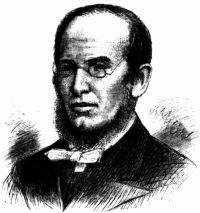
John Sutter

Definition and stakes

Frederick Franklin Schrader,  "1683-1920"

“ Where another German, John Jacob Astor, had failed—that of founding an American colony on the Pacific—he succeeded, even before California, taken from Mexico as a result of the war of 1846, became a State of the Union in 1850. His career is an inspiration to his fellow racials wherever German veins tingle to the thrill of American achievement.
Born 1803 at Kandern, in the Grand Duchy of Baden, Sutter received an excellent education, graduated from the cadet school at Thun and, after serving as an officer in the Swiss army and acquiring Swiss citizenship, he came to the United States in 1834.
”
Source: Gutenberg

Appletons' Cyclopædia of American Biography (1889)

“ SUTTER, John Augustus, pioneer, b. in Kandern, Baden, 15 Feb., 1803; d. in Washington, D. C., 17 June, 1880. He was of Swiss parentage, and his family name was originally Suter. He was graduated at the military college at Berne in 1823, entered the French service as an officer of the Swiss guard, and served in 1823-'4 through the Spanish campaign. In 1834 he emigrated to this country and settled in St. Louis. Afterward he carried on at Santa Fé a profitable trade with Indians and trappers, whose accounts of California induced him in 1838 to cross the Rocky mountains. ”
Source: Wikisource

Samuel Nelson,  The Sutter Case — Opinion of the Court

“ John J. Vioget, whose name is mentioned in the decree of the District Court, was an engineer and surveyor, and made a survey of the eleven square leagues in 1840 or 1841, and also the map referred to in the grant to Sutter; and in his depositions filed in the case he testified that in his survey two leagues were located, at the request of Sutter, south of the American River, and that the remaining nine leagues were located on the banks of the Feather River, on each side, commencing at the Canadian Ford and extending up the river. ”
Source: Wikisource

Get perspective with Kwize: daily news enlightened by great literature