“ But he does not lament like Mimnermus, like Alcman, like Llwyarch Hen. “What is Life, what is delight without golden Aphrodite? May I die!” says Mimnermus, “when I am no more conversant with these, with secret love, and gracious gifts, and the bed of desire.” And Alcman, when his limbs waver beneath him, is only saddened by the faces and voices of girls, and would change his lot for the sea-birds. ”
Mimnermus
Definition and stakes
The theme of “Mimnermus” has been addressed by authors such as E. F. M. Benecke, Edmund Gosse, Hutcheson Macaulay Posnett, Horace and Elizabeth Barrett Browning. It is often associated with terms like mimicry, minnow, natural, selection and Papilio.
Quotes about “Mimnermus”
E. F. M. Benecke, Antimachus of Colophon and the Position of Women in Greek Poetry (1896)
“ But besides this (as it ought to be superfluous to remark, and probably is not) , Hermesianax never states that Mimnermus did so; he does not even go so far as to say that the latter alluded to Nanno in his elegies. Hermesianax makes three definite statements about Mimnermus:— (1) that he invented or utilised the pentameter; (2) that he was in love with Nanno, and used often (in consequence?) to attend entertainments; (3) that he suffered from the enmity of Hermobius and Pherecles. ”
Hutcheson Macaulay Posnett, Comparative Literature (1886)
“ Again, while philosophers like Empedocles turned from the perpetual jar of human conflicts to physical Nature, poets like the Ionic Mimnermus were beginning to sing in a strain which anticipates the tones of Menander—his confession of human sorrow, his pessimism, as we call it in these Schopenhauer days, and his contrast of man's ephemeral life with the ever-renewing powers of Nature. ”
E. F. M. Benecke, Antimachus of Colophon and the Position of Women in Greek Poetry (1896)
“ The first essential of art is accurate observation, and the essence of accurate observation is attention to a definite object. By appreciating this fact, and concentrating upon a definite object the general emotions described by Mimnermus and the like, Anacreon created love-poetry as between man and woman, and thereby created that form of art in which the romantic feeling, when it arose, found the readiest means of expression. ”
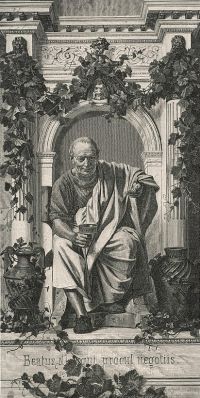 Horace,
The Satires, Epistles, and Art of Poetry of Horace
Horace,
The Satires, Epistles, and Art of Poetry of Horace
“ Or, if 'tis not enough, I bid him rise Mimnermus, and he swells to twice his size. Writing myself, I'm tortured to appease Those wasp-like creatures, our poetic bees: But when my pen's laid down, my sense restored, I rest from boring, rest from being bored.Bad poets are our jest: yet they delight, Just like their betters, in whate'er they write, Hug their fool's paradise, and if you're slack To give them praise, themselves supply the lack. ”
1911 Encyclopædia Britannica, Volume 18… (1911)
“ MIMNERMUS of Colophon, Greek elegiac poet, flourished about 630–600 B.C. His life fell in the troubled time when the Ionic cities of Asia Minor were struggling to maintain themselves against the rising power of the Lydian kings. One of the extant fragments of his poems refers to this struggle, and contrasts the present effeminacy of his countrymen with the bravery of those who had once defeated the Lydian king Gyges. ”
E. F. M. Benecke, Antimachus of Colophon and the Position of Women in Greek Poetry (1896)
“ Leont. iii. 37, of which passage Poseidippus was doubtless thinking in his epigram Anth. Pal. xii. 168. [41] Leont. iii. 27 seqq. 47 seqq. &c. [42] Suidas, it may be remarked, flatly contradicts one half of this view when he says of Mimnermus ἔγραψε βιβλία πολλά. [43] It is hardly justifiable to infer from the passage of Alexander Aetolus ap. Athen. xv. 699 C, that Mimnermus addressed love-poems to boys. [44] It is as a philosopher that Horace (Ep. i. 6, 65) cites his opinion:si, Mimnermus uti censet, sine amore iocisquenil est iucundum; “censet,” the regular word for a philosopher. ”
E. F. M. Benecke, Antimachus of Colophon and the Position of Women in Greek Poetry (1896)
“ Mimnermus had said that life without love was not worth living, but his was hardly the love to last after his lady’s death. Simonides had sung the charms of the ideal housekeeper, but one would not expect to find emotional poetry addressed even to the most perfect housekeeper, as such. Euripides had expatiated on the powers and the capabilities of women; but there is a difference between regarding a woman as a particularly cunning and dangerous sort of beast, and regarding her as a fit object for a life’s devotion. ”
E. F. M. Benecke, Antimachus of Colophon and the Position of Women in Greek Poetry (1896)
“ Mimnermus argued that, considering the shortness of life, and especially of youth, it was advisable to devote one’s self immediately and strenuously to sensual pleasures, before the power of enjoying them was lost. ”
 Edmund Gosse,
Gossip in a Library
Edmund Gosse,
Gossip in a Library
“ In this odd title he seems to refer to elegies of the Colophonian poet, who was famous in antiquity for the plaintive stress which he laid on the necessity of extracting from life all it had to offer, since there was nothing beyond mortal love, which was the life of life. The author of Ionica seems to bring the old Greek fatalist to modern England, and to conduct him to church upon a Sunday morning. But Mimnermus is impenitent. He confesses that the preacher is right when he says that all earthly pleasures are fugitive. He has always confessed as much at home under the olive tree ”
Edmund Gosse,
1911 Encyclopædia Britannica
(1911)
“ These gnomes or maxims were extended and put into literary shape by the poets. Fragments of Solon, Euenus and Mimnermus have been preserved, in a very confused state, from having been written, for purposes of comparison, on the margins of the MSS. of Theognis, whence they have often slipped into the text of that poet. Theognis enshrines his moral precepts in his elegies, and this was probably the custom of the rest; it is improbable that there ever existed a species of poetry made up entirely of successive gnomes. ”
E. F. M. Benecke, Antimachus of Colophon and the Position of Women in Greek Poetry (1896)
“ Mimnermus, Anacreon, and Antimachus were all, of course, natives of Greek Asia, where the cult of women seems always, from the earliest times onwards, to have been more developed than in Greece itself. There is a certain grim irony in the tradition that would make Anaxandrides, too, a native of Colophon. [312] Vide Fr. 3. [313] Plaut. Epid. i. 2, 7. [314] Cp. v. 1, 45, where the lover’s regrets are promptly answered by the assertion that there is another woman ready who will do just as well or better:stultus, tace! ”
 Elizabeth Barrett Browning,
The Complete Works of Mrs. E. B. Browning
(1901)
Elizabeth Barrett Browning,
The Complete Works of Mrs. E. B. Browning
(1901)
“ Translated from the Greek of Æschylus, and Misce11aneous Poems, by the Translator, Author of "An Essay on Mind," with other Poems. [Quotations from Mimnermus and Theognis.] London: Printed and published by A. J. Valpy, M.A., Red Lion Court, Fleet Street. ”
 Shirley Hibberd,
The Book of the Aquarium
(1856)
Shirley Hibberd,
The Book of the Aquarium
(1856)
“ Like carp and tench (and asses) , minnows may be said never to die, for they survive the severest trials of heat and cold, neglect and bad treatment. The colours are pleasing, and bear some close resemblance to the mackerel; but fright will make them assume a pale fawn colour in an instant. Disease seldom attacks them, and when it does, they speedily recover if thrown into a large pan under a jet of water. Minnows spawn in June, and just before that time acquire their gayest mottlings of green, and bronze, and silver, losing colour considerably after spawning. ”
Reginald Crundall Punnett, Mimicry in Butterflies
“ The evidence from mimicry rings makes it almost certain that in some cases the resemblance must be founded on an initial variation of such magnitude that the mimic could straightway be confused with the model. Till the mimic can be mistaken for the model natural selection plays no part. The evidence from breeding suggests strongly that in certain cases (e.g. Papilio polytes) the likeness arose in the form in which we know it to-day. In such cases there is no reason for supposing that natural selection has had anything to do with the formation of the finished mimic. ”
Reginald Crundall Punnett, Mimicry in Butterflies — Chapter IX (1915)
“ Most butterflies rest with their wings closed. In many of the well-known cases of mimicry the pattern on the under surface of the mimic's wings which would meet the monkey's eye is quite different from that of its model. It is difficult in such cases to imagine the monkey operating as a factor in establishing a resemblance between the upper surfaces of the wings of the two unrelated species. ”
Reginald Crundall Punnett, Mimicry in Butterflies — Chapter VII (1915)
“ Are the resemblances of the mimics to the models when alive so close that they might be expected to deceive such enemies [5] as prey upon them and have no difficulty in distinguishing the male form of polytes from P. aristolochiae or P. hector?To answer for a bird is a hazardous undertaking. We know so little of the bird's perceptive faculties whether of taste or sight. ”
 Henry Drummond,
Tropical Africa
Henry Drummond,
Tropical Africa
“ Although the extraordinary phenomena of mimicry are now pretty generally known to science, few workers have yet had the opportunity of studying them in nature. But no study in natural history depends more upon observation in the field; for while in the case of a few mimetic forms—the Heliconidæ, for example—the imitated form is also an insect, and the two specimens may be laid side by side in the cabinet at home, the great majority of mimetic insects are imitations of objects in the environment which cannot be brought into comparison with them in the drawers of a museum. ”
Reginald Crundall Punnett, Mimicry in Butterflies
“ Of all the instances of bird attacks collected together by Marshall [90] more than one-third are instances of attacks upon this group alone. If birds are the agents by which mimetic likenesses are built up through the cumulative selection of small variations, how can the rarity or absence of mimetic Pierids in the Old World be accounted for? For the species of Pierids, like the species of other families, shew considerable variation, and if this process of selection were really at work one would expect to find many more Pierid mimics in these regions than actually occur. ”
Reginald Crundall Punnett, Mimicry in Butterflies — Chapter X (1915)
“ If so natural selection may have favoured the new variety, not because of its colour scheme, but owing to the underlying physiological differences of which the pattern is but an outward sign. And if this could happen in one species there seems to be no reason why it should not happen in others. The weak point of the explanation on the mimicry hypothesis is that it offers no explanation of the change in the so-called dominant Ithomiine pattern as we pass from one region to another. ”
 Charles Alexander MacMunn,
1911 Encyclopædia Britannica, Volume 6…
(1911)
Charles Alexander MacMunn,
1911 Encyclopædia Britannica, Volume 6…
(1911)
“ The facts that mimetic species occur in the same locality, fly at the same time of the year as their models, and are day-flying species even though they may belong to nocturnal groups, are also more or less difficult to explain except on the theory of natural selection, and so also is the fact that mimetic resemblance is produced in the most varied manner. A spider resembles its model, an ant, by a modification of its body-form into a superficial resemblance, and by holding one pair of legs to represent antennae ”
Reginald Crundall Punnett, Mimicry in Butterflies — Chapter VII (1915)
“ Unless the bird were keener sighted than the man the A form would be more likely to be taken in mistake for its unprotected relative than avoided for its resemblance to the presumably unpalatable model. On the other hand, if the bird were sufficiently keen sighted never to confuse the A female with the male form its sight would be too keen to be imposed upon by such resemblance as exists between the A female and P. aristolochiae.These, however, are not the only criticisms of the theory of mimicry which the study of this species forces upon us. ”
Reginald Crundall Punnett, Mimicry in Butterflies — Chapter VII (1915)
“ Mimetics only. The males are in all cases alike to look at but it must nevertheless be supposed that they differ in their transmitting powers. In fact the evidence all points to there being three different kinds of male corresponding to the three different kinds of female. But they cannot shew any difference outwardly because there is always present in the male a factor which inhibits the production of the mimetic pattern even though the factor for that pattern be present. ”
Reginald Crundall Punnett, Mimicry in Butterflies — Chapter IX (1915)
“ Some species again, notably the Bulbuls (Molpastes) and Mynahs, shewed little or no discrimination, but devoured the "protected" as readily as the "unprotected" forms. Finn also states that "Papilio polytes was not very generally popular with birds, but much preferred to its model, P. aristolochiae."In many of Finn's experiments both model and mimic were given to the birds simultaneously so that they had a choice, and he says that "in several cases I saw the birds apparently deceived by mimicking butterflies. ”
William Curtis, The Botanical Magazine, Vol. 08
“ The plant succeeds best in a moist and somewhat shady situation, with a loamy soil.A perusal of the synonyms will shew to what a variety of genera this plant has been referred by different authors; Linnæus first gave to it the name of Mimulus, of which term we find in his Philosophia Botanica the following concise explanation:—"Mimulus mimus personatus;" in plain English, a masked mimick: Mimmulus is a classical word for the Pedicularis, or Lousewort; the English term Monkey flower has probably been given it, from an idea that mimulus originated from μιμω a monkey, as in mimusops monkey face. ”
Reginald Crundall Punnett, Mimicry in Butterflies
“ It may, however, be argued that it is not when at rest but during flight that the mimetic resemblance protects the mimic from attack. Actually this can hardly be true, for the mode of flight constitutes one of the most striking differences between model and mimic. P. hector and P. aristolochiae fly much in the same way. They give one the impression of flying mainly with their fore wings, which vibrate rapidly, so that the course of the insect, though not swift, is on the whole sustained and even. ”
Reginald Crundall Punnett, Mimicry in Butterflies
“ On the mainland where the models are abundant there is a vigorous action on the part of natural selection. The mimetic forms have a strong advantage and the non-mimetics have been gradually weeded out. But on the island, where the Pseudacraeas outnumber the models, the advantage obtained through mimicry is not so great. The so-called transitional forms are little, if at all, worse off than those closely resembling the scarce models, and consequently have as good a chance of surviving as any of the typical mimetic forms. ”
Sir Charles G. D. Roberts, The Watchers of the Trails: A Book of Animal Life
“ The big eyes of the monster never moved. But, suddenly, out shot the mask once more, revealing the face of doom behind it; and those hooked mandibles fixed themselves in [69] the belly of the minnow. Inexorable as was the grip, it nevertheless for the moment left unimpeded the swimming powers of the victim; and he was a strong swimmer. With lashing tail and beating fins, he dragged his captor out from among the weed stems. For a few seconds there was a vehement struggle. Then the minnow was borne down upon the mud, out in the broad sheen where, a little before, the tadpole had been basking. ”
Reginald Crundall Punnett, Mimicry in Butterflies — Chapter IV (1915)
“ It is somewhat remarkable that no Satyrine exhibits mimicry in S. America, in spite of the fact that transparency of the wings, as in so many of the butterflies of this region, is quite common in the group. On the other hand the relatively large number of more or less mimetic Pierines is a striking feature of S. America. For the most part they belong to the genera Dismorphia and Perrhybris, and resemble the yellow, black, and brown Heliconines and Ithomiines, though some of the former genus are mimics of the small transparent Ithomiines. ”
Reginald Crundall Punnett, Mimicry in Butterflies
“ For natural selection cannot be supposed to have operated in causing the male to pass from a protected to an unprotected condition, or even in causing him {68}to change one unprotected condition for another. Probably all adherents of the mimicry theory would be agreed in regarding the male of Elymnias undularis as shewing the ancestral coloration of the species, and in looking upon the female as having been modified to her own advantage in the direction of D. plexippus. ”
Charles C. Abbott, Outings at Odd Times
“ When in the mud these curious minnows can only feel their way, and if they procure any food at all at such a time it can only be such objects as come directly in contact with their mouths. But how different is it when these same fishes are in open water! They are expert fly-catchers then, and capture many an insect that would be lost to a trout or chub. They have not to wait for flies to fall upon the surface, but seize those that happen to alight upon overhanging blades of grass or any projecting twig. ”
