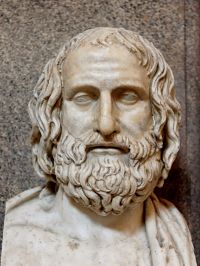
“ He inquired about them, and was told that the River Peneus flowed between them to the sea, and that through the same defile there lay the main entrance to Thessaly. He had previously determined to march his army round the other way, as the King of Macedon had suggested, but he said that he should like to see this defile. So he ordered a swift Sidonian galley to be prepared, and, taking with him suitable guides, and a fleet of other vessels in attendance on his galley, he sailed to the mouth of the Peneus, and, entering that river, he ascended it until he came to the defile. ”
Peneus
Definition and stakes
The Peneus, a river of Thessaly, occupies a prominent place in classical literature as both a geographical feature and a symbol of mythological depth. From Euripides to Ovid, writers have interwoven its waters into stories of conquest, divinity, and cultural identity. Xerxes’ strategic investigation of its course underscores its historical importance, while Pindar’s odes evoke its role in human and celestial aspirations.
Frazer places it within mythic landscapes, connecting it to purification and change, and Müller emphasizes its geographical links to ancient peoples. These diverse viewpoints reveal the Peneus as a bridge between the physical and the spiritual, illustrating the interaction of history, legend, and human endeavor.
Quotes about “Peneus”
Livy, From the Founding of the City… (1905)
“ The passage of the Peneus will be easier for us, the pursuers, than it was for them in their haste to get away, and as soon as we have crossed we shall attack their camp, which we should have taken today if they had not fled. ”
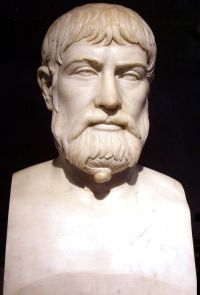
Pindar,
Odes of Pindar
(1874)
“ I have hope that when the folk of Ephyra pour forth my sweet strains by Peneus' side, yet more glorious shall I make their Hippokleas for his crowns and by my songs among his fellows and his elders, and I will make him possess the minds of the young maidens. For various longings stir secretly the minds of various men; yet each if he attain to the thing he striveth for will hold his eager desire for the time present to him, but what a year shall bring forth, none shall foreknow by any sign. ”
The historians' history of the world in twenty-five volumes…
“ Xerxes inquiring of his guides whether the Peneus might be conducted to the sea by any other channel, received from them, who were well acquainted with the situation of the country, this reply: “As Thessaly, O King, is on every side encircled by mountains, the Peneus can have no other communication with the sea.” “The Thessalians,” Xerxes is said to have answered, “are a sagacious people. They have been careful to decline a contest for many reasons, and particularly as they must have discerned that their country would afford an easy conquest to an invader. ”
James George Frazer,
The Golden Bough: A Study in Magic and Religion…
“ When the Dragon had received his deadly wound, the lad, still acting the part of the god, fled far away to be purged of the guilt of blood in the beautiful Vale of Tempe, where the Peneus flows in a deep wooded gorge between the snowy peaks of Olympus and Ossa, its smooth and silent tide shadowed by overhanging trees and tall white cliffs. ”
Karl Otfried Müller,
The History and Antiquities of the Doric Race…
“ The plain on either side of the Peneus was however occupied by the Lapithæ, a race which derived its origin from Almopia in Macedonia, and was at least very nearly connected with the Minyans and Æolians of Ephyra.98 If it be allowed to speak of this heroic race, of superhuman strength and courage, in the same terms as of a real nation, we should say that the towns Elatea, Gyrton, Mopsium, Larissa, Atrax, Œchalia, Ithome, and Tricca, were under their dominion. ”
“ She leaves him every morning in renewed youth, to prepare the way for Phoebus (the Sun) , whilst Tithonus remains in perpetual old age and grayness.3 — l. 23 by Peneus' stream: Phoebus loved the Nymph Daphne whom he met by the river Peneus in the vale of Tempe. L. 27 Amphion's lyre: He was said to have built the walls of Thebes to the sound of his music. L. 35 Night like a drunkard reels: Compare Romeo and Juliet, Act II, Scene 3: 'The grey-eyed morn smiles,' &c.—It should be added that three lines, which appeared hopelessly misprinted, have been omitted in this Poem. ”
Mark Akenside,
The Poetical Works of Mark Akenside
“ On the other hand, Callimachus, who was very learned in all the school-divinity of those times, in his hymn to Delos, maketh Peneus, the great Thessalian river-god, the father of his nymphs: and Ovid, in the fourteenth book of his Metamorphoses, mentions the Naiads of Latium as the immediate daughters of the neighbouring river-gods. Accordingly, the Naiads of particular rivers are occasionally, both by Ovid and Statius, called by patronymic, from the name of the river to which they belong. ”
Karl Otfried Müller,
The History and Antiquities of the Doric Race…
“ The mountain-valley, which in later times bore the name of Thessaly, was bounded to the west by Pindus, to the south by Othrys, to the east by Pelion and Ossa, and to the north by Olympus, under which name the ancient writers, for example Herodotus, also include the chain which in after-times (probably from an Illyrian word) 63 was called the Cambunian mount. The course of the Peneus is so situated as to divide the open plain to the south, the ancient Pelasgic Argos, from the mountainous district to the north ”
Charles Kingsley,
The Heroes; Or, Greek Fairy Tales for My Children
“ And Jason looked and saw the plains of Thessaly, where the Lapithai breed their horses; and the lake of Boibé, and the stream which runs northward to Peneus and Tempe; and he looked north, and saw the mountain wall which guards the Magnesian shore; Olympus, the seat of the Immortals, and Ossa, and Pelion, where he stood. Then he looked east and saw the bright blue sea, which stretched away for ever toward the dawn. Then he looked south, and saw a pleasant land, with white-walled towns and farms, nestling along the shore of a land-locked bay, while the smoke rose blue among the trees ”
Ernest Arthur Gardner, 1911 Encyclopædia Britannica, Volume 9… (1911)
“ ELIS, the chief city of the ancient Greek district of Elis, was situated on the river Peneus, just where it passes from the mountainous district of Acrorea into the champaign below. According to native tradition, it was originally founded by Oxylus, the leader of the Aetolians, whose statue stood in the market-place. ”
Pindar,
Pindar and Anacreon
(1846)
“ This ode is remarkable for the flowing beauty of its diction and general simplicity of construction. ↑ Alluding to the ancient division of the habitable globe into Asia, Europe, and Libya, or Africa. ↑ Peneus was the son of Oceanus, and Hypseus, the father of Cyrene, was the son of Peneus, and of the nymph of Creusa, daughter of Tellus. The description given by the poet in this passage of the martial disposition of Creusa will remind the classical reader of the character of Camilla as sketched by Virgil: (Æn., vii., 805, sq.:) — "Bellatrix ”
Ernest Arthur Gardner, 1911 Encyclopædia Britannica, Volume 9… (1911)
“ Up to this date it only occupied the ridge of the hill now called Kalaskopi, to the south of the Peneus, but afterwards it spread out in several suburbs, and even to the other side of the stream. As all the athletes who intended to take part in the Olympic games were obliged to undergo a month’s training in the city, its gymnasiums were among its principal institutions. ”
“ Not yet was Troy besieged for twice five years, when, Xanthus, Neæra attracted thy eyes. Besides; did not enduring love for the Arcadian maid force Alpheus 574 to run through various lands? They say, too, that thou, Peneus, didst conceal, in the lands of the Phthiotians, Creüsa, 575 already betrothed to Xanthus. Why should I mention Asopus, whom Thebe, beloved by Mars, 576 received, Thebe, destined to be the parent of five daughters? Should I ask of Achelous, "Where now are thy horns?" thou wouldst complain that they were broken away by the wrathful hand of Hercules. ”
Edgar Lee Masters,
The open sea
“ The aches of the day, and being freed shines forth As star companions star, in smiles and words Of praise, affection. Hadrian loves the faith Of happiness, and lets his guests fare free, Wander eight miles of garden, enter vales Of Tempe, watch a mimic Peneus Flow by; encounter fauns amid the brakes; Surprise Bacchantes sleeping; hear from hills A chorus of Euripides soothe their souls With dreams before Faustina’s sculptured face, Or Antinous, Apollo, Venus; bathe Their glowing bodies in the pools; partake Of food or wine, gifts of the gods. Such life Is passing, soon will pass. ”
Herodotus, The Persian Wars — Book VII (1920)
“ Xerxes enquiring of his guides if there were any other outlet for the Peneus into the sea, they answered him out of their full knowledge: “The river, O king, has no other way into the sea, but this alone; for there is a ring of mountains round the whole of Thessaly.” Whereupon, it is said, quoth Xerxes: “They are wise men, these Thessalians ”
Edmund Spenser,
The Works of Edmund Spenser
(1857)
“ The streames of Hebrus with his songs, I weene, As that faire troupe of woodie goddesses Staied thee, O Peneus, powring foorth to thee, From cheereful lookes, great mirth and gladsome glee. XXIV. The verie nature of the place, resounding With gentle murmure of the breathing ayre, A pleasant bowre with all delight abounding In the fresh shadowe did for them prepayre, To rest their limbs with wearines redounding. For first the high palme-trees with braunches faire, Out of the lowly vallies did arise, And high shoote up their heads into the skyes. ”
Homer,
The Iliad of Homer — Book II
(1791)
“ The Titaresius, and other small streams which are rolled from Olympus and Ossa, are so extremely clear, that their waters are distinguished from those of the Peneus for a considerable distance from the point of their confluence.—Dodwell. ↑ Dr. Clarke, in his travels, describes this tomb as a conical mound; and says that it is the spot of all others for viewing the plain of Troy, as it is visible in all parts of Troas. ”
James Baldwin,
Old Greek Stories
“ In the Vale of Tempe, which lies far north of Delphi, there lived a young girl whose name was Daphne. She was a strange child, wild and shy as a fawn, and as fleet of foot as the deer that feed on the plains. But she was as fair and good as a day in June, and none could know her but to love her.Daphne spent the most of her time in the fields and woods, with the birds and blossoms and trees; and she liked best of all to wander along the banks of the River Peneus, and listen to the ripple of the water as it flowed among the reeds or over the shining pebbles. ”
Edwin Abbott Abbott,
Onesimus: Memoirs of a Disciple of St…
“ Through the midst there runs a broad street adorned with four ranks of columns forming two covered colonnades with a wide road between, and along the whole street (which is more than thirty-six furlongs in length) there are statues and busts beautifully wrought of white marble. Greek names have been given to all the region round about, such as Pieria, Peneus, Tempe, Castalia, insomuch that to hear the names of the villages one might fancy oneself in the haunts of the Muses ”
Ovid,
The Metamorphoses of Ovid, Books I-VII
“ Other animated beings are produced by heat and moisture: and, among them, the serpent Python. Phœbus slays him, and institutes the Pythian games as a memorial of the event, in which the conquerors are crowned with beech; for as yet the laurel does not exist, into which Daphne is changed soon after, while flying from Phœbus. On this taking place, the other rivers repair to her father Peneus, either to congratulate or to console him; but Inachus is not there, as he is grieving for his daughter Io, whom Jupiter, having first ravished her, has changed into a cow. ”
Ovid,
The Metamorphoses of Ovid, Books I-VII
“ Thence are we a hardy generation, and able to endure fatigue, and we give proofs from what original we are sprung.EXPLANATION. In the reign of Deucalion, king of Thessaly, the course of the river Peneus was stopped, probably by an earthquake. In the same year so great a quantity of rain fell, that all Thessaly was overflowed. Deucalion and some of his subjects fled to Mount Parnassus; where they remained until the waters abated. The children of those who were preserved are the stones of which the Poet here speaks. ”
A. J. B. Wace, The nomads of the Balkans, an account of life and customs among the Vlachs of Northern Pindus (1914)
“ The district called Hashia comprises the hill country between the Peneus and the Haliakmon on both sides of the former Graeco-Turkish frontier. Its western limit may be marked roughly by a line drawn from Ghrevena to Kalabaka, and its eastern limit by a similar line from Serfije through Elassona to Tirnavos. The name seems to imply that the villages in this district are all chiftliks. That is to say that each village instead of being composed of small holdings, is the absolute property of one or more absentee landlords. ”
A. J. B. Wace, The nomads of the Balkans, an account of life and customs among the Vlachs of Northern Pindus (1914)
“ Many more came out to say good-bye, and send messages to friends and relations at Ghrevena and elsewhere. Beyond Trikkala we set our faces northwards. Here the character of the country changes rapidly ; trees become more common ; the wide, open plain contracts, and beyond Kalabaka gives place to a wooded valley through which the Peneus comes down from Malakasi. Up this valley is the famous route that leads over the Zighos to Metsovo and Yannina and throughout history has been the main road into Thessaly from the west. ”
Baroness Elizabeth Philippa Biddulph, Charles Philip Yorke, Fourth Earl of Hardwicke…
“ So there is another expedition in the boats with sixty men and a twelve-miles pull to Platamona. At a village, Karitza, they hear of an atrocity of the pirates, who had burned a boat and killed all the crew, leaving one poor fellow only, dead on the beach with his right arm missing, as witness to the outrage. So the little force bivouacs on the beach, and at 4.30 next morning chase and fire on some men whom they see hauling a boat over a sandbank into the river Peneus, with others retreating into the forest. ”
Curtis C. Bushnell, Readings from Latin Verse; With Notes
“ The plural expresses the aversion on each occasion. 19. thalamo sub: in the deep river's chamber. Sub governs thalamo, but follows it. Cyrene, as daughter of the river-god Peneus, dwells in subterranean chambers at the source of that stream. She is at this time in the thalamo described in 60 ff. Aristaeus enters through the river, thought of as emerging from the earth a full-grown stream, the waters arching over his head to admit him. He passes beneath the earth where he sees groves and lakes, and rivers which are presently to issue as the various streams of the upper world. ”
Curtis C. Bushnell, Readings from Latin Verse; With Notes
“ Drymoque: que is long according to Greek usage before the double consonant beginning the next word. 28. auro ff.: arrayed in skins embroidered with threads of gold. 31 ff. Odyssey, 8. 34. mollia pensa: their soft tasks. See Lex. pendo II, pensum, B, 1. 35. impulit: struck his mother's ears. 39. procul: sc. dixit. frustra: idly, without reason. 42. nomine: ablative of specification. 43. nova: strange. 44. age: quick. 46. qua ff.: purpose clause, that the youth might enter there. 48. misit: let him pass, lit. sent him. He enters the earth through the opening by which the Peneus finds exit. ”
Euripides,
The Bacchae of Euripides
“ Enter Pentheus, clad like a Bacchanal, and strangely excited, a spirit of Bacchic madness overshadowing him. Thy shape, methinks, is like to one Of Cadmus' royal maids! Pentheus. Yea; and mine eye Is bright! Yon sun shines twofold in the sky, Thebes twofold and the Wall of Seven Gates. . . . And is it a Wild Bull this, that walks and waits Before me? There are horns upon thy brow! What art thou, man or beast? For surely now The Bull is on thee! Dionysus. He who erst was wrath, Goes with us now in gentleness. He hath Unsealed thine eyes to see what thou shouldst see. Pentheus. ”
Ovid,
Metamorphoses
(1921)
“ But Pentheus stood fixed in his purpose. He no longer sent messengers, but went himself to where Cithaeron, the chosen seat for the god's sacred rites, was resounding with songs and the shrill cries of worshippers. As a spirited horse snorts when the brazen trumpet with tuneful voice sounds out the battle and his eagerness for the fray waxes hot, so did the air, pulsing with the long-drawn cries, stir Pentheus, and the wild uproar in his ears heated his wrath white-hot. ”
Thomas Bulfinch,
The Age of Fable: — XXIII. Achelous and Hercules…
(1855)
“ Penelope is another of those mythic heroines whose beauties were rather those of character and conduct than of person. She was the daughter of Icarius, a Spartan prince. Ulysses, king of Ithaca, sought her in marriage, and won her, over all competitors. When the moment came for the bride to leave her father's house, Icarius, unable to bear the thoughts of parting with his daughter, tried to persuade her to remain with him, and not accompany her husband to Ithaca. Ulysses gave Penelope her choice, to stay or go with him. Penelope made no reply, but dropped her veil over her face. ”