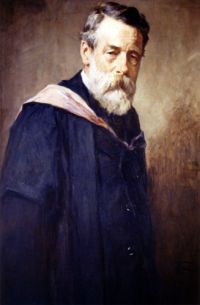
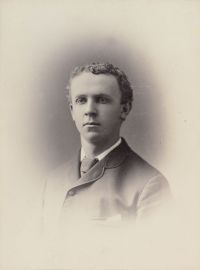
“ Quintus was a poet, as well as his brother—nay, a better poet, in the latter's estimation, or at least he was polite enough to say so more than once. In quantity, at least, if not in quality, the younger must have been a formidable rival, for he wrote, as appears from one of these letters, four tragedies in fifteen days—possibly translations only from the Greek.One of the most remarkable of all Cicero's letters, and perhaps that which does him most credit both as a man and a statesman, is one which he wrote to his brother, who was at the time governor of Asia. ”
Quintus Cicero
Definition and stakes
Quotes about “Quintus Cicero”
James Anthony Froude,
Caesar: A Sketch
“ Cicero himself began a warm correspondence with Caesar, and through Quintus sent continued messages to him. Literature was a neutral ground on which he could approach his political enemy without too open discredit, and he courted eagerly the approval of a critic whose literary genius he esteemed as highly as his own. Men of genuine ability are rarely vain of what they can do really well. Cicero admired himself as a statesman with the most unbounded enthusiasm. ”
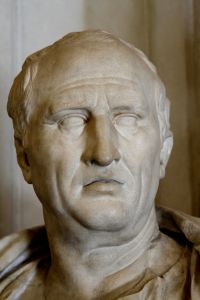
Marcus Tullius Cicero,
The Letters of Cicero, Volume 1
“ The secret of his success seems to have been that he was no man's rival. He resolutely declined all official employment, even on the staff of his brother-in-law Quintus Cicero. He committed himself to no side in politics, and, not being in the senate, had no occasion by vote or speech to wound the feelings of anyone. So, too, though he cared for literature, it was rather as a friendly critic of others than as an author. He did, it is true, compile some books on Roman history, on historical portraits, and certain family biographies ”
Plutarch,
Plutarch's Lives — Cicero
(1859)
“ After Cicero had received this power, he committed all affairs outside to Quintus Metellus, but the management of the city he kept in his own hands. Such a numerous attendance guarded him every day when he went abroad, that the greatest part of the market-place was filled with his train when he entered it. Catiline, impatient of further delay, resolved himself to break forth and go to Manlius, but he commanded Marcius and Cethegus to take their swords, and go early in the morning to Cicero's gates, as if only intending to salute him, and then to fall upon him and slay him. ”
Arthur Benton Sanford, An Easter Disciple: The Chronicle of Quintus…
“ Nor does any man quickly toss aside the faith of his fathers. If belief is waning in the primitive mythologies, and if the social life of the Empire is moved by unrest and despair, the problem is to find a greater satisfaction. There have been spoken many beautiful words by the Roman scholars which are sweet premonitions of immortality. Does not Quintus remember that Cicero likens to heaven a port prepared, and prays that he may sail thither with full-spread sails? And if the gifted Cicero has just gone tragically out of life, let it be hoped that he has reached the harbor. ”
Alfred John Church,
Roman life in the days of Cicero
“ His first impulse was to make for the sea-coast. If he could reach Macedonia, where Brutus had a powerful army, he would, for a time at least, be safe. The two brothers started. But Quintus had little or nothing with him, and was obliged to go home to fetch some money. Cicero, who was himself but ill provided, pursued his journey alone. Reaching the coast, he embarked. When it came to the point of leaving Italy his resolution failed him. He had always felt the greatest aversion for camp life. He had had an odious experience of it when Pompey was struggling with Caesar for the mastery. ”
John Colin Dunlop, History of Roman Literature from its Earliest Period to the Augustan Age…
“ In his work on this topic, which was one almost peculiar to the Romans, Cicero professes to relate the substance of a conversation held at Tusculum with his brother, in which Quintus, on the principles of the Stoics, supported the credibility of divination, while Cicero himself controverted it. The dialogue consists of two books, the first of which comprehends an enumeration by Quintus of the different kinds or classes of divination, with the reasons or presumptions in their favour. The second book contains a refutation by Cicero of his brother’s arguments. ”
Alfred John Church,
Roman life in the days of Cicero
“ They are twenty-seven in number, or rather twenty-six, as the sixteenth of the series contains the congratulations and thanks which Quintus Cicero addresses to his brother on receiving the news that Tiro has received his freedom. "As to Tiro," he writes, "I protest, as I wish to see you, my dear Marcus, and my own son, and yours, and my dear Tullia, that you have done a thing that pleased me exceedingly in making a man who certainly was far above his mean condition a friend rather than a servant. ”
Alfred John Church,
Roman life in the days of Cicero
“ I do implore you, by all our troubles, do not ruin the poor lad. Indeed he is ruined enough already. If he has only something to keep him from want, then modest merit and moderate good fortune will give him all he wants."Appointed to the government of Cilicia, Cicero takes his son with him into the province. When he starts on his campaign against the mountain tribes, the boy and his cousin, young Quintus, are sent to the court of Deiotarus, one of the native princes of Galatia. "The young Ciceros," he writes to Atticus, "are with Deiotarus. ”
Marcus Tullius Cicero,
The Letters of Cicero, Volume 1
“ That Cicero up to the time of his consulship had been connected rather with the populares is illustrated by Quintus (de Petit. i.) urging him to make it clear that he had never been a demagogue, but that if he had ever spoken "in the spirit of the popular party, he had done so with the view of attracting Pompey." [2] De Orat. ii. §§ 1, 2. [3] "The city, the city, my dear Rufus—stick to that, and live in its full light. Residence elsewhere—as I made up my mind early in life—is mere eclipse and obscurity to those whose energy is capable of shining at Rome."—Fam. ii. 12 (vol. ii., p. 166) . ”
Marcus Tullius Cicero,
The Letters of Cicero, Volume 1
“ II. The letter of Quintus is after the emancipation of his own freedman Statius, which apparently took place B.C. 59. III. Quintus is at a distance from Italy, and is looking forward to rejoin his brother and family. IV. Cicero is engaged on some more than ordinary literary work. V. Pompey is visiting Cicero in his Cuman villa. Now after his return from Asia (B.C. 58) , Quintus was only twice thus distant, in B.C. 57-56 in Sardinia, and in B.C. 54-53 in Britain and Gaul. In both of these periods Cicero was engaged on literary work ”
Anthony Trollope,
The Life of Cicero, Volume II
“ It is supposed that Cicero left Rome in company with his brother Quintus, and that at first they went to Tusculum. There was no bar to their escaping from Italy had they so chosen, and probably such was their intention as soon as tidings reached them of the proscription. It is pleasant to think that they should again have become friends before they died. In truth, Marcus the elder was responsible for his brother's fate. Quintus had foreseen the sun rising in the political horizon, and had made his adorations accordingly. ”
Marcus Tullius Cicero,
Cicero: Letters to Atticus, Vol…
“ Some sort of provision must be made for him when he comes to Rome. For I don't think he could endure that woman as a mother-in-law. I refused Pindarus' offer for the villa at Cumae. Now let me tell you why I have sent a messenger. Young Quintus is promising to be as prim as a puritan: and both he and his father have begged me to go bail to you for him, but on the condition that you only believe it when you see it. I shall give him a letter according to his fancy, but don't take any notice of it. I am writing now to prevent you from thinking that I do. God grant he keeps his promise. ”
Plutarch,
Plutarch's Lives — Cicero
(1859)
“ So also, it is related that when Quintus Ligarius was prosecuted for having been in arms against Caesar, and Cicero had undertaken his defense, Caesar said to his friends, "Why might we not as well once more hear a speech from Cicero? Ligarius, there is no question, is a wicked man and an enemy." But when Cicero began to speak, he wonderfully moved him, and proceeded in his speech with such varied pathos, and such a charm of language, that the color of Caesar's countenance often changed, and it was evident that all the passions of his soul were in commotion. ”
“ III. HIS BROTHER QUINTUS. Between Marcus Cicero and his younger brother Quintus there existed a very sincere and cordial affection—somewhat warmer, perhaps, on the side of the elder, inasmuch as his wealth and position enabled him rather to confer than to receive kindnesses; the rule in such cases being (so cynical philosophers tell us) that the affection is lessened rather than increased by the feeling of obligation. He almost adopted the younger Quintus, his nephew, and had him educated with his own son ”
Gaston Boissier, Cicero and his friends (1897)
“ The exile of Cicero completed the confusion of his affairs, and at the time of his brother’s return Quintus was quite ruined. This did not prevent him, at the time of his greatest financial distress, rebuilding his house at Rome, and buying a country house at Arpinum and another in the suburbs, constructing in his villa at Arcae, baths, porticoes, fish-ponds, and such a fine road that it was taken for a work of the state. It is true that the poverty of a Roman of that time would make the fortune of many of our nobles. ”
| editor, The Great Events by Famous Historians… (1905)
“ Among the victims, far the most conspicuous was Cicero. With his brother Quintus, the old orator had retired to his Tusculan villa after the battle of Mutina; and now they endeavored to escape in the hope of joining Brutus in Macedonia; for the orator's only son was serving as a tribune in the liberator's army. After many changes of domicile they reached Astura, a little island near Antium, where they found themselves short of money, and Quintus ventured to Rome to procure the necessary supply. ”
Anthony Trollope,
The Life of Cicero, Volume II
“ How many a man has since learned to regret the lost labor of his household; and yet what god has been the better? There may be a question of æsthetics, indeed, with which Cicero does not meddle. 311In the third book he descends to practical and at the same time political questions. There had been no matter contested so vehemently among Romans as that of the establishment and maintenance of the Tribunate. Cicero defends its utility, giving, with considerable wit, the task of attacking it to his brother Quintus. Quintus, indeed, is very violent in his onslaught. ”
Alfred John Church,
Roman life in the days of Cicero
“ To worship Jupiter or Romulus did not make him a better man, though it might be his necessary duty as a citizen; his real religion, as we understand it, was his reverence for Plato or Zeno. Athens to him was not only what Athens, but what the Holy Land is to us. Cicero describes something of this feeling in the following passage: "We had been listening to Antiochus (a teacher of the Academics) in the school called the Ptolemaeus, where he was wont to lecture. Marcus Piso was with me, and my brother Quintus, and Atticus, and Lucius Cicero, by relationship a cousin, in affection a brother. ”
Anthony Trollope,
The Life of Cicero, Volume II
“ Though broken worlds should fall in disorder round their heads, they would stand firm amid the ruins. But they who are likely to be made responsible will not cause worlds to be broken.Such, I think, was the reasoning within Cicero's mind when he wrote these treatises. In the first he encounters his brother Quintus at his Tusculan villa, and there listens to him discoursing in favor of religion. Quintus is altogether on the side of the gods and the auspices. He is, as we may say, a gentleman of the old school, and is thoroughly conservative. ”
William Smith,
Dictionary of Greek and Roman Biography and Mythology
(1870)
“ The assault was closely pressed for several days in succession, but so energetic were the measures adopted by Cicero, although at that very time suffering from great bodily weakness, and so bravely was he supported by his soldiers, that they were enabled to hold out until relieved by Caesar, who was loud in his commendations of the troops and their commander. (Caes. B. G. v. 24, &c.) Quintus was one of the legati of the orator in Cilicia, b. ”
Charles Thomas Cruttwell, The History of Roman Literature
“ Cicero therefore retired to Athens, where he spent six months studying philosophy with Antiochus the Academic, and with Zeno and Phaedrus who were both Epicureans. His brother Quintus and his friend Atticus were fellow-students with him. He next travelled in Asia Minor, seeking the help and advice of all the celebrated rhetoricians he met, as Menippus of Stratonice, Dionysius of Magnesia, Aeschylus of Cnidos, Xenocles of Adramyttium. At Rhodes he again placed himself under Molo, whose wise counsel checked the Asiatic exuberance which to his latest years Cicero could never quite discard ”
James Leigh Strachan-Davidson,
Cicero And The Fall Of The Roman Republic…
(1894)
“ In Cicero's own case it was mainly the influence gained by his practice at the bar which won him the consulship. His brother puts this in the forefront of his advantages: "You will have your fame as an orator to counterbalance your want of noble birth." The Roman advocate was forbidden to accept a fee, but he expected to be repaid by the personal exertions of the client and his friends at the next election; "you must take care," writes Quintus, "that they are as good as their word ”
Alfred John Church,
Roman life in the days of Cicero
“ It is well that you did not live in old times when they took a Dictator from the plow; when the men who made Rome what it is cultivated their own land, but did not covet the land of others. 'Ah! but,' you say, 'the father intended to disinherit him.' Why? 'I cannot say.' Did he disinherit him? 'No, he did not.' Who stopped him? 'Well, he was thinking of it.' To whom did he say so? 'To no one.' Surely," cries Cicero, "this is to abuse the laws and justice and your dignity in the basest and most wanton way, to make charges which he not only cannot but does not even attempt to establish." ”
Albert Curtis Clark, 1911 Encyclopædia Britannica, Volume 6… (1911)
“ Much exaggeration was permitted to a Roman orator. Thus Cicero frequently speaks as if his client were to be put to death, though a criminal could always evade capital consequences by going into exile. His enemies scoffed at his “tear-drops.” He indulged in the more violent invective, which, though shocking to a modern reader, e.g. in his speeches against Vatinius and Piso, was not offensive to Roman taste (de Orat. ii. 216-290) . He was much criticized for his jokes, and even Quintilian (ii. 17-21) regrets that he made so many in his speeches. ”
Alfred John Church,
Roman life in the days of Cicero
“ These teachers of eloquence were what we may call the "Professors" of Rome. A lad had commonly "finished his education" when he put on the "man's gown;" but if he thought of political life, of becoming a statesman, and taking office in the commonwealth, he had much yet to learn. He had to make himself a lawyer and an orator. Law he learned by attaching himself, by becoming the pupil, as we should say, of some great man that was famed for his knowledge. Cicero relates to us his own experience: "My father introduced me to the Augur Scaevola ”
Thomas De Quincey,
The Uncollected Writings of Thomas de Quincey…
“ And, again, the mere vivacity of his audience, requiring perpetual amusement and variety, compelled a man, as great even as Demosthenes, to curtail his arguments, and rarely, indeed, to pursue a theme with the requisite fulness of development or illustration; a point in which the superior dignity and the far less fluctuating mobility of the Roman mind gave an immense advantage to Cicero. ”
“ For the month that yet remained of his consulship, Cicero was the foremost man in Rome—and, as a consequence, in the whole world. Nobles and commons vied in doing honour to the saviour of the state. Catulus and Cato—men from whose lips words of honour came with a double weight—saluted him publicly by that memorable title of Pater Patriae; and not only the capital, but most of the provincial towns of Italy, voted him some public testimony of his unrivalled services. No man had a more profound appreciation of those services than the great orator himself. ”