Saxon law

Definition and stakes

John Earle,  Anglo-Saxon Literature

“ The Frankish capitularies had a process called Inquisitio, which was adopted into Norman law, and was there called Enquête; this, having passed with the Normans into England, was finally shaped and embodied in the common law among the legal reforms of Henry II.
Under the Saxon laws, the true men who were sworn to do justice had a very different part to act from that which falls to the lot of our English jury.
”
Source: Gutenberg

Francis Stoughton Sullivan,  Lectures on the constitution and laws of England (1776)

“ He even, in some degree, restored the Saxon law of descents, and permitted alienation of lands. For if a man had several fiefs, and several sons, the eldest had the principal one, on which was the place of habitation, only, and the rest went among the sons, as far as they would go; and if a man purchased or acquired land (as land might be alienated by the feudal law, with the consent of the superior lord,) such acquisitions by the laws of Henry, he was not obliged to transmit to his heirs ”
Source: Gutenberg

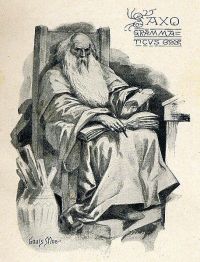
Portrait of Saxo Grammaticus Saxo Grammaticus,  The Danish History — Introduction

“ But the beginnings were dim, and there were simply traditions of good and bad lawyers of the past; such were "Sciold" first of all the arch-king, "Frode" the model lawgiver, "Helge" the tyrant, "Ragnar" the shrewd conqueror.
"Sciold", the patriarch, is made by tradition to fulfil, by abolishing evil customs and making good laws, the ideal of the Saxon and Frankish Coronation oath formula (which may well go back with its two first clauses to heathen days) . His fame is as widely spread. However, the only law Saxo gives to him has a story to it that he does not plainly tell.
”
Source: Wikisource

Get perspective with Kwize: daily news enlightened by great literature