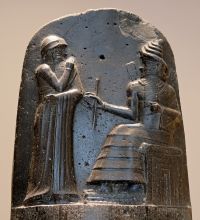
Shamash

Definition and stakes

G. Maspero,  History of Egypt, Chaldæa, Syria…

“ Papsukal, the servant of the great gods, tore his face before Shamash—clothed in mourning, filled with sorrow. Shamash went—he wept in the presence of Sin, his father,—and his tears flowed in the presence of Ea, the king:—‘Ishtar has gone down into the earth, and she has not come up again!—And ever since Ishtar has descended into the land without return... [the passions of men and beasts have been suspended] ... ”

Source: Gutenberg

C. H. W. Johns,  Babylonian and Assyrian Laws, Contracts and Letters

“ A king of knowledge, instructed by Shamash the judge, I strongly established Sippara, reclothed the rear of the shrine of Aya (the consort of Shamash) , and planned out Ê-BAB-BAR (temple of Shamash at Sippara) like a dwelling in heaven. In arms I avenged Larsa (held by the Elamite, Rim-Sin) , and restored Ê-BAB-BAR (temple of Shamash at Larsa) for Shamash my helper. As overlord I gave fresh life to Erech, furnishing abundance of water to its people, and completed the spire of Ê-AN-NA (temple of Nanâ at Erech) . I completed the glory of Anu and Ninni. ”
Source: Gutenberg

Portrait of Lewis Spence Lewis Spence,  Myths & Legends of Babylonia & Assyria

“ The cult of Shamash in Assyria dates from at least 1340 B.C., when Pudilu built a temple to this god in the city of Asshur. He entitled Shamash 'The Protecting Deity,' which name is to be understood as that of the god of justice, whose fiat is unchangeable, and in this manner Shamash differed somewhat from the Babylonian idea concerning him. In the southern kingdom he was certainly regarded as a just god, but not as the god of justice—a very different thing. It is interesting as well as edifying to watch the process of evolution of a god of justice. ”
Source: Gutenberg

Get perspective with Kwize: daily news enlightened by great literature