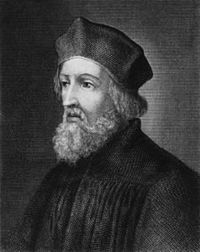
Sigismund II Augustus

Definition and stakes

Paul Fox,  The reformation in Poland (1924)

“ Triumph and Dominance.—As the Reformation in Poland was steadily gathering strength and growing in influence, King Sigismund I died on Easter Sunday, April 1, 1548, and was succeeded by his son Sigismund Augustus, crowned since 1530 to succeed his father as king of Poland. Sigismund Augustus was a truly religious man, believing sincerely in the fundamentals of the Christian religion, but indifferent to the forms in which they were to be expressed. He adhered to the Church of Rome as the state church in which he had been brought up and to whose forms of worship he had become accustomed. ”
Source: Gutenberg

Portrait of Leonard Jan Józef Lepszy Leonard Jan Józef Lepszy,  Cracow, the royal capital of ancient Poland… (1912)

“ Opposite to this, there stood formerly the cenotaph of King Sigismund I. The red marble figure of the king, represented in full armour, sleeping, is a work of Gian Maria Padovano. After the death of Sigismund Augustus, his sister Anne ordered the monument of Sigismund I to be raised from the ground and a second one for her brother to be placed below it, which was executed by Santi Gucci. On the south side, Queen Anne had a marble throne erected, with a recumbent image of herself on the front of it (illustration 57) . ”
Source: Wikisource

Thomas Wilhelm,  A Military Dictionary and Gazetteer

“ Casimir IV. (1444-1492) recovered West Prussia from the Teutonic Knights. The Wallachian invaders carried off 100,000 Poles, and sold them to the Turks as slaves, 1498. Sigismund I. (1506-1548) surnamed “the Great,” raised the country to the utmost pitch of prosperity; he was forced into a war with Russia, in which he lost Smolensk. Sigismund II., Augustus, was a successor worthy of him; Lithuania was finally joined indissolubly to Poland. Livonia was conquered from the Knights Sword-bearers. (See Sword-bearers, Knights.) ”
Source: Gutenberg

Get perspective with Kwize: daily news enlightened by great literature