“ And now on this warm, quiet, flyful afternoon, and still considerably upset over my morning on the trout stream with Thusis, I found myself at my table, abandoning myself to an orgy of self-expression in verse.Having slammed the door I now returned to my poem; and first I carefully re-read as much of it as I had accomplished:To THUSISISlender girl with eyes of gray— Charming mystery called Thusis—Teach me all your lore, I pray!— How your loveliness seduces—How each dimple has its usesLeading men like me astray! ”
Thusis
Definition and stakes
The theme of “Thusis” has been addressed by authors such as Robert W. Chambers, Curtis Guild, F. Barham Zincke and George Edmund Street. It is often associated with terms like soul, human, God, will and Christianity.
Quotes about “Thusis”
“ Art is nothing! Thusis is everything. If she wants a few kings to play with, she shall have them. I'll bag them for her. I'll do anything in the world for her. And if that's not enough I'll step off this damned old planet and pull wires aloft for the honor and glory and happiness of the noblest, sweetest, loveliest, most beauti——"A slight exclamation behind me checked my excited confession.Slowly turning in my tracks I beheld Thusis at the door in cap and apron.There was a terrific silence.Then Thusis, her fair face deeply flushed, dropped us a curtsey. ”
“ I tell you, Thusis, that mankind will emerge naked and equal from this blood-deluge. You and I, too, are going to come out of it—if we do come out—not what our ancestors thought they were, but what we actually are! Very possibly, in generations gone with buried years, some doddering potentate may have managed to beget some ancestor of yours."What of it? Who cares to-day?—outside of the Huns and their barbarian allies? Who cares what you call yourself, I say? Who in God's name will care to-morrow? ”

“ At night the Swiss camp-fires glimmered on the rocks of Mount Terrible while, fireless, McKay and Miss Erith lay in their blankets under heaps of dead leaves on the knees of Thusis, cold as the moon that silvered their forest beds. ”
“ Gravely Miss Erith lifted her young eyes to the eternal peaks—to Thusis, icy, immaculate, chastely veiled before the stealthy advent of the night.Oddly, yet without fear, death seemed to her very near. And love, also—both in the air, both abroad and stirring, yet neither now of vital consequence. Only service meant anything now to this young man so near her—to herself. ”
“ I waited until she was able to control herself."Thusis," I began, stiffly——"Oh, don't! Please don't! I'm too weak. I'll go to bed—really I will, Michael. And leave you to wrap yourself in your nightie and stalk back to the Admiral——""Damn it all!" I broke out. She rocked, helplessly, her face buried in her hands.After a while she got up, supporting herself by one hand on the stair-rail. The other hand pressed her heart."Michael dear," she said, "you are perfectly right. We are what we are. Nothing alters that. We are born what we are; we die what we are. ”
Curtis Guild, Over the Ocean; or, Sights and Scenes in Foreign Lands
“ It cannot fail to make a profound impression by its gloomy grandeur and wild beauty, especially at one point, where the eye can sweep away through the gorge, as if looking through a vast rocky tube, and rest upon green, sunny slopes, and pleasant, smiling scenery beyond.We reach the pleasant village of Thusis, where the river Nolla flows into the Rhine; and there is, from the bridge that spans it, a beautiful view of the valley in a ring of mountains and an old castle, the oldest in Switzerland, perched on a crag, high above the river. ”
“ He shrugged."What a strange, fat, vulgar, good-natured woman," said I. "And what a grotesque company! Can you beat it?—Bulgar and Bolsheviki, King, Queen, Countess, Baron, Admiral, all jumbled up in this little rest-house where I am trying to live in peace and privacy. And now comes an act of God called an avalanche!—and we're all trapped together—you and I, Thusis and Clelia, and this beastly Bulgarian with his beak of a bird of prey; and that vulgar Greek King and his vixen of a wife,—Oh, Lord!" ”
F. Barham Zincke, A walk in the Grisons (1875)
“ Being then obliged to remain at Thusis for the rest of the day, I went in the afternoon to see the old castle of Hohen Rhätien. The ruins of one of these mediæval strongholds cannot, generally, be regarded with much interest, because gratitude is no ingredient in the feelings which the sight of it awakens. The stage of history to which they belong was rather a painful interruption, than a satisfactory continuance, of the progress of human affairs. ”
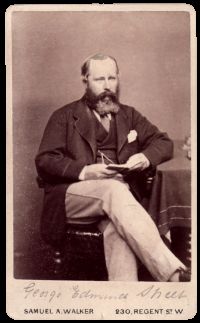 George Edmund Street,
Brick and Marble in the Middle Ages…
George Edmund Street,
Brick and Marble in the Middle Ages…
“ We only wished to reach Thusis by sunset, and so our time was ample for enjoyment; we walked much of the way, detecting eagerly every here and there patches of snow on the mountains in the distance, each of which is hailed as a discovery by every fresh traveller, who feels himself transported with delight by the distant view of the pure white against the sky.Castles are here as numerous as ever upon the Rhine, and at least a dozen, I should think, might be reckoned perched on every favourable spot between Reichenau and Thusis. ”
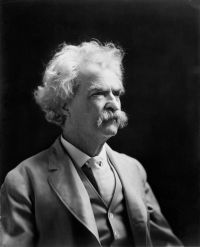 Mark Twain,
Following the Equator
(1897)
Mark Twain,
Following the Equator
(1897)
“ There is reverence there, and tenderness, and gratefulness, and compassion, and resignation, and fortitude, and self-respect—and no sense of disgrace, no thought of dishonor. Everything is there that goes to make a noble parting, and give it a moving grace and beauty and dignity. And yet one of these people is a Thug and the other a mother of Thugs! The incongruities of our human nature seem to reach their limit here. ”
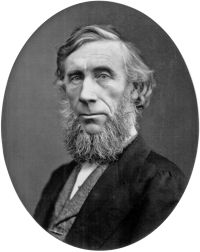 John Tyndall,
Fragments of Science: A Series of Detached Essays…
John Tyndall,
Fragments of Science: A Series of Detached Essays…
“ Facts, rather than dogmas, have been its ministers — hunger and thirst, heat and cold, pleasure and pain, fervour, sympathy, aspiration, shame, pride, love, hate, terror, awe — such were the forces whose interaction and adjustment throughout an immeasurable past wove the triplex web of man's physical, intellectual, and moral nature, and such are the forces that will be effectual to the end. ”
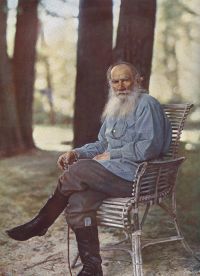 Leo Tolstoy,
A Confession (Maude's translation…
(1882)
Leo Tolstoy,
A Confession (Maude's translation…
(1882)
“ If that explanation was artificial I did not notice its artificiality: so happy was I at humbling and abasing myself before the priest—a simple, timid country clergyman—turning all the dirt out of my soul and confessing my vices, so glad was I to merge in thought with the humility of the fathers who wrote the prayers of the office, so glad was I of union with all who have believed and now believe, that I did not notice the artificiality of my explanation. ”
Leo Tolstoy,
A Confession (Maude's translation…
(1882)
“ That teaching which promised to unite all in one faith and love—that very teaching, in the person of its best representatives, told me that these men were all living a lie; that what gave them their power of life was a temptation of the devil; and that we alone possess the only possible truth. ”
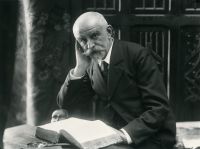 Joris-Karl Huysmans,
Against the Grain — Chapter XII
(1926)
Joris-Karl Huysmans,
Against the Grain — Chapter XII
(1926)
“ And you, Utopians of a system, who make an abstraction of human nature, panegyrists of atheism, nourished on hallucinations and detestations, emancipators of woman, destroyers of the family, genealogists of the simian race, you, whose name was once insult enough, be well content; you will have been the prophets and your disciples will be the high-priests of an abominable future! ”
Mark Twain,
The Facts Concerning the Recent Carnival of Crime in Connecticut
“ That is about the style of conscience I am pining for. If I only had you shrunk you down to a homeopathic pill, and could get my hands on you, would I put you in a glass case for a keepsake? No, sir. I would give you to a yellow dog! That is where you ought to be—you and all your tribe. You are not fit to be in society, in my opinion. ”
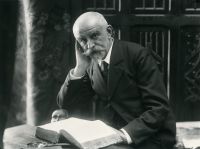
“ Alas, we are no more the humble labourers of the Middle Ages, who toiled, giving God thanks, who submitted without discussion to the Master's orders. We, by our little faith, have exhausted the value of prayer, the panacea of aspirations; consequently many things seem to us unjust and cruel, and we rebel, we ask for pledges; we hesitate to begin our task, we want to be paid in advance, and our distrust makes us vile!—O Lord, give us grace to pray, and never dream of demanding an earnest of Thy favours! ”
Mark Twain,
What Is Man? and Other Essays
“ The accident of a broken leg brought a profane and ribald soldier under religious influences and furnished him a new ideal. From that accident sprang the Order of the Jesuits, and it has been shaking thrones, changing policies, and doing other tremendous work for two hundred years—and will go on. The chance reading of a book or of a paragraph in a newspaper can start a man on a new track and make him renounce his old associations and seek new ones that are in sympathy with his new ideal: and the result, for that man, can be an entire change of his way of life. ”
 Katherine Cecil Thurston,
The Mystics: A Novel
Katherine Cecil Thurston,
The Mystics: A Novel
“ Laying her hands upon [Pg 147] the Sanctuary railing, she leaned forward, and raised her large eyes to the man's face."Which do you consider the greater virtue?" she asked. "Duty or charity?"The Mystic looked at her."Charity," he said, at last, hesitatingly, "the Prophet teaches us—"Enid's face flushed."Yes! yes!" she cried. "The Prophet teaches us that charity is the greater virtue. He tells us that we are to rely upon ourselves—and also upon each other. We are to help ourselves—and to help each other." Her voice shook, her face glowed in her excitement and suspense. ”
 Marie Corelli,
The Master-Christian
Marie Corelli,
The Master-Christian
“ When I treat humanity as a jest—which is really how it should be treated—he looks at me with a grand air of tolerance, 'Oh, you will progress;' he says, 'You are passing through a phase.' 'My dear sir,' I assure him, 'I have lived in this "phase", as you call it, for forty years. ”
Katherine Cecil Thurston,
The Mystics: A Novel
“ If there is a Soul in danger?""The Prophet must not be disturbed. What are we, that we should thrust our wrong-doing or our sorrow upon the Mighty One?"At the words a rage of apprehension shook Enid. She lifted her head, and her fingers closed fiercely round the iron bar that topped the railing."Silence!" she said, excitedly. "You do not know what you are saying! The Prophet sets his people high above himself. The [Pg 150] message of a Soul in distress is of more value in his eyes than a hundred moments of exaltation. Take care that his wrath does not fall upon you!" ”
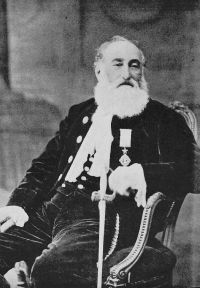 Meadows Taylor,
Confessions of a Thug
Meadows Taylor,
Confessions of a Thug
“ With these exceptions, the whole human race is open to thy destruction, and thou must omit no possible means (but at all times dependent upon the omens by which we are guided) to compass their destruction. I have now finished: you are become a Thug; and what remains of thy profession will be shown to thee by our Gooroo, who will, under the necessary ceremonies, instruct thee in its details. ”
 Caroline Lee Hentz,
Helen and Arthur; or, Miss Thusa's Spinning Wheel
Caroline Lee Hentz,
Helen and Arthur; or, Miss Thusa's Spinning Wheel
“ Miss Thusa is one instance out of many, of a being with strong mind and warm heart, cheated of objects on which to expend the vigor of the one, or the fervor of the other. The energies of her character, finding no legitimate outlet, beat back upon herself, wearing away by continued friction the fine perception of beauty and susceptibility of true enjoyment. ”
W. K. Tweedie, A Lamp to the Path
“ And base things of the world, and things which are despised, hath God chosen, yea, and things which are not, to bring to nought things that are.” “Our faith in eternal realities is weak,” he cried, “and our sense of duty faint, while we neglect the salvation of our fellow-beings. Let us awake to duty, and while we have a tongue or pen, devote them to the service of the Most High, not in our own strength, but with strong faith and confidence in him.” ”
graf Leo Tolstoy, War and Peace
“ Don’t I feel in my soul that I am part of this vast harmonious whole? Don’t I feel that I form one link, one step, between the lower and higher beings, in this vast harmonious multitude of beings in whom the Deity—the Supreme Power if you prefer the term—is manifest? ”
Katherine Cecil Thurston,
The Mystics: A Novel
“ CHAPTER V t is astonishing in how short a space of time a man of vigorous character can make his personality felt. On the night of his mysterious advent, the Prophet had found his people in a condition of mental chaos—as liable to repudiate as to accept the seeker for their confidence; but before one month had passed he had, by domination of will, so moulded this neurotic mass of humanity that his own position had gradually and insensibly merged from suppliant into that of autocrat. Without a murmur of doubt or dissension the Mystics had proclaimed him their king. ”
 Alexander Maclaren,
Expositions of Holy Scripture…
Alexander Maclaren,
Expositions of Holy Scripture…
“ Then come the awful words bidding that generation 'fill up the measure of the fathers.' They are like the other command to Judas to do his work quickly. They are more than permission, they are command; but such a command as, by its laying bare of the true character of the deed in view, is love's last effort at prevention. Mark the growing emotion of the language. Mark the conception of a nation's sins as one through successive generations, and the other, of these as having a definite measure, which being filled, judgment can no longer tarry. ”
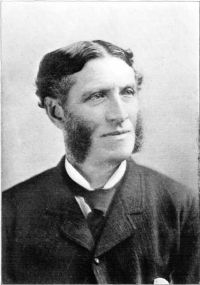 Matthew Arnold,
Culture and Anarchy — Chapter I: Sweetness and Light
(1882)
Matthew Arnold,
Culture and Anarchy — Chapter I: Sweetness and Light
(1882)
“ Where was the hope of making reason and the will of God prevail among people who had a routine which they had christened reason and the will of God, in which they were inextricably bound, and beyond which they had no power of looking? But now the iron force of adhesion to the old routine,—social, political, religious,—has wonderfully yielded; the iron force of exclusion of all which is new has wonderfully yielded. ”
graf Leo Tolstoy, Anna Karenina
“ He felt that besides the blessed spiritual force controlling his soul, there was another, a brutal force, as powerful, or more powerful, which controlled his life, and that this force would not allow him that humble peace he longed for. ”
Katherine Cecil Thurston,
The Mystics: A Novel
“ Some alteration she could not define had grown into his expression; the cold mastery of himself and others was still visible; but a new emotion had insensibly been created—something powerful and even dominant—for which she could find no name. With a sharp, instinctive alarm, her lips parted."What is it?" she said, apprehensively. "Why are you here? The time has not come for you to go out into the world?"A faintly ironic smile flitted across his lips."Surely, if one is a Prophet, one can alter even prophecies." ”
graf Leo Tolstoy, A Letter to a Hindu
“ One need not accept all that Tolstoy says—some of his facts are not accurately stated—to realize the central truth of his indictment of the present system, which is to understand and act upon the irresistible power of the soul over the body, of love, which is an attribute of the soul, over the brute or body force generated by the stirring in us of evil passions. ”
Freiherr von Friedrich Hügel, The Mystical Element of Religion…
“ And this persuasiveness can here be discovered to be greater or less in proportion to the thoroughness and continuousness of this centralization and purification; to the degree in which this issues in a new, spontaneously acting ethico-spiritual personality; and to the closeness and costingness of the connection between those means and this result. Such a soul will be persuasive because of its ever seeking and finding a purifying intermediacy, a river of death, to all its merely naturalistic self-seeking. ”
A. L. O. E., Beyond the Black Waters
“ Pray, which comes first—a thought, or an act?” “The thought, if it prompt the act,” replied Io. “There, I have caught you!” cried Thud triumphantly. “Theories are thoughts, and acts are facts; so facts must be founded on theories, not theories on facts;” and confident that he had gained a victory, and said something very logical and clever, Thucydides quitted the room, carrying his heavy head as high as his very short neck would allow. After attending to household arrangements, Io called her dear little Karen to take her first Scripture lesson. ”
 Albert Bigelow Paine,
Mark Twain: A Biography. Volume III, Part 2…
Albert Bigelow Paine,
Mark Twain: A Biography. Volume III, Part 2…
“ He would fix you keenly with his attention, but you realized, at last, that he was placing you and seeing you not as a part of the material landscape, but as an item of his own inner world—a world in which philosophies and morals stood upright—a very good world indeed, but certainly a topsy-turvy world when viewed with the eye of mere literal scrutiny. ”
