“ The Thénardier, Éponine, and Azelma were like statues also; the very drinkers had paused; a solemn silence reigned through the whole room. Madame Thénardier, petrified and mute, recommenced her conjectures: “Who is that old fellow? Is he a poor man? Is he a millionaire? Perhaps he is both; that is to say, a thief.” The face of the male Thénardier presented that expressive fold which accentuates the human countenance whenever the dominant instinct appears there in all its bestial force. The tavern-keeper stared alternately at the doll and at the traveller ”
Quotes about “Thénardier”
 Victor Hugo,
Les Misérables
(1862)
Victor Hugo,
Les Misérables
(1862)
“ Thus it will be easily understood that that grating, so obligingly opened to Jean Valjean, was a bit of cleverness on Thénardier’s part. Thénardier intuitively felt that Javert was still there; the man spied upon has a scent which never deceives him; it was necessary to fling a bone to that sleuth-hound. An assassin, what a godsend! Such an opportunity must never be allowed to slip. ”
Victor Hugo,
Les Misérables, v. 2/5: Cosette
“ In an ordinary situation Thénardier had everything necessary to make him—we do not say to be—what is conventionally termed an honest tradesman or a worthy citizen. At the same time, certain circumstances being given, certain shocks stirring up his nature from the bottom, he had everything required to make him a villain. He was a shop-keeper in whom there was a monster. Satan must at times crouch in a corner of the lair in which Thénardier lived, and dream before this hideous masterpiece. ”
Victor Hugo,
Les Misérables
(1862)
“ Thénardier was one of those double natures which sometimes pass through our midst without our being aware of the fact, and who disappear without our finding them out, because destiny has only exhibited one side of them. It is the fate of many men to live thus half submerged. In a calm and even situation, Thénardier possessed all that is required to make—we will not say to be—what people have agreed to call an honest trader, a good bourgeois. ”
“ Although their concord had only evil as its result, there was contemplation in Madame Thénardier’s submission to her husband. That mountain of noise and of flesh moved under the little finger of that frail despot. Viewed on its dwarfed and grotesque side, this was that grand and universal thing, the adoration of mind by matter; for certain ugly features have a cause in the very depths of eternal beauty. There was an unknown quantity about Thénardier; hence the absolute empire of the man over that woman. At certain moments she beheld him like a lighted candle ”
“ From Thénardier’s point of view, the conversation with Marius had not yet begun. He ought to have drawn back, to have modified his strategy, to have abandoned his position, to have changed his front; but nothing essential had been compromised as yet, and he had five hundred francs in his pocket. Moreover, he had something decisive to say, and, even against this very well-informed and well-armed Baron Pontmercy, he felt himself strong. For men of Thénardier’s nature, every dialogue is a combat. ”
“ Had Thénardier, spurred on by that thirst for liberty which changes precipices into ditches, iron bars into wattles of osier, a legless man into an athlete, a gouty man into a bird, stupidity into instinct, instinct into intelligence, and intelligence into genius, had Thénardier invented a third mode? No one has ever found out. The marvels of escape cannot always be accounted for. The man who makes his escape, we repeat, is inspired; there is something of the star and of the lightning in the mysterious gleam of flight ”
Victor Hugo,
Les Misérables — Volume 2, Book Third…
“ All at once he caught sight of Thenardier. He plunged suddenly into the brushwood with Cosette, where they could both hide themselves. "The deuce!" said Thenardier, and he redoubled his pace.The thickness of the undergrowth forced him to draw nearer to them. When the man had reached the densest part of the thicket, he wheeled round. It was in vain that Thenardier sought to conceal himself in the branches; he could not prevent the man seeing him. The man cast upon him an uneasy glance, then elevated his head and continued his course. The inn-keeper set out again in pursuit. ”
“ Whatever may have been the obstinate injustice of destiny in this case, Thénardier was one of those men who understand best, with the most profundity and in the most modern fashion, that thing which is a virtue among barbarous peoples and an object of merchandise among civilized peoples,—hospitality. ”
“ The terrified ruffians flung themselves on the arms which they had abandoned in all the corners at the moment of flight. In less than a second, these seven men, horrible to behold, had grouped themselves in an attitude of defence, one with his meat-axe, another with his key, another with his bludgeon, the rest with shears, pincers, and hammers. Thénardier had his knife in his fist. The Thénardier woman snatched up an enormous paving-stone which lay in the angle of the window and served her daughters as an ottoman. ”
Victor Hugo,
Les Misérables
(1862)
“ Here was one of those men who command amazement in desperate circumstances. Extreme as was the crisis, inevitable as was the catastrophe, there was nothing here of the agony of the drowning man, who opens his horror-filled eyes under the water. Thénardier rose in an unpretending manner, went to the fireplace, shoved aside the screen, which he leaned against the neighboring pallet, and thus unmasked the brazier full of glowing coals, in which the prisoner could plainly see the chisel white-hot and spotted here and there with tiny scarlet stars. ”
Victor Hugo,
Les Misérables, v. 2/5: Cosette
“ Some persons, however, remained curious, thinking that there was probably in the affair, not the fabulous treasure of the legend, but something more palpable and tangible than the fiend's bank-notes, and that the road-mender had doubtless found out half the secret. The most puzzled were the schoolmaster and Thénardier the publican, who was everybody's friend, and had not disdained an intimacy with Boulatruelle."He has been to the galleys," Thénardier would say. "Well, good gracious! we do not know who is there, or who may go there." ”
“ On Christmas eve itself, a number of men, carters, and peddlers, were seated at table, drinking and smoking around four or five candles in the public room of Thénardier’s hostelry. This room resembled all drinking-shop rooms,—tables, pewter jugs, bottles, drinkers, smokers; but little light and a great deal of noise. The date of the year 1823 was indicated, nevertheless, by two objects which were then fashionable in the bourgeois class: to wit, a kaleidoscope and a lamp of ribbed tin. The female Thénardier was attending to the supper, which was roasting in front of a clear fire ”
Victor Hugo,
Les Misérables — Volume 2, Book Third…
“ Thenardier was cunning, greedy, slothful, and clever. He did not disdain his servants, which caused his wife to dispense with them. This giantess was jealous. It seemed to her that that thin and yellow little man must be an object coveted by all.Thenardier, who was, above all, an astute and well-balanced man, was a scamp of a temperate sort. This is the worst species; hypocrisy enters into it.It is not that Thenardier was not, on occasion, capable of wrath to quite the same degree as his wife ”
Victor Hugo,
Les Misérables, v. 5/5: Jean Valjean
“ Let us finish at once with this man: two days after the events we have just recorded he started for America, under a false name, with his daughter Azelma, and provided with an order on a New York banker for twenty thousand francs. The moral destitution of Thénardier, the spoiled bourgeois, was irremediable, and he was in America what he had been in Europe. The contact with a wicked man is sometimes sufficient to rot a good action, and to make something bad issue from it: with Marius's money Thénardier turned slave dealer. ”
Victor Hugo,
Les Misérables
(1862)
“ He added the “grandfather,” which produced a good effect. This was the story that Javert hit upon when he arrived at Montfermeil. The grandfather caused Jean Valjean to vanish. Nevertheless, Javert dropped a few questions, like plummets, into Thénardier’s history. “Who was that grandfather? and what was his name?” Thénardier replied with simplicity: “He is a wealthy farmer. I saw his passport. I think his name was M. Guillaume Lambert.” Lambert is a respectable and extremely reassuring name. Thereupon Javert returned to Paris. ”
Victor Hugo,
Les Misérables — Volume 2, Book Third…
“ The man opened his pocket-book once more and drew from it, not the handful of bills which Thenardier expected, but a simple little paper, which he unfolded and presented fully open to the inn-keeper, saying:--"You are right; read!"Thenardier took the paper and read:-- "M. SUR M., March 25, 1823. "MONSIEUR THENARDIER:-- You will deliver Cosette to this person. You will be paid for all the little things. I have the honor to salute you with respect, FANTINE." "You know that signature?" resumed the man. ”
Victor Hugo,
Les Misérables, v. 4/5: The Idyll and the Epic
“ Through this, which was only French, Thénardier recognized Montparnasse, whose pride it was to understand all the slang dialects and not speak one of them. As for the fourth man, he held his tongue, but his wide shoulders denounced him, and Thénardier did not hesitate,—it was Gueulemer. Brujon replied almost impetuously, but still in a low voice:—"What is that you are saying? The innkeeper has not been able to bolt. He doesn't understand the dodge. A man must be a clever hand to tear up his shirt and cut his sheets in slips to make a rope; to make holes in doors; manufacture false papers ”
Victor Hugo,
Les Misérables
(1862)
“ M. Leblanc had barely pronounced a few words, without raising his voice, and even during his struggle with the six ruffians near the window he had preserved the most profound and singular silence. Thénardier continued:— “Mon Dieu! You might have shouted ‘stop thief’ a bit, and I should not have thought it improper. ‘Murder!’ That, too, is said occasionally, and, so far as I am concerned, I should not have taken it in bad part. It is very natural that you should make a little row when you find yourself with persons who don’t inspire you with sufficient confidence. ”
Victor Hugo,
Les Misérables, v. 1/5: Fantine
“ It is not enough to be bad in order to prosper: and the pot-house was a failure. Thanks to the fifty-seven francs, Thénardier had been able to avoid a protest, and honor his signature; but the next month they wanted money again, and his wife took Cosette's outfit to Paris and pledged it for sixty francs. So soon as this sum was spent, the Thénardiers grew accustomed to see in the little girl a child they had taken in through charity, and treated her accordingly. As she had no clothes, she was dressed in the left-off chemises and petticoats of the little Thénardiers, that is to say, in rags. ”
Victor Hugo,
Les Misérables
(1862)
“ Thénardier had just passed his fiftieth birthday; Madame Thénardier was approaching her forties, which is equivalent to fifty in a woman; so that there existed a balance of age between husband and wife. ”
Victor Hugo,
Les Misérables, v. 1/5: Fantine
“ There are crab-like souls which constantly recoil toward darkness, retrograde in life rather than advance, employ experience to augment their deformity, incessantly grow worse, and grow more and more covered with an increasing blackness. This man and this woman had souls of this sort.Thénardier was peculiarly troublesome to the physiognomist: there are some men whom you need only look at to distrust them, for they are restless behind and threatening in front. There is something of the unknown in them. We can no more answer for what they have done than for what they will do. ”
Victor Hugo,
Les Misérables, v. 3/5: Marius
“ Thénardier exclaimed,—"Are you mad? are you drunk? Why, what a set of humbugs; lose time, I suppose, draw lots, eh,—with a wet finger, a short straw, write our names and put them in a cap—""Would you like my hat?" a voice said at the door.All turned; it was Javert, who held his hat in his hand and offered it smilingly. CHAPTER XXI. ALWAYS BEGIN BY ARRESTING THE VICTIMS.Javert posted his men at nightfall, and ambushed himself behind the trees of the Rue de la Barrière des Gobelins, which joins No. 50-52 on the other side of the boulevard. ”
 Alfred Tennyson,
Idylls of the King — Geraint and Enid
Alfred Tennyson,
Idylls of the King — Geraint and Enid
“ With gold and scattered coinage, and the squire Chafing his shoulder: then he cried again, 'To the wilds!' and Enid leading down the tracks Through which he bad her lead him on, they past The marches, and by bandit-haunted holds, Gray swamps and pools, waste places of the hern, And wildernesses, perilous paths, they rode: Round was their pace at first, but slackened soon: A stranger meeting them had surely thought They rode so slowly and they looked so pale, That each had suffered some exceeding wrong. ”
Alfred Tennyson,
Idylls of the King — The Marriage of Geraint
“ He answered: 'Earl, entreat her by my love, Albeit I give no reason but my wish, That she ride with me in her faded silk.' Yniol with that hard message went; it fell Like flaws in summer laying lusty corn: For Enid, all abashed she knew not why, Dared not to glance at her good mother's face, But silently, in all obedience, Her mother silent too, nor helping her, Laid from her limbs the costly-broidered gift, And robed them in her ancient suit again, And so descended. Never man rejoiced More than Geraint to greet her thus attired ”
Alfred Tennyson,
Idylls of the King — The Marriage of Geraint
“ Moved the fair Enid, all in faded silk, Her daughter. In a moment thought Geraint, 'Here by God's rood is the one maid for me.' But none spake word except the hoary Earl: 'Enid, the good knight's horse stands in the court; Take him to stall, and give him corn, and then Go to the town and buy us flesh and wine; And we will make us merry as we may. Our hoard is little, but our hearts are great.' He spake: the Prince, as Enid past him, fain To follow, strode a stride, but Yniol caught His purple scarf, and held, and said, 'Forbear! ”
Alfred Tennyson,
Idylls of the King — Geraint and Enid
“ To your good damsel there who sits apart, And seems so lonely?' 'My free leave,' he said; 'Get her to speak: she doth not speak to me.' Then rose Limours, and looking at his feet, Like him who tries the bridge he fears may fail, Crost and came near, lifted adoring eyes, Bowed at her side and uttered whisperingly: 'Enid, the pilot star of my lone life, Enid, my early and my only love, Enid, the loss of whom hath turned me wild-- What chance is this? how is it I see you here? Ye are in my power at last, are in my power. ”
Alfred Tennyson,
Idylls of the King — Geraint and Enid
“ And only meet for mowers;' then set down His basket, and dismounting on the sward They let the horses graze, and ate themselves. And Enid took a little delicately, Less having stomach for it than desire To close with her lord's pleasure; but Geraint Ate all the mowers' victual unawares, And when he found all empty, was amazed; And 'Boy,' said he, 'I have eaten all, but take A horse and arms for guerdon; choose the best.' He, reddening in extremity of delight, 'My lord, you overpay me fifty-fold.' 'Ye will be all the wealthier,' cried the Prince. ”
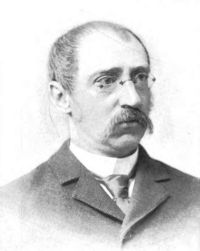 Henry A. Beers,
From Chaucer to Tennyson
Henry A. Beers,
From Chaucer to Tennyson
“ In 1833 Tennyson's friend, Arthur Hallam, died, and the effect of this great sorrow upon the poet was to deepen and strengthen the character of his genius. It turned his mind in upon itself, and set it brooding over questions which his poetry had so far left untouched; the meaning of life and death, the uses of adversity, the future of the race, the immortality of the soul, and the dealings of God with mankind.Thou madest Death: and, lo, thy footIs on the skull which thou hast made. ”
George Henry Blore, Victorian Worthies: Sixteen Biographies
“ It may be that the claim of Tennyson to popular sovereignty will, in the end, rest chiefly on the pleasure which he gave to many thousands of his fellow-countrymen, a pleasure to be renewed and found again in English scenes, and in thoughts which coloured grey lives and warmed cold hearts, which shed the ray of faith on those who could accept no creeds and who yet yearned for some hope of an after-life to cheer their declining days. ”
