Bulla

Definition and stakes

Thomas Wyatt,  A Manual of Conchology

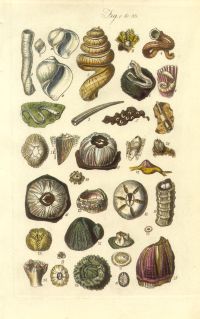
“ Bulla. The Bubble. Eleven species. The great confusion that existed in this genus, as classed by Linnæus, has been elucidated by the division and classification of Lamarck. This genus derived its name from the resemblance which some of the smaller species have to a bubble of water. Its shells are found in almost all parts of the world.
Shell external, oval, involuted; aperture very large, open the whole length of the shell, and generally wider at the base; outer edge sharp and smooth; summit umbilicated.
”
Source: Gutenberg

Portrait of Louis Figuier Louis Figuier,  The Ocean World: Being a Description of the Sea and Its Living Inhabitants

“ The genus Bulla differs materially from the Aplysiæ. They have a well-developed shell, the form of which is elegant; they are delicate in structure; their brilliant colours, consisting of red, black, or white [394] bands, separated by many varied tints, cause these little molluscs to be much sought after for ornamental collections. The shell itself is oval or globulous, rolled up in a scroll, smooth, spotted, very thin and fragile, with a concave spiral, umbilicate, open in all its length, with a straight, wide, and cutting edge.
Figs. 183 and 184. Bulla ampulla (Linnæus) .
”
Source: Gutenberg

Portrait of Charles Babbage Charles Babbage,  Reflections on the Decline of Science in England…

“ The fact, however, is, that no such animal exists, but that the knight of Malta, finding on the Sicilian shores the three internal bones of one of the species of Bulla, of which some are found on the south-western coast of England, [Bulla lignaria] described and figured these bones most accurately, and drew the whole of the rest of the description from the stores of his own imagination. ”
Source: Gutenberg

Get perspective with Kwize: daily news enlightened by great literature