“ Where, principally, is cockcrow?”“The cocks of the neighbourhood have been warned that a superhuman crower of crows has come to dwell among them. Therefore they are silent and abashed.”“I’d be ashamed, if I were a cock, not to put up a little competition. All hail! here’s what was once a waiter!”The half-dressed, yawning apparition that, mop and bucket in hand, uprose from the lower regions, stared aghast at the mention of breakfast; muttered “Not for an hour or two, anyways”; and began without enthusiasm to sweep the dining-room.“We’d better go for another walk,” suggested Peter ”
Cockcrow
Definition and stakes
The theme of “cockcrow” has been addressed by authors such as G. B. Stern and Joseph MacRory. It is often associated with terms like cockatoo, cockroach, bird, cockchafer and wing.
Quotes about “cockcrow”
Joseph MacRory, The Gospel of St. John
“ Mark (xiii. 35) , our Lord says: “Watch ye therefore (for you know not when the lord of the house cometh; at even, or at midnight, or at the cockcrowing, or in the morning) .” Thus, then, although the cock crew after Peter's first denial, as St. Mark records (Mark xiv. 68) , still the time generally known as cockcrow—about 3 a.m.—was that meant when the word was used, as it is in our Lord's prediction in SS. Matt., Luke, and John, without any special indication that the first crowing of the cock was the one intended. Hence, the second crowing of the cock referred to by St. ”
Angus Buchanan, Exploration of Aïr (1921)
“ Travelling by the wayside in inhabited country, if you happen to be near human dwellings, cockcrows will herald in the African dawn from some village hut-top obscure among the bush foliage, and on the third day we were busy with the load-ropes in the chill of late darkness ere the first glad cock-call told of approaching day. ”
Various, 500 of the Best Cockney War Stories
“ I had hung a mess tin on a nail to catch the water that dripped through, partly to keep it off my head, also to provide water for an easy shave in the morning.A strafe began. The night was illuminated by hundreds of vivid flashes, and shells of all kinds burst about us. The dug-out shook with the concussions. Trench mortars, rifle grenades, and machine-gun fire contributed to the din.Whale, who never had the wind up, was shifting his position and turning from one side to the other."What's the matter?" I asked my chum. "Can't you sleep?" ”
 G. E. Farrow,
Adventures in Wallypug-Land
G. E. Farrow,
Adventures in Wallypug-Land
“ In such a country, the unexpected is always happening, and I am continually being startled in the streets at being addressed by some dangerous-looking quadruped, or an impertinent bird, for I must say that as a class the birds are the most insolent of all the inhabitants of this strange land. There is in particular one old crow, a most objectionable personage, and a cockatoo who is really the most violent and ill-natured bird that I have ever been acquainted with. ”
 George Fletcher Moore,
Extracts from the letters and journals of George Fletcher Moore…
George Fletcher Moore,
Extracts from the letters and journals of George Fletcher Moore…
“ The white cockatoos are very numerous, and now feed upon the flower of the red gum tree, which lately came into blossom. There are three or four species of the cockatoo, white, black, grey, and black with a red tail. The parrots are small and green, the neck ornamented with a gold ring. The pigeons are beautiful, with a bronze-coloured wing. Many birds have singular calls or cries, and our crow makes a most dismal noise, terminated by a long doleful cry. The white cockatoo screams like a clucking hen disturbed from her nest, and the black one whines like a discontented pug dog. ”
 William Clark Russell,
Round the Galley Fire
William Clark Russell,
Round the Galley Fire
“ The current that dangerously and helplessly sweeps him away from the land delights him by a sense of velocity. The waves which rise and threaten to fill the boat gladden him with the sensation of going “up and down.” I once took the trouble to watch a cockney get into a wherry and row himself out to sea. I kept a very powerful glass bearing upon him, and had his face within reach of my hand, so to speak, when he was two miles off. There was a strong tide setting to the eastward, in which direction lay the North Sea. ”
Thomas Garnett, Essays in Natural History and Agriculture
“ I am the more inclined to be of this opinion, because we have many Rooks in this neighbourhood where the cockchafer is not known as a destructive insect, and I know that insects of that class and their larvae are the most favourite food of the Rook, which may be seen in the twilight catching both cockchafers and the large blackbeetles which are flying at that time in the evening. ”
Janet Millett, An Australian Parsonage (1872)
“ The white cockatoo lives chiefly upon roots, which Nature has enabled the bird to dig for in the driest weather, by furnishing him with a large bill shaped exactly like a pick-axe. A flock of these busy delvers hard at work turning up the ground in search of grain just sown, their eyes surrounded by the curious broad blue rim peculiar to white cockatoos making them look like a gang of navvies in spectacles, is an object of such especial disgust to the farmer, that it is no wonder that he tries every plan to keep his cook in a good supply of them, more particularly as they make capital broth. ”
R. Cadwallader Smith, On the Seashore
“ It lives in sand, and can bury itself so quickly that you would have to use your spade with all your might in order to keep pace with this little shell-fish. Where Cockles have buried themselves you will see spurts of water and sand, showing where they are busy down below in the wet sand.Besides being so skilful at digging, the Cockle is a first-rate jumper. If left on the beach, it jumps over the sand, towards the sea, in the funniest way. It is strange to see a quiet-looking shell suddenly take to hopping and jumping like an acrobat. ”
 Louis Figuier,
The Insect World
Louis Figuier,
The Insect World
“ They fear the heat of the day and the bright sunshine, so, during the day, they remain hooked on to the under surface of leaves. It is only early in the morning, and at sunset, that one sees the cockchafers fluttering round the trees which they frequent. They fly with rapidity, pro 447 ducing a monotonous sound by the friction of their wings. But the cockchafer steers badly when it flies; it knocks itself at each instant against obstacles it meets with. ”
William Clark Russell,
Round the Galley Fire
“ AN HOUR’S ROW. There is not a more painfully diverting sight in the whole world than that of a cockney with a face as yellow as a London fog, a tall hat at the back of his head, his coloured shirt-sleeves rolled above his elbows, tugging upon the sea at a small pair of oars in a rather heavy wherry. He has no idea of tides, of waves, of winds, or weather. He looks to leeward for squalls, and over the stern for any other news of the sea. ”
William S. Walsh, In Search of a Son
“ It falls in every instance towards us, but it falls with exactly the same swiftness as that with which it seeks to get away from us. Consequently it remains always at the same distance. The attraction which prevents the moon from running away may be likened to a string tied to the claws of a cockchafer. The cockchafer flies, seeking to free itself; the string pulls it back towards the child's finger; and very often the circular flight which the insect takes around the finger which holds it represents exactly the circular flight of the moon around the earth. ”
George Cupples, The Green Hand: Adventures of a Naval Lieutenant
“ With this I took hold of something to scramble up, bringing down a bag of cabin-biscuit over me, and got on my legs in the midst of the dust; but grim enough I must have looked, with my face like a North American Indian's, and the cockroaches sticking in my hair, as I stumbled out of the corner. The little Cockney of a steward seemed to think me dangerous, for all I saw of him next moment was his striped gingham jacket vanishing round a bulkhead aft. ”
Frances Jenkins Olcott, The Book of Elves and Fairies for Story-Telling and Reading Aloud and for the Children's Own Reading
“ The archer approached nearer to the bed, and held out his bow, and discharged a tiny arrow. A cockroach that was crawling before the dogs, made a bound, fell on its back, kicked, and was motionless. The arrow had run through it.Behind the little man, other little men had come. Some rode on small horses, and were armed with swords, and still others were on foot. All these huntsmen scattered about the room, and ran or rode, to and fro, shooting arrows, and brandishing their swords; until hundreds and hundreds of insects were killed. ”
A. Safroni-Middleton, Sailor and beachcomber
“ When I tell you that an old cockatoo dropped down from the tropic sky on to a blue gum twig overhead and surveyed me with a sideways melancholy eye as I sat alone by my camp fire, be quite sure that that cockatoo lived and breathed, took stock of me and flew away into the sunset, and has doubtlessly dropped into the scrub, a small bunch of dead feather and bone, years ago.At school I read more from the pages of romance than from school-books. ”
Sir A. E. Shipley, More Minor Horrors
“ It is the hinder wings which really do the active flying. After a flight, the hinder wings are shut up something in the manner of a fan.The flattened coxae, or thighs, of the leg are adapted for shovelling débris back from beneath the body when the insect is enlarging its habitation. When the cockroach gets into a dusty ‘milieu’ the dust is immediately removed; the hairs on the legs act as clothes-brushes and brush every part of the body, whilst the antennae, which attract any dust in the neighbourhood, are repeatedly drawn through the closed mandibles and so cleaned. ”
 James Fenimore Cooper,
The Pilot: A Tale of the Sea
James Fenimore Cooper,
The Pilot: A Tale of the Sea
“ The cockswain stood examining his game with cool discretion, and replied to this interrogatory: “No, sir, no—he's going into his flurry; there's no occasion for disgracing ourselves by using a soldier's weapon in taking a whale. Starn off, sir, starn off! the creater's in his flurry!” The warning of the prudent cockswain was promptly obeyed, and the boat cautiously drew off to a distance, leaving to the animal a clear space, while under its dying agonies. ”
Charles H. Eden, Australian Search Party
“ A curious and indescribable wailing cry is heard in the air, singularly depressing in its effect, and a string of some dozen black cockatoos flit from tree to tree, the brilliant scarlet band on the tail of the male flashing as he alternately expands and contracts it, to keep his balance whilst extracting the sweets from the flowers of the 'Eucalypti'. ”
 John Milne,
Colonial facts and fictions: Humorous sketches
(1886)
John Milne,
Colonial facts and fictions: Humorous sketches
(1886)
“ The reply came by wire, ‘File their teeth.’The first bird that was shot was a great big white cockatoo. All the other cockatoos, that were with the one we shot, fled away. This happened at a small shanty standing near the edge of a lagoon. I should have shot the cockatoo myself, but it looked too much like slaughtering a domestic fowl. Cockatoos were good to eat, they make excellent pies, and I must shoot every one I saw; but—and here my companions were very impressive—be careful and not get ‘bushed.’To get ‘bushed’ means to get lost. ”
George Grey, Journals of Two Expeditions of Discovery in North-West and Western Australia…
“ The native throws aside his cloak so that he may not even have this slight covering to impede his motions, draws his kiley from his belt, and with a noiseless, elastic step approaches the lagoon, creeping from tree to tree, from bush to bush, and disturbing the birds as little as possible; their sentinels however take the alarm, the cockatoos farthest from the water fly to the trees near its edge, and thus they keep concentrating their forces as the native advances; they are aware that danger is at hand but are ignorant of its nature. ”
George Grey, Journals of Two Expeditions of Discovery in North-West and Western Australia…
“ At length the pursuer almost reaches the edge of the water, and the scared cockatoos, with wild cries, spring into the air; at the same instant the native raises his right hand high over his shoulder, and, bounding forward with his utmost speed for a few paces to give impetus to his blow, the kiley quits his hand as if it would strike the water, but when it has almost touched the unruffled surface of the lake it spins upwards with inconceivable velocity, and with the strangest contortions. In vain the terrified cockatoos strive to avoid it ”
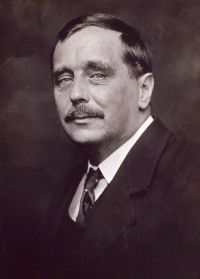 Herbert George Wells,
Tales of Space and Time
(1920)
Herbert George Wells,
Tales of Space and Time
(1920)
“ The sun was broad and blood-red between the stems of the distant chestnuts, and the west was all on fire; the evening breeze had died to a warm tranquillity. The air was full of midge swarms, the fish in the river hard by would leap at times, and now and again a cockchafer would drone through the air. ”
 Owen Jones,
A Gamekeeper's Note-book
(1910)
Owen Jones,
A Gamekeeper's Note-book
(1910)
“ We can forgive the Cockney uncertainty of this sort, as we forgive him for calling rooks, and even starlings, crows. The countryman may well confuse crows and rooks; his- 254 - safest plan when in doubt about a big black bird is to name him rook, for in most parts crows are now scarce to the point of extermination. But those who live in the country have as little excuse for speaking of stoats, when they should speak of weasels, as for mixing rabbits with hares. It is easier to tell a weasel from a stoat than a rabbit from a hare, if one is fairly close and has a clear view. ”
 Charles Darwin,
The Descent of Man, and Selection in Relation to Sex
Charles Darwin,
The Descent of Man, and Selection in Relation to Sex
“ The invincible courage of the game-cock is notorious: a gentleman who long ago witnessed the brutal scene, told me that a bird had both its legs broken by some accident in the cockpit, and the owner laid a wager that if the legs could be spliced so that the bird could stand upright, he would continue fighting. This was effected on the spot, and the bird fought with undaunted courage until he received his death-stroke. In Ceylon a closely allied, wild species, the Gallus Stanleyi, is known to fight desperately “in defence of his seraglio,” so that one of the combatants is frequently found dead. ”
Douglas Dewar, Birds of the Plains
“ They are very fond of sparrow for breakfast. Nevertheless, Passer domesticus is quite plentiful enough and is ever ready to nest inside one’s bungalow.The Indian cock sparrow differs slightly in appearance from the English bird, having more white on the sides of his neck. This is not, as might be supposed, due to the fact that he is not coated with soot to such an extent as the cockney bird. Every widely distributed species, including man, has its local peculiarities, due to climatic influences, isolation, and other causes. ”
The Yellow Fairy Book (1894)
“ A great cockchafer came flying past; he caught sight of Thumbelina, and in a moment had put his arms round her slender waist, and had flown off with her to a tree. The green leaf floated away down the stream, and the butterfly with it, for he was fastened to the leaf and could not get loose from it. Oh, dear! how terrified poor little Thumbelina was when the cockchafer flew off with her to the tree! But she was especially distressed on the beautiful white butterfly’s account, as she had tied him fast, so that if he could not get away he must starve to death. ”
E. Stenhouse, An Introduction to Nature-study
“ At the next step the body is carried by the remaining three legs. In the American (Fig. 220) and German cockroaches both sexes possess two [Pg 354] pairs of wings, which are fixed at the front angles of the second and third segments of the thorax. The hind-wings, which alone are used in flight, are folded up fanwise when not in use, and are covered by the smaller fore-wings, which are generally called the wing-covers. In the common cockroach of this country, only the male has well developed wing-covers and wings. ”
“ So shy and furtive a bird would choose his time for refreshment when there is little likelihood of interruption. In the ravine there are often metallic starlings by the dozen, and little green pigeons—for those domiciled come and go at all hours of the day. Occasionally a sulphur-crested cockatoo comes sailing down to the diminishing pool through interwoven leafage noiselessly as a butterfly; but scrub fowls, scared by the apparition in white, scamper off with a clatter, scattering the dead leaves. In such narrow quarters, birds are under restraint, and show anxiety and apprehension. ”
William T. Palmer, In Lakeland Dells and Fells
“ The birds face each other and try to jump, so that when descending the sharp spurs will cut into their opponent which is, of course, beneath. The wounds in cock-fighting, save for occasional pecks, are almost always on the head, neck, and back. Most are slight, the thick felting of feathers stopping all but the most directly delivered strokes. Some cockers, when the birds are fairly set to, will not allow them to be separated, but I never let my cock down into a ring unless it is agreed that any fighter cut down—that is, knocked off its feet with a blow from the spurs—is considered beaten. ”
