Hartebeest

Definition and stakes

Portrait of John T. McCutcheon John T. McCutcheon,  In Africa: Hunting Adventures in the Big Game Country

“ It certainly is a stirring tail! The impalla is about the same size as the Grant's gazelle, but has horns of a lyrate shape.
The hartebeest is speedily identified, because he is unlike any other antelope in appearance and exists in such large numbers in nearly every part of East Africa. Indeed, if a returned traveler were asked what animal is most typical of the country he would at once name the hartebeest. He sees it so much and so often that after a time it seems to be only a necessary fixture in the landscape.
”
Source: Gutenberg

Alfred W. Drayson,  Sporting Scenes amongst the Kaffirs of South Africa

“ I lost a little ground by dismounting, and before I had loaded again, the herd had passed out of sight over some rising ground. Upon again viewing the hartebeest, I was alarmed at the start they had obtained; they were mere specks in the distance. Feeling great confidence in the gameness of my well-conditioned, hardy little nag, I let him go over the green springy turf, and soon found that the distance between us and the hartebeest was diminishing. ”
Source: Gutenberg

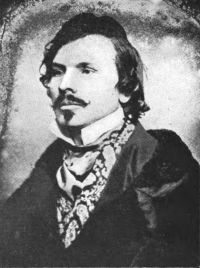
Portrait of Mayne Reid Mayne Reid,  The Vee-Boers: A Tale of Adventure in Southern Africa

“ But the incident was too comical to be looked upon as an evil omen; instead, it elicited peals of laughter, with applauding shouts; all inclined to regard it as the forecast of a prosperous voyage.
Note 1. The “Hartebeest-house” is a hut of rude construction, the usual materials being reeds and grass with a plastering of mud. The name is derived from a fancied resemblance to the form of the antelope so called. Hartebeest-houses are common throughout Southern Africa, not inhabited by natives, but the poorer class of colonists, especially Vee-Boers when not on the move.
”
Source: Gutenberg

Get perspective with Kwize: daily news enlightened by great literature