Male deer

Definition and stakes

Our Young Folks at Home and Abroad

“ The mother keeps them in a quiet place where she thinks the hunters and dogs cannot get them; for men often hunt the wild deer. It is a great pity to kill them for sport, is it not?
HOW FLEET HE IS!
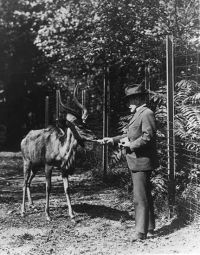
The deer hears quickly, and his scent is very keen too. When the hunters are after him, how fleet he is! Sometimes he leaps into the water and swims. Then the dogs lose the scent and cannot follow him. The male deer sheds his horns every year.
When the horns are growing they look as if they were covered with velvet.
HAVE THEY NO LANGUAGE?
EVERYBODY’S DOG.
”
Source: Gutenberg

Edwin C. Alberts,  Rocky Mountain National Park, Colorado

“ Few shed antlers, therefore, are seen by visitors to the park.
26
Mule deer are common. The fawns, born in early June, are spotted when young.
Male bighorn display the horns that have made them famous.
27
In summer, mule deer are seen singly or in small groups, browsing in the higher country; like the elk, they descend into the lower meadows in autumn. They, too, find the winter difficult, because of limited range. Deer are browsing animals, eating such things as willow, aspen, antelope bitterbrush, and even pine needles.
”
Source: Gutenberg

William Harrison,  Elizabethan England

“ It is also much to be marvelled at that, whereas they do yearly mew and cast their horns, yet in fighting they never break off where they do grife or mew. Furthermore, in examining the condition of our red deer, I find that the young male is called in the first year a calf, in the second a broket, the third a spay, the fourth a staggon or stag, the fifth a great stag, the sixth a hart, and so forth unto his death. And with him in degree of venerie are accounted the hare, boar, and wolf. The fallow deer, as bucks and does, are nourished in parks, and conies in warrens and burrows. ”
Source: Gutenberg

Get perspective with Kwize: daily news enlightened by great literature