“ The Gyroscopic Monorail, at a great expense and complication, eliminates one rail, but there is no particular gain in so doing, in fact there is a distinct loss for the thing that limits the speed of the ordinary electric car, is the loss of grip on the rail, and in the Gyroscopic Monorail the bearing surface of the steel wheels is reduced to just one-half that of the ordinary car. ”
Monorail
Definition and stakes
The theme of “monorail” has been addressed by authors such as Edgar Chambless, Archibald Williams and Edward Huntington Williams. It is often associated with terms like locomotive, train, railway, rail and vehicle.
Quotes about “monorail”
Archibald Williams, The Romance of Modern Invention
“ A monorail car is divided lengthwise by a gap that allows it to hang half on either side of the trestles and clear them as it moves. The double [Pg 261] flanged wheels to carry and drive the car are placed at the apex of the gap. As the “centre of gravity” is below the rail the car cannot turn over, even when travelling round a sharp curve.The first railway built on this system was constructed by M. Charles Lartigue, a French engineer, in Algeria, a district where an ordinary two-rail track is often blocked by severe sand-storms. ”
Edward Huntington Williams, Every-day Science: Volume 7. The Conquest of Time and Space
“ The introduction of electricity facilitated the construction of monorail systems of roads, which had long been the dream of railroad constructors, since this power192 could be applied with so much more flexibility. The defects of the parallel rail system are apparent both in construction of the roadbed and the operating of trains. It is almost impossible to lay and maintain the rails in exact parallels, and even more difficult to keep each rail at the proper height at all points. ”
Archibald Williams, The Romance of Modern Invention
“ A train will consist of a single vehicle for forty, fifty, or seventy passengers, as the occasion requires. It is calculated that an average of twelve passengers at one penny per mile would pay all the expenses of running a car.Mr. Behr maintains that monorails can be constructed far more cheaply than the two-rail, because they permit sharper curves, and thereby save a lot of cutting and embankment; and also because the monorail itself, when trestles and rail are specially strengthened, can serve as its own bridge across roads, valleys and rivers. ”
James W. Buel, Glimpses of America
“ To secure perfect safety in ascending and descending such a tremendous grade, the track is composed of three rails bolted to a trestle of heavy timbers, the centre rail being an immense wrought-iron ladder, with rounds four inches apart, into which the cogs of the locomotive drive-wheel fit, and thus drag the train up the steep as well as control it, with aid of air-brakes, in making the descent. One and a half hours are consumed in making the round trip, and the fare is six dollars, but the view from the summit is so magnificent that it fully justifies the expense. ”
William Francis Bailey, The Story of the First Trans-Continental Railroad
“ On shot the locomotive, like an arrow from the bow, the men throwing over the ties until the train was well nigh unloaded, when just as they were close to the curve by which the train arrives at the station, they saw the dreaded cars strike a tie, or something equally of service, and with a desperate plunge rush down the embankment, some fifteen feet, to the little valley, and creek below. ”
Joseph Husband, The Story of the Pullman Car
“ In the years which followed the actual inception of the railroad in the United States, railway travel was fraught with discomfort and inconvenience beyond the realization of the present day. Travel by canal boat had at least offered a relative degree of comfort, for here comfortable berths in airy cabins were provided as well as good meals and entertainment, but the locomotive, by its greatly increased speed over the plodding train of tow mules, instantly commanded the situation, and as the mileage of the pioneer roads increased, travel by boat proportionately languished. ”
Benjamin F. Taylor, The World on Wheels, and Other Sketches
“ The bars of the trans-continental railroad had careened the horizon with their mighty leverage, and let the cargo through—the very cargo for which they waited in the old days with their faces toward the rising sun, like a praying Israelite. The locomotive had wheeled the rolling globe a half revolution, brought the tide of commerce to the right-about, like a soldier upon his heel. It has proved to be anything but what it was suspected of being—the locomotive has—for, made to be a common carrier, a gigantic, quicktime dray-horse, it is a civilizer, a builder of cities ”
Howard Elliott, The Truth About The Railroads (1913)
“ The railways of the country, in their present form, have been built since the close of the Civil War, or in less than fifty years, and are the wonder and admiration of students of the transportation problem who come here from other countries. There are 234,182 miles of railway, and more than 340,000 miles of track in this country, as compared with a trifle less than 300,000 miles of railway in all the other countries of the world combined. There are nearly 58,000 locomotives; more than 45,000 passenger-train cars; nearly 2,200,000 freight- and service-cars. ”
David Stevenson, Life of Robert Stevenson, Civil Engineer
“ Those rails are so much liked in this neighbourhood, that I think in a short time they will do away the cast iron railways. They make a fine line for our engines, as there are so few joints compared with the other. I have lately started a new locomotive engine, with some improvements on the others which you saw. It has far surpassed my expectations. I am confident a railway on which my engines can work is far superior to a canal. On a long and favourable railway I would stent my engines to travel 60 miles per day with from 40 to 60 tons of goods. ”
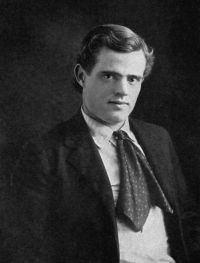 Jack London,
The Road
(1907)
Jack London,
The Road
(1907)
“ Another locomotive whistled, and another train came through at top speed, and another, and another, train after train, train after train, till toward the last the trains were composed of passenger coaches, box-cars, flat-cars, dead engines, cabooses, mail-cars, wrecking appliances, and all the riff-raff of worn-out and abandoned rolling-stock that collects in the yards of great railways. When the yards at Council Bluffs had been completely cleaned, the private car and engine went east, and the tracks died for keeps. ”
Samuel Irenæus Prime, The Alhambra and the Kremlin: The South and the North of Europe
“ All the passengers are requested to walk. In single file we march over the bridge, and then await the train. It comes across, lightened of its load, slowly and safely. It is quite likely that in America the engineer would have put on all steam, and dashed across in a second, or, if not, he would have gone down a hundred feet, into a frightful chasm, and the verdict, if any were sought, would have been, “nobody to blame.” Fret as we do about the railroad management in Europe, it is safer and surer than ours. ”
“ More than forty different kinds of locomotive work for the railroads. Some of them haul freight, and some are passenger train engines. Some are steam locomotives, some are not.Steam locomotives all need water to make the steam that makes the wheels turn. But they don’t all get it in the same way. One kind never has to stop and wait for its tender to be filled. Instead it has a scoop that dips down as the engine passes over a long track-pan of water set between the rails. With no time lost, the scoop sucks up water into the tank. ”
“ Then, as the sand-box is brought into requisition, the wheels distinctly bite the rail, and, in the words of the race-track, "They're off." For a few seconds progress is very slow, indeed. Then the good work of the trusted locomotive becomes apparent, and before we are well out of the yards quite a good speed is being obtained. The fireman is busy ringing the bell, and the engineer, from time to time, adds to the warning noise by one of those indescribable toots made only by a steam engine.Now we are outside the city limits, and the train is making excellent time. ”
Benjamin F. Taylor, The World on Wheels, and Other Sketches
“ The lever is swung a little farther down. The search for things gets lively. Fleeces are getting plentier. The coal goes into the furnace and out at the chimney like the beat of a great black artery. There is a brisk breeze that makes your hair stream like a comet's. The locomotive is alive with reserved power. It has a sentient tremor as it hugs the track, and hurls itself along sixty feet for every tick of the clock—as if you should walk twenty paces while your heart beats once! ”
Maude Ward Lafferty, A Pioneer Railway of the West
“ The delight experienced at the sight of a car loaded by sixty passengers and drawn by one horse at the rate of ten miles an hour through a country where heretofore five miles per hour with one passenger to a horse has been thought good speed, is sufficient of itself to repay the beholder for the trouble of a journey of fifty miles. We understand a locomotive steam engine is now being constructed to be placed upon the road as soon as the distance is opened on the whole of the First Division. ”
Samuel Smiles, Men of Invention and Industry… (1884)
“ This invention has started into full life within our own time. The locomotive engine had for some years been employed in the haulage of coals; but it was not until the opening of the Liverpool and Manchester Railway in 1830, that the importance of the invention came to be acknowledged. The locomotive railway has since been everywhere adopted throughout Europe. In America, Canada, and the Colonies, it has opened up the boundless resources of the soil, bringing the country nearer to the towns, and the towns to the country. ”
Edward Hungerford, The Modern Railroad
“ That man has ever been able to create and build the locomotive, a giant creature of some 200 tons, perhaps, built together with infinite care of some 5,000 to 7,000 parts, and these parts acting with the delicacy of the hair-spring of a watch, almost passes ordinary belief. The wonder becomes even greater when it is realized that this monster creature, set upon two slender rails, is capable of pulling a 4,000 ton train, through every stress of weather and over considerable grades. ”
Edward Hungerford, The Modern Railroad
“ When the engine emerges from the paint-shop it is gorgeous and refulgent—brilliantly new. Unless it is going to foreign lands, when it must be partly dismantled and crated, it will ride its own wheels to the road which has purchased it. A string of new locomotives may be sprinkled through a freight train—never coupled together—in charge of an inspector from the locomotive company, who will bunk in one of the cabs and never leave his charges until they have been receipted for. ”
 William Dean Howells,
Stories Of Ohio
William Dean Howells,
Stories Of Ohio
“ The children of this day can hardly imagine what rude and simple affairs the earliest railroads were. Instead of the long smooth steel rails which now carry the great trains, with their luxurious cars, in their never-ceasing flight, day in and day out the whole year round, flat bands of iron, spiked to wooden rails, formed the path of the small carriages drawn by a locomotive of the size and shape of a threshing-machine engine. ”
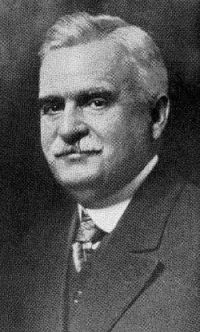 Charles DeLano Hine,
Letters from an old railway official…
(1912)
Charles DeLano Hine,
Letters from an old railway official…
(1912)
“ Have you not seen cars pulled to pieces in big trains, have you not seen freight delayed in a manner to suggest to an innocent bystander that the road was perhaps running its last train and giving its cars their last load? The inevitable tendency of the big train is to hold back and combine in large lots cars destined to the same point and to the same consignee. When a whole train can be unloaded at the ship’s side at tidewater, or at a large consuming plant, the system is ideal. ”
John Moody, The Railroad Builders: A Chronicle of the Welding of the States
“ The champions of artificial waterways would point in contrast to the beautiful packet boats on the Erie Canal, with their fine sleeping rooms, their restaurants, their spacious decks on which the fine ladies and gentlemen congregated every warm summer day, and would insist that such kind of travel was far more comfortable than it could ever be on railroads. To all these pleas the advocates of the railroad had one unassailable argument—its infinitely greater speed. ”
Benjamin F. Taylor, The World on Wheels, and Other Sketches
“ HABITS OF ENGINES AND TRAIN MEN. A locomotive has two habits. It drinks and it smokes. It seems to take comfort in drinking at a liberal river, rather than where the draught is trickled out to it through a stingy pipe on a dry prairie. Climbing heavy grades involves hard drinking. On the Mount Washington Railway, where you travel a mile and rise nineteen hundred feet in an hour and half, the thirsty engine disposes of eighteen hundred gallons of water—all dissipated in breath. During the late war they often watered engines from pails, as they would ponies. ”
Robert Routledge, Discoveries and Inventions of the Nineteenth Century
“ A greater number of adjuncts and subsidiary appliances are also provided for the more effective and convenient working of the engine, and for giving control over the movement of the train, and these, in fact, conduce much to the greater economy and safety with which trains are now run. As the circumstances and conditions under which railways are worked vary much in different parts of the world, the locomotive has to be designed to meet the requirements of each case, and its general appearance, details and dimensions are accordingly much diversified. ”
William Hadfield, Brazil, the River Plate, and the Falkland Islands
“ Swifter than an arrow, than the flight of a swallow, the locomotive threaded the rails, swung about, ran, flew, devoured space, and, passing through fields, barren wastes, and affrighted animals, it stopped at last breathless, at the point where the road does not yet afford a safe passage. ”
John Moody, The Railroad Builders: A Chronicle of the Welding of the States
“ The railroad is sprung from the application of two fundamental ideas—one the use of a mechanical means of developing speed, the other the use of a smooth running surface to diminish friction. Though these two principles are today combined, they were originally absolutely distinct. In fact there were railroads long before there were steam engines or locomotives. If we seek the real predecessor of the modern railroad track, we must go back three hundred years to the wooden rails on which were drawn the little cars used in English collieries to carry the coal from the mines to tidewater. ”
Various, Chambers's Edinburgh Journal, No…
“ Like the steamship, the railway is cosmopolitan in its character. The range of its operations may be as extensive as the globe itself; and throughout that sphere of activity, be it what it may, the locomotive engine is scattering thickly the seeds of civilisation, as well as of wealth. ”
“ But indeed it is the result of accidental impediments, of avoidable difficulties that we travel to-day on rails.Railway travelling is at best a compromise. The quite conceivable ideal of locomotive convenience, so far as travellers are concerned, is surely a highly mobile conveyance capable of travelling easily and swiftly to any desired point, traversing, at a reasonably controlled pace, the ordinary roads and streets, and having access for higher rates of speed and long-distance travelling to specialized ways restricted to swift traffic, and possibly furnished with guide-rails. ”
Charles Mackie, Norfolk Annals, Vol. 2
“ Burrell, of Thetford, and both were shown at work. “The new engine is like a railway locomotive, but with the addition of an apparatus, which answers the purpose of a railway, attached to the wheels. The endless railway consists of a series of flat boards, six in number, plated with iron on both sides of each wheel, equal in length to the radius of the wheel, and from 10 to 16 inches in width, loosely attached to the felloe of the wheel in such a manner that they are carried round with it as it revolves. ”
Victor Verasius Branford, Science and Citizenship : A Lecture delivered before the Manchester Sociological Society November 13th… (1906)
“ With literal and historical accuracy, the typical railway engineer sees the modern locomotive as just an elaborated pit pump-engine placed on wheels, and engaged all day in hauling coal-laden trollies from the pit mouth to the cities, and all night in hauling them back empty. ”
Arthur H. Beavan, Tube, Train, Tram, and Car; or…
“ On each side of the A-shaped trestle are fixed two guide-rails fitting close into horizontal grooved wheels effectually checking all oscillation. In front is the bogie locomotive motor with a pointed bow, the stern of the car also being pointed, so that the entire arrangement resembles when seen from above a great stickless rocket with a sharp and flexible snout.As the sister isle was the first to adopt electricity to a railway (vide Chapter II.) , so was she the pioneer of mono-railism. ”
