“ The stream, which, like nearly all Martial rivers, is wide and shallow, had during the last fifty miles of our course grown narrower, with a depth at the same time constantly lessening, so that some care was required on the part of the pilot to avoid running aground. A stream of twenty inches in depth, affording room for two boats to pass abreast, is considered navigable for vessels only carrying passengers; thirty inches are required to afford a course which for heavy freight is preferable to the road. ”
Navigable stream
Definition and stakes
The theme of “navigable stream” has been addressed by authors such as E. S. Bellasis, Thomas C. Chamberlin, Various, Leveson Francis Vernon-Harcourt and John Muir. It is often associated with terms like canal, navigation, tide, river and ship.
Quotes about “navigable stream”
Leveson Francis Vernon-Harcourt, 1911 Encyclopædia Britannica (1911)
“ Regulation works for increasing the navigable capabilities of rivers can only be advantageously undertaken in large rivers with a moderate fall and a fair discharge at their lowest stage; for with a large fall the current presents a great impediment to up-stream navigation, and there are generally great variations in water-level, and when the discharge becomes very small in the dry season it is impossible to maintain a sufficient depth of water in the low-water channel. ”
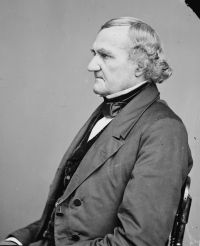 John Catron,
Jones v. Soulard — Opinion of the Court
John Catron,
Jones v. Soulard — Opinion of the Court
“ In considering the question of what rivers being above tidewater are yet navigable, in fact, courts of justice have repeatedly shown an impatience of the suggestion that an insignificant rivulet, which is yet subject to have its volume so increased by freshets as to render it capable of floating a ship of the line for a few hours, deserves, for that reason, to be called a navigable stream. ”
Leveson Francis Vernon-Harcourt, 1911 Encyclopædia Britannica (1911)
“ Eventually, large rivers, under favourable conditions, often furnish important natural highways for inland navigation in the lower portion of their course, as, for instance, the Rhine, the Danube and the Mississippi; and works are only required for preventing changes in the course of the stream, for regulating its depth, and especially for fixing the low-water channel and concentrating the flow in it, so as to increase as far as practicable the navigable depth at the lowest stage of the water-level. ”
E. S. Bellasis, River and Canal Engineering, the characteristics of open flowing streams…
“ A narrow place is likely to be deep or it may be liable to widen. In a hard and stable stream there is no restriction as to site.Weirs are frequently constructed for purposes of navigation, as mentioned in Chap. VIII. They are also used in streams which are not navigable in order that the gradient may not be too steep, and in irrigation 103 canals for the same reason. They are used both in rivers and canals in order that the water-level may be raised and water drawn off by branch channels for purposes of manufactures, water-power or irrigation. ”
Thomas Rainey, Ocean Steam Navigation and the Ocean Post
“ From the above statement it will be seen that the proposed line of steam communication will bring within thirty days of each other, the commercial outlets of navigable streams which drain a back country greater in extent than that which is drained by all of the navigable streams which empty themselves into the Atlantic, the Pacific, and the Indian oceans, from those portions of Europe, Asia, and Africa, which are accessible to American commerce. Settlement and cultivation will, in the course of time, make these American river basins as rich in products as those of the old world. ”
Various, The Bay State Monthly — Volume 1…
“ For lack of a reservoir system to withhold and control the flow of water, the river falls from flood-tide--seventy-one feet--to points so low as to seriously impede or prevent navigation. Sometimes even the smallest steamers and barges fail to pass between Pittsburgh and Cincinnati, and coal famines have not been unfrequent, resulting from difficult navigation. An equable flow of this stream is impossible. It will always be subject to these extremes. ”
E. S. Bellasis, River and Canal Engineering, the characteristics of open flowing streams…
“ In dealing with a large perennial stream it is nearly always necessary to know the approximate highest and lowest water-levels, and these can generally be ascertained by local inquiry, combined with observations of water marks; but a higher level than the highest known and a lower level than the lowest known are always liable to occur, and must to some extent be allowed for. If navigation exists or is to be arranged for, the highest and lowest levels consistent with navigation must be ascertained. The highest such level depends chiefly on the heights of bridges. ”
 Samuel Freeman Miller,
Atlee v. Packet Company — Opinion of the Court
Samuel Freeman Miller,
Atlee v. Packet Company — Opinion of the Court
“ Wharves and piers are as necessary almost to the successful use of the stream in navigation as the vessels themselves, and are to be considered as an important part of the instrumentalities of this branch of commerce. But to be of any value in this respect they must reach so far into deep water as to enable the vessels used in ordinary navigation to float while they touch them and are lashed to their sides. They must of necessity occupy a part of the stream over which a vessel could float if they were not there. ”
Leveson Francis Vernon-Harcourt, 1911 Encyclopædia Britannica (1911)
“ In rivers which always have a fair fresh-water discharge, or a small fresh-water flow combined with a tidal flow and ebb, the channel sometimes has its direct outlet closed, and is deflected parallel to the shore till it reaches a weak place in the line of beach, through which a new outlet is formed; or, where the current is strong enough to keep the outlet open, a bar is formed across the entrance by the littoral drift, reducing the navigable depth. ”
 Thomas C. Chamberlin,
Geology
(1906)
Thomas C. Chamberlin,
Geology
(1906)
“ Where streams are large enough to be navigable industrial considerations often prevent the utilization of their power, the streams being more serviceable as highways than as sources of power. Other things being equal, it follows that streams are most available for water-power when they are large enough to have a moderately steady flow, and not so large as to be beyond ready control, or to be valuable for purposes of navigation. ”
Intercolonial Railway, Summer Provinces by the Sea
“ We see the high, steel cable strung across the river, with the running block and gang ropes connecting it with the side-railed flat barge or ferry. These floats are often propelled across stream by the force of the current. Just as a ship makes headway by the side wind running off her sails obliquely, so does a boat cross a stream by the action of the tide, if care is taken to have the boat’s head turned partly against the current. ”
Thomas C. Chamberlin,
Geology
(1906)
“ Streams well advanced in life are much more readily navigable than young ones, because their grades are lower and their volumes of water greater. Old streams, on the other hand, are sometimes depositing sand or silt along their lower courses to such an extent as to interfere with navigation.At certain stages of their development the power of streams is more easily utilized than at others. Young streams, depending as they do for their supply on the rainfall of a limited area, are likely to be fitful in their flow, and therefore unreliable as a source of power. ”
E. S. Bellasis, River and Canal Engineering, the characteristics of open flowing streams…
“ If a bridge has piers, there must be some disturbance of the water. The disturbance will be least when the area of the waterway of the bridge is at least as great as that of the stream, and when its shape is as nearly as possible the same. For small streams, a single span clearing the whole stream may be adopted, especially when the channel is of soft material, but for a large stream the cost of intermediate piers, even with a certain amount of protection for them or with deep foundations, will be more than counterbalanced by the smaller thickness of arch or depth of girder. ”
E. S. Bellasis, River and Canal Engineering, the characteristics of open flowing streams…
“ The distribution of the water between the diversion and the old channel really depends on their relative discharging capacities. If the required quantity of water does not flow down a diversion it can be dredged.Sometimes a long spur is run out to send the water towards the off-take of a diversion. The effect of this is very small—it merely causes a set of the stream,—unless its length is so great that it amounts to something like a closure dam. It is sometimes said that it is easier to lead a river than to drive it. ”
A. Hamilton, Afghanistan (1906)
“ Again, the constant shifting of the proper channel in the lower reaches, the liability of the river to sudden rises between April and August and the irregular falls between August and October—sometimes making within a few hours a difference of 8 feet in the level of the stream—create a further obstacle against the successful organisation of a purely commercial service. The difficulty is much greater down-stream where obstructions to navigation, owing to the diminution of the current as the surface of the stream increases, are more frequent. ”
 Stanley Forman Reed,
United States v. Appalachian Electric Power Company…
Stanley Forman Reed,
United States v. Appalachian Electric Power Company…
“ Fourteen authenticated instances of use in a century and a half by explorers and trappers, coupled with general historical references to the river as a water route for the early fur traders and their supplies in pirogues and Durham or flat-bottomed craft similar to the keelboats of the New, sufficed upon that phase in the case of the DesPlaines. [55] Nor is lack of commercial traffic a bar to a conclusion of navigability where personal or private use by boats demonstrates the availability of the stream for the simpler types of commercial navigation. ”
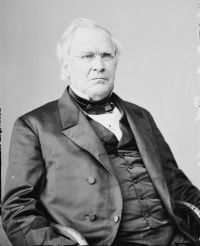 Robert Cooper Grier,
Rundle v. Delaware — Opinion of the Court
Robert Cooper Grier,
Rundle v. Delaware — Opinion of the Court
“ The canals in both States, supplied by the river, are intimately and extensively connected with their trade, revenues, and general property-while the navigation of the river above tide water, and the rapids at Trenton, is of comparatively trifling importance, being used only at times of the spring freshets, for floating timber down the stream, when the artificial diversions do not affect the navigation. ”
Lardner Gibbon, Lieutenant, U.S.N., Exploration of the Valley of the Amazon… (1854)
“ As the upper country wears away, and the heavy load of earth is carried down towards the mouth of the river, the head of the stream is deepening, and being constantly cut down towards a level with the bottom, which is filling up at its mouth. This will be best explained by the sounding-line, cast from a vessel entering the mouth of a river, The pilot is taken on board to carry the ship safely over the bar, or that bank of earth which has been carried down from the head of the streams and deposited at the river’s mouth. ”
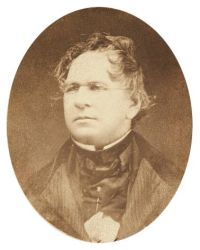 Henry Rowe Schoolcraft,
The Indian in his Wigwam; Or, Characteristics of the Red Race of America
Henry Rowe Schoolcraft,
The Indian in his Wigwam; Or, Characteristics of the Red Race of America
“ The rate of increase which doubles our population in a given number of years must also increase the lake tonnage, and add new motives for the improvement of its navigation.Besides the St. Clair delta, I know of no other impediment in the channel itself, throughout the great line of straits between Buffalo and Chicago, which prudence and good seamanship, and well found vessels, may not ordinarily surmount. The rapids at Black Rock, once so formidable, have long been obviated by the canal dam. The straits of Detroit have been well surveyed, and afford a deep, navigable channel at all times. ”
E. S. Bellasis, River and Canal Engineering, the characteristics of open flowing streams…
“ The Hydraulics of Open Streams.—When any reach of a stream is altered, say by widening, narrowing, or deepening, so that the water-level is changed, there will also be a change in the water-level, a gradually diminishing change, for some distance upstream of the reach. Also in the lowest portion of the reach the change will gradually diminish and it will vanish at the extreme downstream end of the reach. In the next lowest reach there is no change. ”
E. S. Bellasis, River and Canal Engineering, the characteristics of open flowing streams…
“ While the width and depth of the stream will be fixed so as to be suitable for the navigation, the ratio of depth to velocity should be so arranged, if this is possible, as to minimise trouble connected with silting or scour (Chap. IV., Art. 6) . A remodelled channel is, in short, designed in exactly the same way as a new channel. The depth of water exercises the greatest effect on the discharge, and the gradient the least. The weak point in a scheme which includes weirs is the difficulty of dealing with floods. ”
Anonymous, The Arctic World (1876)
“ In the mid-stream the roar of the waters is frequently so great that the travellers cannot make their voices audible to one another. There is the swirl of the torrent, the seething of the spray, the crunching of the floating ice, the roll of stones and boulders against the bottom,—and all these sounds combine in one confused chaotic din. Up to this point, a diagonal line, rather down stream, is cautiously followed; but when the middle is reached, the horses’ heads are turned slightly towards the current, and after much effort and many risks the opposite bank is reached in safety. ”
E. S. Bellasis, River and Canal Engineering, the characteristics of open flowing streams…
“ A succession of gentle bends, of any considerable angle, cannot of course occur within a moderate length of channel.When there is head to spare there is clearly no objection to bends, except that the bank may need protection. At a place where the bank has in any case to be protected, e.g. at a weir, there is no objection to an elbow.9. General Tendencies of Streams.—Since the velocity is greater as the area of the cross-section is less, a stream always tends to scour where narrow or shallow, and to silt where wide or deep. The cross-section thus tends to become uniform in size. ”
Stanley Forman Reed,
United States v. Appalachian Electric Power Company…
“ Where the stream 'has never been impressed with the character of navigability by past use in commerce, * * * commerce actually in esse or at least in posse is essential to navigability' and 'a theoretical or potential navigability or one that is temporary, precarious and unprofitable is not sufficient.' The most important criterion by which to ascertain the navigability of a stream is that navigability in fact must exist under 'natural and ordinary conditions'. ”
E. S. Bellasis, River and Canal Engineering, the characteristics of open flowing streams…
“ The advancing end of a flood wave may, while the 152 wave is rising and being formed, travel rapidly, but when the wave has been formed it travels at the ordinary rate of flow of the risen stream. The advancing end of a trough may, while it is being formed, travel rapidly, but after formation it travels at the ordinary rate of the fallen stream (Hydraulics, Chap. IX., Arts. 3 and 4) . Thus the rate at which a change in water-level travels down a stream depends at first on the amount of the rise or fall, but afterwards on the water-level of the risen or fallen stream. ”
 Carl Ritter,
Comparative geography
(1865)
Carl Ritter,
Comparative geography
(1865)
“ The stream is a unit; most streams have a single channel as the last goal of their descent. Others may have double channels, which contend with each other for the superiority. If they are double only for a part of the whole length of the river, and in the upper or middle course flow together, and form one main channel, they can be called twin head-streams. We have an example in the Danube and Inn, which are equally long and equally large. Other instances are the Rhone and the Saone, the Volga and Kama, the Missouri and Mississippi, the Blue and White Nile, the Ganga and Jumna. ”
John Newman, Earthwork Slips and Subsidences upon Public Works
“ It is essential to know the heaviest flood discharge of any river that may flow into an estuary, the greatest depth and velocity of the river, the normal and flood channels, their sectional area and direction, and the extent and shape of the catchment area, so as to establish the required opening to give the natural waterway; for it is important not to interfere with the tidal capacity of an estuary or the volume or flow of any upland waters into the sea, as a navigable 172channel may become filled with silt, especially when the shore is flat or sandbanks exist ”
 E. Keble Chatterton,
The Old East Indiamen
E. Keble Chatterton,
The Old East Indiamen
“ In order to lighten her forward, the bower anchors were made fast between boats, and the stream anchor was taken out in the launch ready for the next flood, and with the last quarter of that tide she came off; the hawsers were slipped, and while the anchors were being recovered Captain Grant backed and filled across the channel and finally came to anchor again. ”
 George Manville Fenn,
The Khedive's Country
George Manville Fenn,
The Khedive's Country
“ Branches of the Nile and the canals which in the maps cover the Delta with such a network of blue lines are also of great value, but the number of canals which are perennially navigable is limited, and the canal barge is nowhere renowned for speed, while sailing boats cannot use certain canals at all in the dry season, and their use of others is often attended by the risk of grounding. ”
Related terms
Authors who wrote about “navigable stream”
E. S. BellasisThomas C. ChamberlinVariousLeveson Francis Vernon-Harcourt John MuirStanley Forman ReedThomas RaineyJohn CatronPercy GregIntercolonial RailwayA. HamiltonRobert Cooper GrierLardner Gibbon, Lieutenant, U.S.N.Samuel Freeman MillerAnonymousCarl RitterJohn NewmanE. Keble ChattertonGeorge Manville FennJ. Stephen Jeans
Thomas C. ChamberlinVariousLeveson Francis Vernon-HarcourtJohn MuirStanley Forman ReedThomas RaineyJohn CatronPercy GregIntercolonial RailwayA. HamiltonRobert Cooper GrierLardner Gibbon, Lieutenant, U.S.N.Samuel Freeman MillerAnonymousCarl RitterJohn NewmanE. Keble ChattertonGeorge Manville FennJ. Stephen Jeans