Nihilism

Definition and stakes

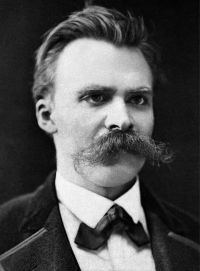
Portrait of Friedrich Nietzsche Friedrich Nietzsche,  The Will to Power

“ On the other hand, the present writer has done little else, hitherto, than reflect and meditate, like an instinctive philosopher and anchorite, who found his advantage in isolation in remaining outside, in patience, procrastination, and lagging behind; like a weighing and testing spirit who has already lost his way in every labyrinth of the future; like a prophetic bird-spirit that looks backwards when it would announce what is to come; like the first perfect European nihilist, who, however, has already outlived nihilism in his own soul who has out grown, overcome, and dismissed it. ”
Source: Wikisource

Portrait of Willard Huntington Wright Willard Huntington Wright,  What Nietzsche Taught

“ It is always man's exaggerated ingenuousness to regard himself as the sense and measure of all things. 15
Every purely moral valuation (as, for instance, the Buddhistic) terminates in Nihilism: Europe must expect the same thing! It is supposed that one can get along with a morality bereft of a religious background; but in this direction the road to Nihilism is opened. 19
Nihilism is not only a meditating over the "in vain"—not only the belief that everything deserves to perish; but one actually puts one's shoulder to the plough; one destroys.
”
Source: Gutenberg

Portrait of Friedrich Wilhelm Nietzsche Friedrich Wilhelm Nietzsche,  The Will to Power: An Attempted Transvaluation of All Values…

“ People have not yet seen what is so terribly-obvious—namely, that Pessimism is not a problem but a symptom,—that the term ought to be replaced by "Nihilism,"—that the question, "to be or not to be," is itself an illness, a sign of degeneracy, an idiosyncrasy.
The Nihilistic movement is only an expression of physiological decadence.
”
Source: Gutenberg

Get perspective with Kwize: daily news enlightened by great literature