Summary

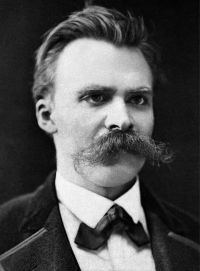
Portrait of Friedrich Wilhelm Nietzsche Friedrich Wilhelm Nietzsche The Birth of Tragedy; or, Hellenism and Pessimism

It is an eternal phenomenon: the avidious will can always, by means of an illusion spread over things, detain its creatures in life and compel them to live on. One is chained by the Socratic love of knowledge and the vain hope of being able thereby to heal the eternal wound of existence; another is ensnared by art's seductive veil of beauty fluttering before his eyes; still another by the metaphysical comfort that eternal life flows on indestructibly beneath the whirl of phenomena: to say nothing of the more ordinary and almost more powerful illusions which the will has always at hand.
Source: Gutenberg

Portrait of Friedrich Wilhelm Nietzsche Friedrich Wilhelm Nietzsche The Birth of Tragedy; or, Hellenism and Pessimism

Tragedy sets a sublime symbol, namely the myth between the universal authority of its music and the receptive Dionysian hearer, and produces in him the illusion that music is only the most effective means for the animation of the plastic world of myth. Relying upon this noble illusion, she can now move her limbs for the dithyrambic dance, and abandon herself unhesitatingly to an orgiastic feeling of freedom, in which she could not venture to indulge as music itself, without this illusion. The myth protects us from the music, while, on the other hand, it alone gives the highest freedom thereto.
Source: Gutenberg

Portrait of Friedrich Wilhelm Nietzsche Friedrich Wilhelm Nietzsche The Birth of Tragedy; or, Hellenism and Pessimism

Can the deep hatred of the present, of "reality" and "modern ideas" be pushed farther than has been done in your artist-metaphysics?—which would rather believe in Nothing, or in the devil, than in the "Now"? Does not a radical bass of wrath and annihilative pleasure growl on beneath all your contrapuntal vocal art and aural seduction, a mad determination to oppose all that "now" is, a will which is not so very far removed from practical nihilism and which seems to say: "rather let nothing be true, than that you should be in the right, than that your truth should prevail!"
Source: Gutenberg

Get perspective with Kwize: daily news enlightened by great literature