Octroi

Definition and stakes

Frank E. Beddard,  The Cambridge natural history, Vol… (1901)

“ Each ocellus consists of a capsule placed at right angles to the surface of the body in the parenchyma, below the dorsal muscles, and with its convex face outwards. It is a single cell in which pigment granules have accumulated. The light, however, can only reach the refractive rods, which lie within it, obliquely at their outer ends. These rods are in connexion with the retinal cells, and thus communicate by the optic nerve with the brain. The cerebral eyes are really paired, and are directed some upwards, some sideways, some downwards. ”
Source: Gutenberg

A system of practical medicine… (1886)

“ Each division governs the vascular tone of its own side of the body,14 and lesions in its region in man produce unilateral vaso-motor symptoms.15 This centre can be excited to reflex action by strong irritation locally or through the blood, in which case a general constriction or dilatation of the vessels of the entire body will ensue. It seems probable, however, that the general centre in the medulla is made up of a number of special centres, each of which governs a definite set of organs. ”
Source: Gutenberg

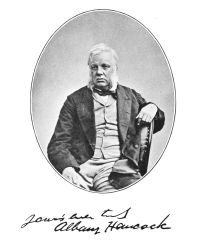
Portrait of Albany Hancock Albany Hancock,  Natural History Review: a quarterly journal of biological science

“ The heart, in some of the Loliginidæ, lies within the genital chamber, but is not enclosed in a special receptacle. The membrane, forming the wall of the chamber, is apparently reflected over it, though it is so completely incorporated with the surface of the organ as not to be demonstrable. In the Octopodidæ the heart lies in the cellular tissue, between the renal and genital chambers, and is more or less enveloped by the wall of the former : but here, as in the other group, there is no pericardial sac.
The heart itself is strong and muscular, and the fibres are of the striated kind.
”
Source: Wikisource

Get perspective with Kwize: daily news enlightened by great literature