Pottery wheel

Definition and stakes

Mary White,  How to make pottery

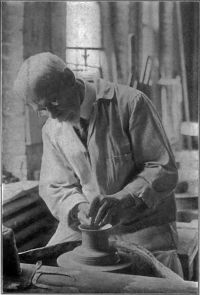
“ The rapidity with which pieces can be formed on the wheel is an advantage over other processes, while the regularity of shape, refinement and perfection of finish give wheel-made pottery a beauty all its own. Until lately, few women potters have worked on the wheel, because the ordinary form of potter’s wheel, which was turned with one foot, the potter standing on the other, made the work too difficult and laborious for a woman to attempt. ”

Source: Gutenberg

William Burton, Harry R. H. Hall, Albert van de Put, Henry B. Walters, Robert L. Hobson and Bernard Rackham,  1911 Encyclopædia Britannica (1911)

“ No further advance seems to have been made before the 17th century, when the wheel was spun by means of a cord working over a pulley; and though a steam-driven wheel was introduced in the middle of the 19th century, this form remains the best for the production of fine pottery.
A prevalent misconception with regard to the potter’s wheel needs correction. For anything beyond very simple shapes it is impossible to carry the work to completion on the wheel at one operation as is generally imagined.
”
Source: Wikisource

Bernard Capes,  The mill of silence (1896)

“ For, firmly set in a hole dug in the brick side of the chasm at a point so chosen within the sweep of the wheel that no spoke traversed it when it lay motionless, and at arm’s reach only from one standing on the paddle, was a vessel of ancient pottery about a foot in height, and so smeared and dank with slime as that a careless grasp on its rim might have sent the whole treasure clattering and raining through the wheel into the water below. ”
Source: Gutenberg

Get perspective with Kwize: daily news enlightened by great literature