“ Wire shrouds set up too taut put an enormous strain on the sides of a boat, and will in course of time pull them quite out of shape. The mast should not be so rigidly stayed down that it has no play; on the contrary, when sail is set, a mast should be allowed to bend and so take upon itself a considerable proportion of the strain before any is thrown upon the weather shrouds.The shroud lanyards are of rope, but are not long enough to give sufficient play by stretching ”
Shroud (sailing)
Definition and stakes
The theme of “shroud (sailing)” has been addressed by authors such as G. L. Blake, Howard Irving Chapelle, Basil Lubbock, W. H. Smyth and Douglas Frazar. It is often associated with terms like sail, ship, mast, boat and yacht.
Quotes about “shroud (sailing)”
“ Across and across the Broad skim the white sails of boats and canoes making the most of the dying breeze, and the wavelets sink to ripples, and the ripples are shot with streaks and patches of cloud-reflecting calm. We leave this, the most beautiful and deepest of the Broads, to make the most of the evening air down the river.On the occasion of the annual regatta there is a prodigious water frolic at Wroxham, which is attended by perhaps a hundred sailing craft of all kinds, and much merriment results. ”
 Joshua Slocum,
Sailing Alone Around the World
“ The "bones" of a wreck tossed up lay bleaching on the shore abreast. The wind still freshening, I settled the throat of the mainsail to ease the sloop's helm, for I could hardly hold her before it with the whole mainsail set. A schooner ahead of me lowered all sail and ran into port under bare poles, the wind being fair. As the Spray brushed by the stranger, I saw that some of his sails were gone, and much broken canvas hung in his rigging, from the effects of a squall. ”
T. Jenkins Hains, The Chief Mate's Yarns: Twelve Tales of the Sea
“ As yet we were outside the Stream, and consequently not in the usual line of the coasters, which are the dread of the liner's officers, for nothing is so uncomfortable as the sudden raising of the dim and sometimes half-extinguished lights of a schooner on a thick night while tearing along before a gale. Having the right of way, the sailing vessel has nothing to do but keep her course, while the steamship, with but a few seconds to spare, swings quickly to pass, sometimes missing a catastrophe by a few feet. A poor red light on such a night cannot be seen twenty fathoms. ”
Kennedy Holbrook, How? or, Spare Hours Made Profitable for Boys and Girls
“ Other smaller spars which enter into the equipment of racing craft, will be mentioned in speaking of the sails.The standing rigging is now to be considered; this consists of stays and shrouds. “Shrouds” are ropes which lead from near the head of the mast to either side of the vessel, where they are fastened into the chain-plates. These are strong iron bands firmly bolted to the timbers. The shrouds of the model yacht, however, can be attached to copper tacks driven into the sides. They—the shrouds—are tied around the mast just below the point where the lower end of the topmast ends. ”
 Henry Billings Brown,
The Chattahoochee — Opinion of the Court
“ Whether the Golden Rule was also liable for excessive speed is a question of more difficulty. She was a topsail schooner, rigged with twelve sails, all of which she was carrying, except one-half her double square sail on the foremast, which had been taken in. She was sailing on her port tack, with the wind well abaft the beam, through a fog, which did not admit of the hull of a vessel being seen more than a few hundred feet distant. It appears to have been a surface fog, as the crew of the schooner are confident they saw the masts of the steamer some 2,000 feet away. ”
 R. M. Ballantyne,
Man on the Ocean: A Book about Boats and Ships
“ The shrouds rise from the chains, which are a series of blocks called “dead eyes,” fixed to the sides of the ship. To these the shrouds are fixed, and also to the masts near the tops; they serve the purpose of preventing the masts from falling sideways. Backstays prevent them from falling forward, and forestays prevent them from falling backward, or “aft.” Besides this, shrouds have little cross ropes called ratlines attached to them, by means of which rope-ladders the sailors ascend and descend the rigging to furl, that is, tie up, or unfurl, that is, to untie or shake out, the sails. ”
Douglas Frazar, Practical Boat-Sailing: A Concise and Simple Treatise
“ Of course, in yachts over thirty to forty feet in length, with crews, every thing can be made fast: but we are now writing of smaller craft, and it is repeated, in squally and dirty weather never make fast the main-sheet; it is the key to the whole science of boat-sailing, and should never be out of one's hand in time of emergency. It can, after taking one turn, be wound around the tiller, and brought to the same hand as the one that is moving the helm, and yet be instantly cast off, if necessary. ”
 Katherine Routledge,
The mystery of Easter island: the story of an expedition
(1919)
“ On first going on board a big liner after being accustomed to Mana, it felt an alarmingly dangerous means of transit.Existence on any ship has drawbacks in bad weather or extreme heat, but on the yacht the arrangement by which the saloon and cabins were connected with the deck-house made the circulation of air particularly good. A sailing ship is also without the universal and unpleasant draughts which are omnipresent in a steamer. ”
Various, Golden Days for Boys and Girls…
“ To take the pull off the tops, the shrouds are continued round to the mast as "futtock" shrouds, on the same principle as the foretopmast-stay finds its continuation in the bobstay.The shrouds are "rattled down;" that is to say, thin lines are fastened across them to make a ladder for the men to go aloft. These lines are the "rattle-lines" or "ratlines." The foremost shroud of the lower rigging has only a "catch ratline;" that is, one ratline in about six continued to the shroud that lies furthest forward. ”
Douglas Frazar, Practical Boat-Sailing: A Concise and Simple Treatise
“ There are times when the sea is too high, and the sail so much reduced that a yacht will not go about by turning towards the wind, but must be gotten on the other tack by wearing, as it is technically called in ships, where the yards are square, and jibing, as it is called in crafts that carry fore-and-aft sails, i.e., sails that hoist up on a mast, and are stretched upon booms, in contradistinction to those that are fastened to yards that cross the mast at right angles, as in a ship often called by sailors, for this reason, a "square-rigger." ”
Joshua Slocum,
Sailing Alone Around the World
(1900)
“ Their craft, with too much sail on, broached to on the crest of a great wave. This one great sea changed the aspect of affairs suddenly as the flash of a gun. Three minutes later the same wave overtook the Spray and shook her in every timber. At the same moment the sheet-strop parted, and away went the main-boom, broken short at the rigging. Impulsively I sprang to the jib-halyards and down-haul, and instantly downed the jib. The head-sail being off, and the helm put hard down, the sloop came in the wind with a bound. ”
Douglas Frazar, Practical Boat-Sailing: A Concise and Simple Treatise
“ As a rule, sailing-boats and small yachts are "trimmed by the stern;" that is, the bow is slightly elevated from the water, the boat being pressed, by the position of its ballast, deeper into the water at the stern than at the bow. But every yacht is a law to itself; and no rule will do for all. The position of the ballast has also much to do with the steering qualities, as well as affecting speed: if it be placed too far forward, the yacht will "yaw," and at times, before the wind, be almost unmanageable. ”
Basil Lubbock, The Colonial Clippers
“ A glance at the perfect lines of the ship in dry dock would be quite sufficient to show there was nothing to stop her going through the water, and I can honestly say that during my 11 years I never saw any other sailing ship pass her in a breeze either on a wind or before it. The fact of the Sobraon being first intended for an auxiliary steamer and having the two stern posts, the space between which was filled up with solid timber, gave her a perfect run, and her bows were as fine as any yacht’s. Runs of over 300 knots when running down the easting were frequent. ”
Douglas Frazar, Practical Boat-Sailing: A Concise and Simple Treatise
“ A yacht is said to be close-hauled, or sailing "full and by" when she is brought as near to the wind as is possible, so as to advance through the water; for it is to be presumed that it is understood, that if the main-boom were brought so as to pass directly over the line of the keel of the yacht, and the head of the yacht brought as near the wind as possible, and the sail to remain full, and not shake, she would not advance, but would simply be pushed to leeward by the wind. ”
Howard Irving Chapelle, The Migrations of an American Boat Type
“ Windage of the topside structures necessary on sharpie yachts also affected speed, particularly in sailing to windward. Hence, there was an immediate trend toward the addition of deadrise in the bottom of the yachts, a feature that sufficiently increased displacement and draft so that the superstructure and rig could be better carried. Because of its large cabin, the sharpie yacht when under sail was generally less workable than the fishing sharpie. ”
 William Clark Russell,
The Wreck of the Grosvenor, Volume 1 of 3
“ The men were at work getting in the fore-topmast stun'-sail, and some were aloft rigging in the boom. There was no air to be felt save the draughts wafted along the deck by the flapping canvas. Even where I stood I could hear the jar and shock of the rudder struck by the swell, and the grinding of the tiller-chains as the wheel kicked. The sky was thick with half a dozen spars sparely glimmering upon it here and there. The sea was black and oily, flashing fitfully with spaces of phosphorescent light which gleamed below the surface. ”
Ralph Stock, The Cruise of the Dream Ship
“ A winch is better than a capstan for heaving anchor, and if placed abaft the mast, serves also for "swigging" on halyards, or hoisting sail.As for sails, the dream ship's were all "barked" or tanned after the fisherman style, and there is no doubt that this process prevents rot, especially in the humid tropics. We carried one medium-weight mainsail, a working and a balloon foresail, storm and balloon jibs, and a squaresail, and of these the last was the most generally useful. Again I hear the howlers howling: "Why not a spinnaker?" ”
Douglas Frazar, Practical Boat-Sailing: A Concise and Simple Treatise
“ When on top of a sea, and all the sails full, the yacht will go fast: when she attempts to bury her head, and kick up her heels, and becalms the jib and lower part of the mainsail, she will go slower. There is one thing to be guarded against in running before the wind, and that is the "jibing" of the main-boom; that is to say, the wind getting on the forward part of the sail, from any cause,—whether by change of wind, or on account of bad steering,—and carrying it violently over to the other side, endangering the yacht, and with a liability, in heavy weather, of carrying away the mast. ”
 William Falconer,
The shipwreck
(1818)
“ Shrouds, so called from the Saxon scrud, consist of a range of thick ropes stretching downwards from the mast heads, to the right and left sides of a ship, in order to support the masts, and enable them to carry sail; they are also used as rope ladders, by which seamen ascend or [159] descend to execute whatever is wanting to be done about the sails and rigging. Reef-band, consists of a piece of canvass sewed across the sail, to strengthen it in the place where the eyelet-holes of the reefs are formed. The outer turns of the earing serve to extend the sail along its yard ”
Douglas Frazar, Practical Boat-Sailing: A Concise and Simple Treatise
“ When the two winds meet, and one finds one's self in the vortex between them, it is very difficult to command a boat. Each wind, fighting for the supremacy, will fill the sails with gusts, for which one does not more than have time to prepare before [105] a counter-gust will throw them aback, or violently to the opposite side of the boat. Often, in fact, the wind, blowing a gale all the time, will in less than five minutes have visited every point of the compass. An anchor down and a furled sail are the best for all small, open, or half-decked boats or yachts in such an emergency. ”
Douglas Frazar, Practical Boat-Sailing: A Concise and Simple Treatise
“ One's natural pride, and the desire to sail fast, prevent often the taking on board of the necessary amount; and then, when it suddenly comes on to blow, the yacht is found to be crank, perhaps dangerously so. How much better would it be to have a little too much ballast, which, when homeward bound,—if there is need of haste, and the weather be settled,—can be discharged over the side, increasing her speed! ”
Douglas Frazar, Practical Boat-Sailing: A Concise and Simple Treatise
“ This slacking of the sheet also prevents the boat from going about on the other tack, should she be brought too suddenly to the wind.With an experienced hand at the helm, unless the squall is very severe, there is no need of luffing so as to shake the sail to any great degree. The slightest movement of the tiller will keep the sail just quivering in the wind, the boat still advancing, so that she will not lose steerage-way; thus enabling one to at once luff up nearer to the wind, or change the boat's position rapidly, should the wind, which is often the case, shift its direction suddenly. ”
“ The lake was subject to sudden and violent squalls, and it was very convenient to be able to let go the peak halyards without leaving the tiller, and have them up again in a moment as soon as the squall had passed, without disturbing the passengers in the least. Had the sail been the uncompromising balance lug, the whole sail would have had to be lowered in a body on to the heads of the passengers.A topping lift, always belayed so as to feel the weight of the boom, is indispensable in a cat boat, else the end of the boom would drop into the water when the peak was lowered. ”
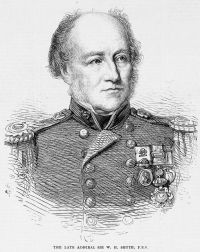 W. H. Smyth,
The Sailor's Word-Book
“ Either clincher or carvel-built, no jib-stay, the jib hoisting and hanging by the halliards alone. She carries a fore-and-aft main-sail, gaff-topsail, stay-foresail, and jib. The name is derived from their fast sailing. The cutter (as H.M.S. Dwarf) has been made to set every sail, even royal studding-sails, sky-scrapers, moon-rakers, star-gazers, water and below-water sails, that could be set by any vessel on one mast. One of the largest which has answered effectually, was the Viper, of 460 tons and 28 guns ”
“ It is in this manner that most boats are upset in a surf, especially on flat coasts, and in this way many lives are annually lost. Hence it follows that the management of a boat, when landing through a heavy surf, must, as far as possible, be assimilated to that when proceeding to seaward against one, at least so far as to stop her progress shoreward at the moment of being overtaken by a heavy sea, and then enabling it to pass her. ”
 Arnold Bennett,
From the Log of the Velsa
“ Hardly can one distinguish between a starboard and a port broom. Is the life of a yacht to depend on such negligent devices? The skipper is worried. And the spectacle of a ship aground in mid-sea does not tranquilize. Sometimes the hail wipes out for a few seconds the whole prospect. The eyes of everybody are strained with looking for distant brooms. Then we are free of the archipelago, and also the sky clears. The sun, turning orange, is behind us, and the wind in our teeth. Ahead is a schooner, beating. And she is the schooner of the morning. Our engine now has the better of her. ”
William Clark Russell,
The Death Ship: A Strange Story…
“ But by this time the sail upon our lee-quarter had greatly grown, and the vigorous red radiance, rained by the sinking luminary in such searching storms of light as crimsoned the very nethermost east to the black water-line, clearly showed her to be a small but stout schooner, hugging the wind under a prodigious pile of canvas, and eating her way into the steady breeze with the ease and speed of a frigate-bird that slopes its black pinions for the windward flight. ”
Douglas Frazar, Practical Boat-Sailing: A Concise and Simple Treatise
“ Heaving the lead is done usually by a person who is placed in the main-chains for that purpose, on the weather-side, or, in smaller craft, on deck, forward, just clear of the shrouds. It is thrown whilst the yacht is under way, and being kept on her course, and the results announced in a singing voice by the one casting; and, when the water becomes too shoal, the yacht is put about, and stands off from the danger which she was approaching. The one casting the lead takes hold of the line at about a fathom from it, and swings it to and fro till enough velocity is gained to swing it over his head ”