“ The silk weavers of Asia had, of old, found out the way so to gear their looms, and dress their silk, or their threads of gold, that with a warp and woof, both precisely of the same tone of colour they could give to the web an elegant design, each part of which being managed in the weaving, as either to hide or to catch the light and shine, looked to be separated from or stand well up above the seeming dusky ground below it: at times the design was dulled, and the ground made glossy. ”
Silk weaving
Definition and stakes
The theme of “silk weaving” has been addressed by authors such as Daniel Rock, Frank Warner, Richard Snow and Arthur Mellor, Sara Ware Bassett, William H. Dooley and Clinton G. Gilroy. It is often associated with terms like fabric, cotton, thread, textile and wool.
Quotes about “silk weaving”
Various, Birds and All Nature, Vol. 4, No…
“ In plain silk-weaving the process is much the same as in weaving wool or linen, but the weaver is assisted by a machine for the even distribution of the warp, which frequently consists of eight thousand separate threads in a breadth of twenty inches. ”
William H. Dooley, Textiles, for Commercial, Industrial…
“ Generally speaking there are two large classes into which silk goods may be divided, those in which the threads are colored before weaving and called yarn-dyed goods, and those dyed or printed after weaving and called piece-dyed or printed goods. In dyeing yarns, the silk is first ungummed and cleaned by boiling in soap and water, then washed in cold water. If the thread is to be weighted, as is frequently done, tin salts, iron, or other heavy material is deposited on the fiber. If carried far, this is injurious, making the silk tender and weak. Sometimes there is more weighting than silk. ”
Sara Ware Bassett, The Story of Silk
“ First the silk reeled from the cocoons must be wound; then cleaned of all gum; picked—which means that the uneven lumps must be removed; doubled, to make the thread stronger; twisted, to make it still firmer; rewound; and finally reeled all over again into silken yarn. Then it is ready to be put into any form desired, in accordance with orders received from the weaving companies. Sometimes it is made into what we call singles, one thread being given a twist to make it stronger. ”
Popular Science Monthly (1880)
“ If we depended for this upon European mills, the color desired would be out of fashion before the thread arrived. As to the weaving of silk, it is said that we are obliged to import the very best raw silk, owing to the high price of labor here—poor silk requiring great cost in labor. "It costs five times as much to tic a knot here as in France." In the best silk, the thread is not lumpy; but, in weaving the lumpy thread of poor silk, the weaver is constantly busy picking off the imperfections. ”
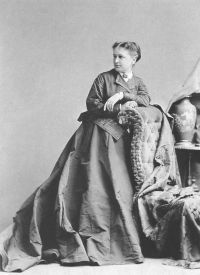 Candace Wheeler,
How to make rugs
“ This is quite a different thing from a silk portiere made from some beautiful old silk garment, which is too much worn for further use, where warp and woof colour are selected for fitness and harmony, and the weaver uses her rags, as the painter does his colours, with a purpose of artistic effect. If the work is done from that point of view, the last state of the once beautiful old garment may truly be said to be better than the first. If a light cloth is used for this kind of manufacture, it may be torn into strips so narrow as to simulate yarn—and make what appears to be yarn weaving. ”
Helen Campbell, Women Wage-Earners: Their Past…
“ Carded woollen yarn was the same per skein. Weaving plain flannel or tow or linen brought fivepence per yard; common worsted and linen, one penny a yard; and other linens in like proportion. [11] Silk growing and weaving had been the result of the silkworm cocoons sent over by James the First, who offered bounties of money and tobacco for spun and woven silk according to weight. Three women were famous before the Revolution as silk growers and weavers,—Mrs. Pinckney, Grace Fisher, and Susanna Wright ”
Various, The Mirror of Literature, Amusement…
“ The principal branches of this manufacture consist in the dyeing, winding, warping, throwing, and weaving. The first needs no explanation; the winding is the process between the throwing and the weaving. After the silk is thrown it is dyed, and then wound off preparatory to the loom. The warping is stretching the parallel threads on the loom, preparatory to weaving. Throwing silk, is twisting two threads into one for the purpose of weaving. The single thread, as wound off from the cocoon, is designated the raw silk. ”
Edwin Creer, Board-Work; or the Art of Wig-making…
“ From the above it will be seen that the hair to be woven is placed in the brushes which lie upon the table; the roots allowed to project a little, and convenient to the workman’s hand. The three “strings” as they are sometimes called, are in reality silk, one skein of weaving-silk being wound round each groove of the weaving-peg. The silk can be had either fine, medium, or coarse, according to the taste or requirement of the user. ”
Viscountess Marianne Margaret Compton Cust Alford, Needlework As Art
“ From the first to the sixth centuries, poets and historians continually speak of silk, [249] praising its beauty or blaming it as extravagance or luxury; but according to Yates, all the information we collect from these sources requires to be tested as to accuracy, and is often erroneous.I have spoken of the first silk-weaving in Cos, 300 B.C. The first arrival of the silkworm in Europe was in the sixth century, 900 years later. Cosmas Indicopleustes and another monk brought eggs from China in the hollow staves they carried in their hands. ”
James Ward, Historic Ornament, Vol. 2 (of 2…
“ In France the silk weaving industry was first established at Lyons about the middle of the sixteenth century. The designs of the first efforts of the French weavers were very 316similar if not copies of the prevailing Italian school, but soon after became more floral in character, and more and more realistic renderings of flowers and foliage, until about the eighteenth century, when they partook of the same character as the pottery and furniture decoration, which has been already described. ”
Edwin Creer, Board-Work; or the Art of Wig-making…
“ These fronts can be made very light, and seeing that there is no net and but little galloon, ventilation does not suffer impediment. Proceed as follows:—Set up the weaving frame as shown in Fig. 21, but instead of nine silks there are now to be twelve. Tie them in threes as before, and intertwine a piece of straight, twelve-inch hair according to the following directions:—Hold the root end, pointing downwards, firmly between the thumb and finger of the left hand, and also the lower silk. Push the long hair through, pass two silks, and bring the hair to the front again. ”
“ As trade grew up, she brought these fine silken textiles to our markets, and articles of dress were made of silk for men’s as well as women’s wear among the wealthy. At what period the raw material came to be imported here, not so much for embroidery as to be wrought in the loom, we do not exactly know; but from several sides we learn that our countrywomen of all degrees busied themselves in weaving. ”
Sara Ware Bassett, The Story of Silk
“ The problems of weaving are not in my line. Here in Pont-de-Saint-Michel almost every one is employed in the Gaspard filature, or in the throwing mills; and if not, the people raise silkworms. Since the men have been called to the colors practically all the work of this big manufacturing plant is being done by women, boys, and children. The few men we have who are operating the heavier machines have either been sent home from the front because they were wounded or else they are not strong enough to fight. So you see, silk is the language of the whole village. ”
Arnold Wolfensberger, Theory of Silk Weaving
“ It is mostly used in selvedges, where it serves to give more firmness to the edge of an otherwise loosely woven cloth, and prevents the weaving ahead of the edge in a tight weave. Gros de Tours is sometimes used, especially when cotton or wool filling is employed, with a view to lay two picks nicely side by side, whereas a thread entered two ply with the taffeta weave will always receive some twist, which may disturb the perfect evenness of the fabric.Fig. 18 is a Gros de Tours with two picks on four harness straight through. ”
Viscountess Marianne Margaret Compton Cust Alford, Needlework As Art
“ For example, the early French silks from monastic establishments are not remarkable for either style or texture till the sixteenth century, when they came to the front as a national manufacture, and have held the highest place in silk-weaving ever since. ”
Arnold Wolfensberger, Theory of Silk Weaving
“ Most goods gain from 3 to 7 per cent. in weaving. That is, if we make a warp of 300 meters for a satin and we obtain 315 yards of cloth, this gain should not be calculated, as usually there is no account taken of samples used in the selling department. But the loss in length should be figured and taken account of on goods with a heavy rib, such as moiré, faille, etc.DISP. 7—A 3 1/3-inch repeat can be obtained with a 600-hook jacquard machine, seven repeats in a width of 23 inches.DISP. 8—Taffeta weave, but the two cotton picks must go in one hole. ”
William H. Dooley, Textiles, for Commercial, Industrial…
“ Floss silk is not used for weaving. It is a slack twisted tram, generally composed of a large number of threads of singles.Spun Silk. There is another class of threads made from waste silk by spinning and known as spun silk. Waste silks include the pierced cocoons, that is, those from which the moth has come out by making the hole and breaking the fibers in one end of the cocoon; the waste made in the filatures in producing raw or reeled silk, chiefly the outside fiber of the cocoon and the inside next the chrysalis; and also the waste made in manufacture. The waste silk is ungummed ”
Frederick Ricketts Hemingway, Gódávari (1915)
“ Agricultural methods have been referred to in Chapter IV above, and the breeds of cattle and sheep in Chapter I. Of the arts and industries, weaving employs a larger number of hands than any other. The weaving of silk is done on only the smallest scale. Silk borders are often given to cotton cloths, but the pure silk cloths worn in the district are imported. ”
Arnold Wolfensberger, Theory of Silk Weaving
“ That we are, on the other hand, not yet at the height of perfection we are also compelled to acknowledge, but if we consider the short space of time that the American industry has required for its development, as compared to the decades, almost centuries, to which some of the great European silk centers can look back, the fact is neither surprising nor discouraging. ”
Arnold Wolfensberger, Theory of Silk Weaving
“ The calculator first ascertains for the warp: What silk will be used, the cost of the same, total number of ends in the warps for the amount of silk, cost of throwing, dyeing, winding, warping, twisting, entering, and weaving.Then the filling: Silk to be used, how much, cost of silk, cost of throwing, dyeing, winding, doubling, quilling.After this determine the cost of weaving, cloth picking, finishing, factory costs, and selling expenses.To-day most of the operations are paid by "piece work." ”
Various, The Saturday Magazine, No. 65, July 6th…
“ The silk, when reeled off in this manner, is called singles, and is used in weaving to form the weft, that is, the thread that crosses the cloth from side to side. Another description of silk threads, are called trams, and these consist of two or three singles twisted together; but the strongest and most valuable sort is the organzine, which is formed by placing skeins of singles upon a reel, and as they are wound off, they are, by the assistance of machinery, strongly twisted. ”
Arnold Wolfensberger, Theory of Silk Weaving
“ The silk industry of America has of late years rapidly advanced to the front rank among the great textile industries of the world. It may indeed be proud of this position, to which that enterprising spirit and untiring energy peculiar to our nation, combined with our great technical and natural resources, has brought it. ”
“ Silk damask (Sicilian) with imitated Arabic letters. 47 The weaving of letters in textiles is neither a Moorish nor Saracenic invention; ages before, the ancient Parthians used to do so, as we learn from Pliny: “Parthi literas vestibus intexunt.” A curious illustration of the frequent use of silken stuffs bearing letters, borrowed from some real or supposed oriental alphabet, is the custom which many of the illuminators had of figuring on frontals and altar canopies, evidently intended to represent silk, meaningless words ”
Arnold Wolfensberger, Theory of Silk Weaving
“ In combining these weaves it is advantageous to have them contrast distinctly, for instance, a short weave such as taffeta or Gros de Tours, with a longer and looser one such as satin, sergé or cannele, also changes from warp to filling effects. Care must be taken to arrange the joining of the two weaves so that the last thread of one weave will cross the first thread of the other. This will prevent the threads from either stripe to slide over into the other, and so make a clean cut line.Pekin. A stripe ofFig. ”
Anna M. Cooley, Clothing and Health: An Elementary Textbook of Home Making
“ Remember wool is an expensive fiber. Do not expect to get all wool for little money.3. Remember the weave affects wearing quality. A close twill weave is often more durable than a basket weave.Do you remember your lessons about silk; how it is grown and made by the little worm, and how it is manufactured or spun into thread or woven into silk cloth? In buying silk one must remember about its manufacture.1. Silk is seldom pure. It is apt to be weighted. If the silk feels heavy in the hand, it does not always mean that it is a good piece of material and will wear ”
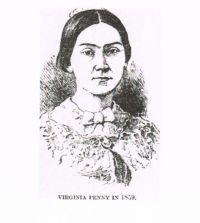 Virginia Penny,
The Employments of Women: A Cyclopædia of Woman's Work
“ Silk weavers mostly work in attics, where they can have the best light to distinguish shades of colors, and where the silk, which moisture would damage, can be kept perfectly dry. In Spitalfields, the silk manufacture is mostly carried on by the workmen at their homes, their families assisting. Each child has his own branch, and the wife hers. It is the same case in the making of lace, artificial flowers, embroidery, straw braiding, &c. The strength of silk is greater than that of cotton, flax, or wool. ”
M.A. William Davis, Hosiery Manufacture
“ If silk is employed for the entire fabric, much of it is lost by intersecting on the back, only a tithe of the material being visible on the face. There is no real advantage in having silk on the back of the texture, and fuller effectiveness and greater comfort and weight are attained by bringing a heavier material on to the back, preferably a woollen thread with the silk showing on the face only. The back woollen thread by its bulk gives greater proportional weight and at the same time pushes the silk yarn prominently on to the surface and enables it to exhibit its full lustre. ”
Members of the Arts and Crafts Exhibition Society, Arts and Crafts Essays (1893)
“ Or if silk were preferred, the silks of past centuries were at once thick, firm, soft and pure, quite free from the dress or artificial thickening, by whose aid a silk nowadays tries to look rich when it is not. The oatmeal cloth, diagonal cloth, cotton-backed satin, velveteen and plush, so much used now, are very inferior materials as grounds for needlework to the hand-loom linens and silks on which so large a part of the old embroidery remaining to us was worked. ”
Anna M. Cooley, Clothing and Health: An Elementary Textbook of Home Making
“ It is not fair to pay the price for an all-new wool material if shoddy and mungo and flocks, which are all old wool and waste, have been used. The per cent of new wool should be told and the price made accordingly. [281] Silk is sometimes sold as reeled silk when waste from cocoons which is called spun silk has been used for the woof or filling thread.In finishing of materials, adulteration is sometimes practiced. In pressing cotton or linen, a luster is given to the surface. Cotton can be made to appear like silk or like linen, and is often sold for those fibers. ”
William H. Dooley, Textiles, for Commercial, Industrial…
“ Throwing. The manufacture in the United States begins with raw silk. We import our raw silk chiefly from Italy, China, and Japan. It is handled here first by the “throwster,” who winds it from the skein and makes various kinds of thread for different purposes.Raw silk wound on spools in a single thread, and [Pg 207] called singles is often used to make warps (that is, the threads running lengthwise of a piece of cloth) for piece-dyed goods, or cloth which is woven with the gum in the silk, and afterward boiled out and dyed. ”
Related terms
Authors who wrote about “silk weaving”
Daniel RockFrank Warner, Richard Snow and Arthur MellorSara Ware BassettWilliam H. DooleyClinton G. GilroyArnold WolfensbergerCandace WheelerViscountess Marianne Margaret Compton Cust AlfordM.A. William DavisA. E. BlancoKate Heintz WatsonEdwin CreerAnna M. CooleyEffie Archer ArcherMembers of the Arts and Crafts Exhibition SocietyVanness Copeland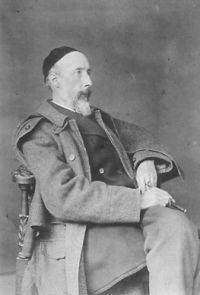 John Henry MiddletonVariousAnonymous
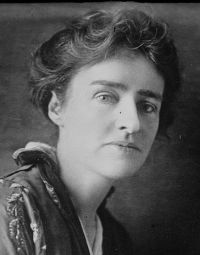 Jean Webster
Candace WheelerViscountess Marianne Margaret Compton Cust AlfordM.A. William DavisA. E. BlancoKate Heintz WatsonEdwin CreerAnna M. CooleyEffie Archer ArcherMembers of the Arts and Crafts Exhibition SocietyVanness CopelandJohn Henry MiddletonVariousAnonymousJean Webster