Knitting

Definition and stakes

Miss Lambert,  My Knitting Book

“ In most knitting, the edge-stitch is slipped.
It is easiest to learn to knit, by holding the wool over the fingers of the left hand; the position of the hands is more graceful when thus held.
It is always advisable to cast off loosely.
[108] When it is requisite to cast off, and continue the row on a separate needle, it is sometimes better to run a coarse silk through the cast off stitches; they are easily taken up, when required, and the inconvenience of the idle needle is avoided.
In knitting, when a pattern is spoken of, it means as many rows as form the pattern.
”
Source: Gutenberg

William H. Dooley,  Textiles, for Commercial, Industrial…

“ The principle of knitting is quite distinct from that of weaving. In the weaving of cloth the yarns of one system cross those of another system at right angles, thus producing a solid, firm texture. The great elasticity of any kind of texture produced by knitting is the chief feature that distinguishes hosiery from woven stuffs. The nature of the loop formed by the knitting needle [Pg 154] favors elongation and contraction without marring in the least the general structure of the goods. ”
Source: Gutenberg

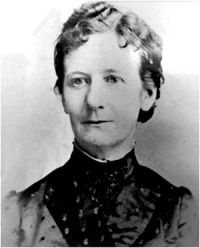
Portrait of Ann S. Stephens Ann S. Stephens,  The ladies' complete guide to crochet… (1854)

“ The transition from one needle to more, and the weaving of thread into forms of beauty, was a progress natural to the spirit of invention, and the facilities for thought which the first step in any art creates.
Probably the first progress which Knitting made toward a distinct art, was when yarn stockings were invented in Flanders. The stitch, as every New England housewife knows, is simple enough. But inventive genius has so adorned and varied it, that stockings are easily enriched with lace-work, and lace itself is abundantly manufactured by a little thread and a pair of knitting needles.
”
Source: Gutenberg

Get perspective with Kwize: daily news enlightened by great literature