“ My garden is a forest ledge Which older forests bound; The banks slope down to the blue lake-edge, Then plunge to depths profound. ”
Edge
Definition and stakes
The concept of "edge" primarily refers to the surface formed by the closed pages of a book, yet its significance goes beyond bibliographic contexts. Authors such as John Ruskin examined its visual acuity in shadows, while Elisabeth Luther Cary highlighted its functional role in bookbinding.
Nellie Bly conjured geographical boundaries in her vivid descriptions of landscapes, and O. Henry employed it metaphorically to frame human relationships. From physical limits to literary and artistic subtleties, the theme encompasses both concrete and abstract aspects, demonstrating how the "edge" functions as a transitional space where form and meaning converge.
Quotes about “edge”
 Nellie Bly,
Six Months in Mexico
Nellie Bly,
Six Months in Mexico
“ Then would I take you from the table-land to the mountain, where we descend into deep canons that compare in their strange beauty with any in the world; the queer separation of the earth, not more than 100 feet from edge to edge of precipice, but 400 feet deep. ”

“ The two in the edge of the grove turn back along the dim pathway, and walk close, close—for, after all, what is the world at its best but a little round field of the moving pictures with two walking together in it? ”
 John Ruskin,
Modern Painters, Volume 1 (of 5…
John Ruskin,
Modern Painters, Volume 1 (of 5…
“ For no outline of objects whatsoever is so sharp as the edge of a close shadow. Put your finger over a piece of white paper in the sun, and observe the difference between the softness of the outline of the finger itself and the decision of the edge of the shadow. ”
1911 Encyclopædia Britannica, Volume 16… (1911)
“ An edge or border, frequently used in scientific language for the boundary of a surface. It is thus used of the edge of the disk of the sun or moon, of the expanded part of a petal or sepal in botany, &c. ”
 Edgar Allan Poe,
The Works of Edgar Allan Poe, The Raven Edition
Edgar Allan Poe,
The Works of Edgar Allan Poe, The Raven Edition
“ To tear a piece from the interior, where no edge is presented, could only be effected by a miracle through the agency of thorns, and no one thorn could accomplish it. But, even where an edge is presented, two thorns will be necessary, operating, the one in two distinct directions, and the other in one. And this in the supposition that the edge is unhemmed. ”
Elisabeth Luther Cary, William Morris: Poet, Craftsman…
“ The two pages of a book, facing each other as it is opened, should be considered a unit, the edge of the margin that is bound in should be the smallest of the four edges, the top should be somewhat wider, and the front edge wider still, and the tail widest of all. ”
Mountain Craft (1920)
“ Habit will at once make the movements actual again wherever expedient,—on all descents of medium difficulty, or on easy descents where a slip might have dangerous consequences, such as the edge of a lofty ridge, or an easy gallery above a sheer wall. ”
Charlotte Oelschlager, Hippodrome Skating Book
“ The right outside edge forward is the best way to start to learn the changes of edge. It is easier than the change of edge which begins with the right inside edge forward, for the reasons which I have explained in previous chapters concerning the way that the body tends to swing around toward the circle on inside edges and tends to swing away from it on outside edges. ”
Joseph William Zaehnsdorf, The Art of Bookbinding (1890)
“ A gilt edge is the most elegant of all modes of ornamenting edges, and this branch of bookbinding has from time to time been so greatly extended, that at the present day there are many ways in which a book may have the edges gilt ”
 Dorothea Beale,
Work and Play in Girls' Schools
Dorothea Beale,
Work and Play in Girls' Schools
“ Appearances.We have to deal with appearances rather than realities. The edges we know to be horizontal, no longer appear so; we compare them with the pencil held horizontally until we realise the angle they make with it. The width has apparently grown much less and must be compared with the front edge. ”
Thomas Baines, Shifts and Expedients of Camp Life…
“ In practice, however—when, for instance, he is looking over the edge of a cliff—this might deprive him of the sight of some of the most beautiful portions of the view, and it might be better to remain on the edge, leaving a sufficient blank at the bottom of the paper, and then retiring to sketch the foreground, choosing such a position as should make its characteristic features enhance the beauty of the view. ”
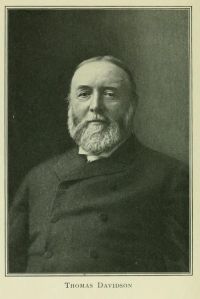 Thomas Davidson,
Chambers's Twentieth Century Dictionary 1908…
(1908)
Thomas Davidson,
Chambers's Twentieth Century Dictionary 1908…
(1908)
“ Edge of the sword, a rhetorical phrase for the sword as the symbol of slaughter.—Outside edge, figure in skating, made on the outer edge of the skate.—Play with edge-tools, to deal carelessly with dangerous matters.—Set on edge, to excite ”
 Edwin Abbott Abbott,
Flatland (second edition) — Section 1
(1884)
Edwin Abbott Abbott,
Flatland (second edition) — Section 1
(1884)
“ Imagine a vast sheet of paper on which straight Lines, Triangles, Squares, Pentagons, Hexagons, and other figures, instead of remaining fixed in their places, move freely about, on or in the surface, but without the power of rising above or sinking below it, very much like shadows—only hard and with luminous edges—and you will then have a pretty correct notion of my country and countrymen. ”
Harold Speed, The Practice and Science of Drawing
“ But in all painting that aims at reproducing the impressions directly produced in us by natural appearances, this question of focus and its influence on the quality of your edges is of great importance.Something should be said about the serrated edges of masses, like those of trees seen against the sky. These are very difficult to treat, and almost every landscape painter has a different formula. The hard, fussy, cut-out, photographic appearance of trees misses all their beauty and sublimity. ”
John Ruskin,
Modern Painters, Volume 1 (of 5…
“ Their excessive appearance of transparency.perceive in extreme distance, anything like solid form or projection of the hills. Each is a dead, flat, perpendicular film or shade, with a sharp edge darkest at the summit, and lost as it descends, and about equally dark whether turned towards the light or from it ”
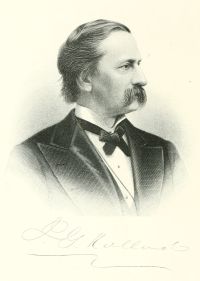 J. G. Holland,
Lessons in Life; A Series of Familiar Essays
J. G. Holland,
Lessons in Life; A Series of Familiar Essays
“ We examine them as we would a hillside strewn with fragments and planted with boulders of marble. We are obliged to dig to learn whether the signs we see are from an out-cropping ledge, or an outside deposition. Sometimes the plunge of a single question will reveal the whole story. ”
 William MacLeod Raine,
A Texas Ranger — I. A DESERT MEETING
(1911)
William MacLeod Raine,
A Texas Ranger — I. A DESERT MEETING
(1911)
“ Round the bend came a pair of bays hitched to a single-seated open rig. They were driven by a young man, and as he reached the summit he drew up opposite her and looked down into the valley.It lay in a golden glow at their feet, a basin of pure light and silence stretching mile on mile to the distant edge of jagged mountain-line which formed its lip. Sunlight strong as wine flooded a clean world, an amber Eden slumbering in an unbroken, hazy dream primeval. ”
 Herbert Spencer,
First Principles
Herbert Spencer,
First Principles
“ By the addition of matter to their inner edges, the borders slowly broaden, and thus encroach on the areas of the polygons; until at length there remains nothing but a dark spot in the centre of each. ”
John Ruskin,
The Seven Lamps of Architecture
“ Of course, therefore, whatever characters of line or shade or expression are productive of sublimity, will become productive of picturesqueness; what these characters are I shall endeavor hereafter to show at length; but, among those which are generally acknowledged, I may name angular and broken lines, vigorous oppositions of light and shadow, and grave, deep, or boldly contrasted color ”
James Johnson, Pilgrimages to the Spas in Pursuit of Health and Recreation
“ Let a large stone be dropped into the centre of the former, and we shall quickly observe a series of waves or undulations, rolling in excentric circles to the remotest edges of the water, in every direction—all parallel, all close to each other, but never touching or mingling. ”
Various, Popular Science Monthly (1894)
“ Here and there a giant peak rising from these sunless depths lifts his head to see the sky, and the dredge and trawl tell us that all along his rugged sides, and on the hills and plains below, and even in the inky blackness and the freezing cold of the deepest valleys, there is life. ”
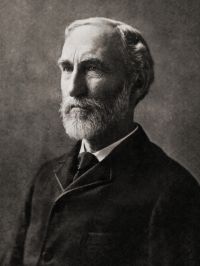 Josiah Willard Gibbs,
Scientific Papers of Josiah Willard Gibbs
(1906)
Josiah Willard Gibbs,
Scientific Papers of Josiah Willard Gibbs
(1906)
“ We may avoid all such confusion by using and to represent a strain. Let us consider an element of the body strained which in the state is a cube with its edges parallel to the axes of , and call the edges according to the axes to which they are parallel, and consider the ends of the edges as positive for which the values of or are the greater. ”
 Thomas Hardy,
Tess of the d'Urbervilles
(1891)
Thomas Hardy,
Tess of the d'Urbervilles
(1891)
“ Behind him the hills are open, the sun blazes down upon fields so large as to give an unenclosed character to the landscape, the lanes are white, the hedges low and plashed, the atmosphere colourless. ”
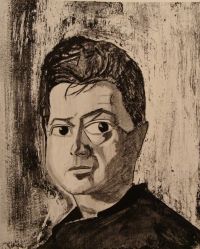 Francis Bacon,
The Works of Francis Bacon
(1884)
Francis Bacon,
The Works of Francis Bacon
(1884)
“ the one, because nothing is more pleasant to the eye than green grass kept finely shorn, the other, because it will give you a fair alley in the midst, by which you may go in front upon a stately hedge, which is to enclose the garden: but because the alley will be long, and, in great heat of the year, or day, you ought not to buy the shade in the garden by going in the sun through the green; ”
Roger Williams, The Bloudy Tenent of Persecution for Cause of Conscience Discussed and Mr…
“ and that when they have opened a gap in the hedge, or wall of separation, between the garden of the church and the wilderness of the world, God hath ever broke down the wall itself, removed the candlestick, &c. and made his garden a wilderness, as at this day. ”
Dorothy Furniss, Drawing For Beginners (1920)
“ In the foreground are large strong masses of light and shade, broken up into details—clothes, hands, faces, and features; in the background are misty effects, either of trees or other details of a landscape; in the middle distance are groups of people, some sitting and some walking, their clothes of dark or uniform tint, their faces misty blurs, their features indistinguishable. ”
Dorothy Furniss, Drawing For Beginners (1920)
“ Objects become Smaller as they Recede to say, in the foreground—are largest; the things in the middle, or middle distance, are smallest. And to explain these apparently simple facts we must exerecise our wits. You know that when you stand on the seashore and look seaward the extent of your vision is bounded by the meeting of the sea and sky, which boundary is called the horizon. The horizon is the line that follows the line of your eyes, the boundary line. ”
Augustus William Dubourg, Once a Week (1860)
“ So by the law of perspective, as we look up, we behold ridge below ridge of jewel- work resting on the golden columns, and glowing with transmitted light. The background, shutting in the court, is a screen of delicate metal work, the details standing out against the bright glare of day. ”
Charles H. Caffin, A Child's Guide to Pictures
“ We will begin with the latter. Note, then, how the sloping line of the field cuts across the picture. This diagonal line is contrasted with the perpendicular sides of the picture, and with the upright direction of the figure of the man. It forms, however, another contrast; it divides the light from the dark. The sun has gone down behind the slope; so that, while the sky is still luminous with a lovely glow, the ground is in shadow, dreary and heavy looking. So, too, the figure of the man. The light is at his back, so that what we see of him is shrouded in gloom. ”
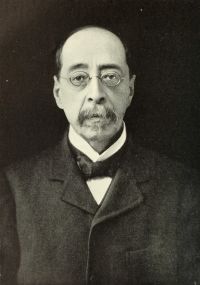 John La Farge,
An Artist's Letters from Japan
John La Farge,
An Artist's Letters from Japan
“ I am right in calling this mass of rock, which is a spur of the mountain's slope, a wall; for I look down from its top to the next inclosure far below, now overgrown and wild. What is natural and what was made by man has become so blended together, or has always been so, that I can choose to look at it as my mood may be, and feel the repose of nature or enjoy the disposing choice of art. ”
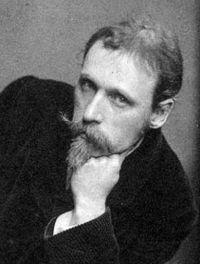 Walter Crane,
Line and Form (1900)
Walter Crane,
Line and Form (1900)
“ When we look at a landscape, putting aside for the moment all the surface charms of colour and effect, and concentrating our attention upon its lines of structures, we shall find that it owes a great part of its beauty to the harmonious relation of its leading lines, or to certain pleasant contrasts, or a certain impressiveness of form and mass, and at the same time we shall perceive that this linear expression is inseparable from the sentiment or emotion suggested by that particular scene. ”
 Boyd Winchester,
The Swiss Republic
(1891)
Boyd Winchester,
The Swiss Republic
(1891)
“ Grandeur of bulk and mass is conjoined with splendor and fulness of detail; form and shape are crowned with soaring peak and matchless line; and the summits mingle with that sky which seems to be the only fitting background for the eternal hills. ”
Harold Speed, The Practice and Science of Drawing
“ As was said above, their relation to the sides of the composition to which they are parallel in rectangular pictures is of great importance in uniting the subject to its bounding lines and giving it a well-knit look, conveying a feeling of great stability to a picture.How impressive and suggestive of contemplation is the long line of the horizon on a calm day at sea, or the long, horizontal line of a desert plain! The lack of variety, with all the energy and vitality that accompany it, gives one a sense of peace and rest, a touch of infinity that no other lines can convey. ”
Dorothy Furniss, Drawing For Beginners (1920)
“ What do you see? Every window, every cornice and roof, coming down to the level of your eye. Now take the lift to the top story of your tall building. What do you then see? Everything is reversed. The eaves of each lower building, the roofs and cornices, rising to meet the level of your eye. And the level of your eye is the height of your horizon. "Is the thing below the level of my eye, or is it above the level of my eye?" is the inevitable question. You sit in a chair and look at the cornice, the beading, the top line of the picture frames, the mirror over the fireplace ”
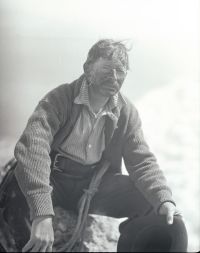 Dallas Lore Sharp,
The Face of the Fields
Dallas Lore Sharp,
The Face of the Fields
“ The face of the fields is as changeful as the face of a child. Every passing wind, every shifting cloud, every calling bird, every baying hound, every shape, shadow, fragrance, sound, and tremor, are so many emotions reflected there. ”
John Ruskin,
The Poetry of Architecture
(1873)
“ Have we mountains? their peaks must appear over foliage, or through it, the highest and boldest catching the eye conspicuously, yet not seen from base to summit, as if we wanted to measure them. Such a prospect as this is always compatible with as much concealment as we choose. ”
 Edward Bradford Titchener,
A Beginner's Psychology
Edward Bradford Titchener,
A Beginner's Psychology
“ We notice the distribution of light and shade; a morning or evening landscape, a shaded face or sphere, looks deeper, more solid, more plastic, than the landscape at high noon or the outline drawing. We notice the course of boundary lines and the visibility of surfaces ”
John Ruskin,
Modern Painters, Volume 1 (of 5…
“ The only truth in the picture is the exact pitch of relief against the sky of both trees and hills, and to this the organization of the hills, the intricacy of the foliage, and everything indicative either of the nature of the light, or the character of the objects, are unhesitatingly sacrificed. ”
 Anthony Trollope,
Tales of All Countries
Anthony Trollope,
Tales of All Countries
“ The peaks are glorious with more than the beauty of earth and rock and vegetation. He dreams of some mysterious grandeur of design which tempts him on under the hot sun, and over the sharp rock, till he has reached the mountain goal which he had set before him. ”
 Percival Lowell,
Mars
(1896)
Percival Lowell,
Mars
(1896)
“ Imperceptible in themselves, the heights become perceptible by their shadows. A road illuminated by a distant arc light gives us a startling instance of this; the smooth surface taking on from its shadows the look of a ploughed field. ”
Charles Francis Hall, Life with the Esquimaux (1864)
“ Before me were long and wide plains, meadows of grass, smoothly-sloping hills, and a range of mountains beyond, which, parting in one particular spot, formed, as it were, a natural gateway, that might almost lead, in fancy, to some fairy land beyond. ”
Various, The Atlantic Monthly, Volume 13…
“ A certain depth beneath the surface is most favorable to it,—a dim, midway region of twilight and calm, remote alike from the stagnant obscurity of mere sensation and from the agitated surface of day, the dry light of the intellect. ”
 Josiah Royce,
The Sources of Religious Insight
Josiah Royce,
The Sources of Religious Insight
“ When you are to examine the landscape from a height, in order to obtain a wide prospect, you may have to use a glass, or a compass, or some other instrument of abstraction, in order to define what the distance tends to render obscure, or what the manifoldness of the scenery surveyed makes it hard rightly to view in its true relations. And, in such cases, the glass or the compass is but an auxiliary, intended to help in the end your whole outlook. Now the world of good and evil is a world of wide prospects, of vast distances, of manifold features. ”
 Henry David Thoreau,
A Week on the Concord and Merrimack Rivers
(1849)
Henry David Thoreau,
A Week on the Concord and Merrimack Rivers
(1849)
“ Sitting with our faces now up stream, we studied the landscape by degrees, as one unrolls a map, rock, tree, house, hill, and meadow, assuming new and varying positions as wind and water shifted the scene, and there was variety enough for our entertainment in the metamorphoses of the simplest objects. ”
Edward Fenton Elwin, India and the Indians
“ Then, far away, but exactly in a line with the stones which indicated your line of vision, you will catch sight of another boundary stone, and you know that that is the extent of the plot, or that at any rate there is an angle at that point. Whenever there is any doubt through a stone getting overgrown with vegetation, or displaced, the truth is easily got at by going to some other corner and taking the line from there. ”