“ Any time after four o'clock in the afternoon, according to the light, the sphinx moth, a creature of the gloaming, begins its rounds, to be mistaken for a hummingbird seven times out of ten. Hovering about its chosen white or yellow flowers, that open for it at the approach of twilight, it remains poised above one a second, as if motionless - although the faint hum of its wings, while sucking, indicates that no magic suspends it - then darts swift as thought to another deep tube to feast again, of course transferring pollen as it goes. ”
Sphinx moth
Definition and stakes
Quotes about “sphinx moth”
W. Hamilton Gibson,
My Studio Neighbors
“ What insect, then, is here implied? The sphinx-moth again, one of the lesser of the group. A larger individual might sip the nectar, it is true, but its longer tongue would reach the base of the tube without effecting the slightest contact with the pollen, which is of course the desideratum here embodied, and which has reference to a tongue corresponding to the length of the nectary. There [Pg 193] are many of these smaller sphinxes. Let us suppose one to be hovering at the blossom's throat. ”
Frances Power Cobbe,
The Peak in Darien, With Some Other Inquiries Touching Concerns of the Soul and the Body
(1882)
“ There is an insect, the Lunar Sphinx Moth, which exhibits, in its first stage, not only the usual prevision for its security while in the helpless chrysalis state, but a singular foresight of its own requirements when it shall have become a winged moth. Having made, by eating its way upward through the pith of a willow, an appropriate hiding-place, it finds itself with its head in a position in which, were it to become a moth, it could never push itself down, and escape at the aperture below. ”

W. Hamilton Gibson,
My Studio Neighbors
“ The evolution of the long nectary implies an adaptation to an insect's tongue of equal length. What insect has a tongue five inches long, and sufficiently slender to probe this nec [Pg 190] tary? The sphinx-moth only. Hence we infer the sphinx-moth to be the insect complement to the blossom, and we may correctly infer, moreover, that the flower is thus a night-bloomer. Examination of the flower, with the form of this moth in mind, will show other adaptations to the insect's form in the position of pollen and stigma, looking to the flower's cross-fertilization. ”
Julia McNair Wright,
Nature readers
(1888)
“ The sphinx moth lays its eggs on the top sprays of a weed called the spurge. This weed has a milky juice. The seed grows in a little nut-like pod or case. The caterpillar of the sphinx hatches from the egg among the tender green top leaves. These will make its food. At once it begins to eat. It grows fast. As it is greedy, and likes spurge, it eats up all the plant but the roots. ”
“ The caterpillar is very destructive to hops, by devouring the roots.27 Sphinx atropos.—This is called the Death’s Head moth from the resemblance of the spot on its thorax to a human skull. It is the largest of the Sphinx tribe, and is vulgarly regarded as the messenger of pestilence and death. When touched it utters a plaintive cry, like that of a bat or mouse. Reaumur says, that a whole convent in France was thrown into consternation, by one of these moths flying into the dormitory. It frequently robs hives, and Huber states, that its cry renders the bees motionless. ”
“ A number pass the cold season in the earth with no protective covering whatever. Among these is a large brown chrysalis with a long tongue case bent over so as to resemble the handle of a jug. Every farm boy has ploughed or spaded it up in the spring, and is it but the pupa of a large sphinx moth, Protoparce celeus Hub., the larva of which is the great green worm, with a “horn on its tail,” so common on tomato plants in the late summer. ”
by William Swainson, Zoological Illustrations — Vol II. Pl… (1820)
“ Hawk-moths, or Sphinxes, at the rising and setting of the sun; and Moths during the night. The insects of Europe, indeed, offer but few exceptions to these characters; but the habits of certain exotic tribes, in each of these families, partake both of one and the other in a remarkable manner. Thus, among the butterflies, there is a genus in South America (hitherto unnoticed) , which fly only during the dusk of evening: a number of the Linnæan Hawk-moths prefer the meridian heat of the sun; and there are not wanting several moths which are only seen during the same period of the day. ”
Robert Chambers, Vestiges of the Natural History of Creation
“ Swainson, “the singular threatening aspect which the caterpillars of the sphinx moth assume on being disturbed, is a remarkable modification of the terrific or evil nature which is impressed in one form or another, palpable or remote, upon all sub-typical groups; for this division of the lepidopterous order is precisely of this denomination. In the pre-eminent type of this order of insects, the butterflies, (papilionides,) our associations little prepare us for expecting any trace of the evil principle ”
George Adams, Essays on the Microscope
“ Most of the sphinges of Linnæus, or, as they are usually called, hawk-moths, are but seldom met with in their fly state, and when seen on the wing, generally elude the swiftest pursuit; but in their caterpillar state they are frequently found, and easily taken. Thus the caterpillar of the sphinx atropos or jasmine hawk-moth, the largest and most beautiful species of moth this country produces, [159] is often found feeding on the jasmine and potatoe, and sometimes on green elder ”
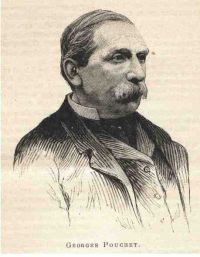
Georges Pouchet,
Popular Science Monthly
(1873)
“ We have seen how the ant understands when an object is too large to pass through the entrance to its cave. The bee, to which we would attribute sensitiveness to regularity of lines, certainly has the notion of relations of length. There is a large moth, the death's-head sphinx, very fond of honey, and which asks nothing better than to make its way into the hive ”
Richard South, The Moths of the British Isles…
“ Owing to some confusion between this moth (Plate 15, Fig. 3) and the North American Striped Morning Sphinx (D. lineata) , which also seems to have had a place in the cabinets of the earlier British entomologists, the localities given by authors previous to 1828 are doubtful. Haworth, however, in 1803, mentions Cornwall, and Stephens, in his remarks on this species, refers to a specimen from Norfolk; one taken off the mast of the Ramsgate steam vessel at Billingsgate, in June, 1824; and three specimens, one of which he figured, captured near Kingsbridge, Devonshire. ”
Charles Darwin,
The Descent of Man, and Selection in Relation to Sex
“ Giard has always observed that the musky odour, which is emitted by two species of Sphinx moths, is peculiar to the males (4. ‘Zoological Record,’ 1869, p. 347.) ; and in the higher classes we shall meet with many instances of the males alone being odoriferous. Every one must have admired the extreme beauty of many butterflies and of some moths; and it may be asked, are their colours and diversified patterns the result of the direct action of the physical conditions to which these insects have been exposed, without any benefit being thus derived? ”
Gene Stratton-Porter,
Moths of the Limberlost: A Book About Limberlost Cabin
“ When in my field work among the birds, so many moths of other families almost had thrust themselves upon me that I began a collection of reproductions of them, I found little difficulty in securing almost anything else. I could picture Sphinx Moths in any position I chose, and Lunas seemed eager to pose for me. A friend carried to me a beautiful tan-coloured Polyphemus with transparent moons like isinglass set in its wings of softest velvet down, and as for butterflies, it was not necessary to go afield for them ”
“ It breaks from its chrysalis between four and seven in the afternoon, as the Hawk moth of the Lime always appears at noon, and that of the Evening Primrose at sunrise.28 Sphinx cellata.—The Eyed-hawk moth flies very swiftly by night, and its caterpillar is very beautiful.29 Geometra cratægaria.—The Brimstone lays eggs twice in the same year. ”
Louise Jamison, The Real Fairy Folk
“ I am a sphinx,” was the answer. “All of us look somewhat alike, though some are smaller than others, and colours vary. But our wings are always clear cut, our scales close fitting, and our colours quiet; a tailormade air about us, as it were. We are sometimes called hawk moths, because our wings are narrow, long, and strong, and sometimes hummingbird moths, because we fly at twilight, and poise above a flower while extracting its honey, just as hummingbirds do.”“But why are you named the sphinx?” asked Ruth. ”
Jean-Henri Fabre,
Animal Life in Field and Garden
“ It is the hour when the sphinx-moths fly abruptly from flower to flower and thrust their long probosces into the depths of the corollas, where honey is stored; the hour when the mosquito, thirsting for human blood, sounds its war-cry in our ears and selects our tenderest spot to stab with its poisoned lancet; the hour when the June-bug leaves the shelter of the leaf, spreads its buzzing wings, and goes humming through the air in quest of its fellows. ”
Edward Newman, Sphinx Vespiformis: An Essay
“ A great proportion of the perfect insects have hyaline spots and patches in their wings, and nearly all of them are brilliantly coloured. It is known that Linnæus occasionally, as in Tenebrio and the present instance, made his genera recipients of species, which he found a difficulty in locating properly; but it is really astonishing to find a naturalist like Latreille abiding by so absurd a combination as the contents of the Linnæan genus Sphinx, and, in servile imitation, calling creatures which nothing but an unclouded sun ever tempts abroad—Crepuscularia. ”
George Herbert Carpenter, 1911 Encyclopædia Britannica, Volume 16… (1911)
“ The family is world-wide in its range. The tropical Uraniidae are large handsome moths (figs. 44, 45) , often with exquisite wing-patterns, allied to the Geometridae, but distinguished by the absence of a frenulum in the moth and the presence of the normal ten prolegs in the larva. The Sphingidae (hawk moths) are insects often of large size (figs. 46a, 47) , with spindle-shaped feelers, elongate and powerful forewings and the maxillae very well developed. The hindwing carries a frenulum and has its sub-costal nervure connected with the radial by a short bar. ”
Spencer Fullerton Baird,
A History of North American Birds…
“ At sight of the insect the bird attacks it with his pointed beak with great fury. The Sphinx, overcome in this unlooked-for attack, beats a retreat, but, soon returning to the attractive flowers, is again and again assaulted by its infuriated enemy. ”
Edward Newman, Sphinx Vespiformis: An Essay
“ Whoever will give himself the trouble to examine thoroughly a collection of British Lepidoptera, will find a very great majority of them evincing very evident symptoms of relation to one or other of the following species:—Papilio Machaon, Sphinx Ligustri, Pyralis verticalis, Tinea pellionella, Noctua pronuba, and Geometra roboraria; and should any form widely different from either of these occur, it may, if the larva be known, be placed in the centre of a ring formed by the groups, which we will suppose surrounding their six respective types ”
Various, The Atlantic Monthly, Volume 05…
“ Mightier and mightier grew the yearning within her, as the full moon floated upward from the east and cast her dewy dreams over land and sea. The hour was come; the whole impulse and persistence of her nature went out in vivid life, and, filling the very stones which the winds had gathered and piled against her breast, cleft them with its sentient spell, clothed them with lean flesh and wiry sinews, shaped them after the fashion of the Desert men, and sent them out alive with intellect and will, but with hearts of flint, into the wide world,—the Sphinx's children! ”
Gustave Flaubert,
The Temptation of St. Antony; Or…
“ Those who traverse the desert meet animals passing all conception ..."And, opposite him, on the other side of the Nile, lo! the Sphinx appears.It stretches out its feet, shakes the fillets on its forehead, and lies down upon its belly.Jumping, flying, spirting fire through its nostrils, and striking its wings with its dragon's tail, the Chimera with its green eyes, winds round, and barks. The curls of its head, thrown back on one side, intermingle with the hair on its haunches; and on the other side they hang over the sand, and move to and fro with the swaying of its entire body. ”
Manly Palmer Hall,
The Secret Teachings of All Ages
(1928)
“ The shallow depression in the crown of the head, once thought to be the terminus of a closed up passageway leading from the Sphinx to the Great Pyramid, was merely intended to help support a headdress now missing.Metal rods have been driven into the Sphinx in a vain effort to discover chambers or passages within its body. The major part of the Sphinx is a single stone, but the front paws have been built up of smaller stones. The Sphinx is about 200 feet long, 70 feet high, and 38 feet wide across the shoulders. ”
August Weismann,
Studies in the Theory of Descent…
“ The caterpillars of the Sphingidæ are known to behave themselves in different manners when attacked. Some species, such, for instance, as Sphinx Ligustri and Smerinthus Ocellatus, on the approach of danger assume the so-called Sphinx attitude; if they are then actually seized, they dash themselves madly to right and left, by this means not only attempting to get free, but also to terrify330 their persecutor. This habit frequently succeeds with men, and more especially with women and children ”
Alfred Russel Wallace,
Darwinism (1889)
“ With reference to this general resemblance of insects to their environment the following remarks by Mr. Poulton are very instructive. He says: "Holding the larva of Sphinx ligustri in one hand and a twig of its food-plant in the other, the wonder we feel is, not at the resemblance but at the difference; we are surprised at the difficulty experienced in detecting so conspicuous an object. And yet the protection is very real, for the larvae will be passed over by those who are not accustomed to their appearance, although the searcher may be told of the presence of a large caterpillar. ”
William Swainson, Zoological Illustrations, Volume 1
“ This genus was instituted by Scopoli many years ago, and differs principally from Sesia by having opaque wings, and from Thyreus by the very great difference in the construction of their antennæ. Many exotic species are known, but only one is found in Europe (Sphinx stellatarum of Linn.) , which likewise inhabits our own country, and to which this our insect is very nearly allied.Though by no means uncommon in collections, I cannot find this species either figured or described, nor indeed am acquainted with its locality. The under figure is of the male; the upper of the female ”
Moncure Daniel Conway,
Demonology and Devil-lore
“ Such a Sphinx is this Life of ours to all men and societies of men. Nature, like the Sphinx, is of womanly celestial loveliness and tenderness; the face and bosom of a goddess, but ending in claws and the body of a lioness. There is in her a celestial beauty,—which means celestial order, pliancy to wisdom; but there is also a darkness, a ferocity, fatality, which are infernal. She is a goddess, but one not yet disimprisoned ”
George Vernon Hudson,
New Zealand Moths and Butterflies…
(1898)
“ The imagos are usually large insects, with stout, heavy bodies, elongate-triangular fore-wings with very oblique termen, and relatively small hind-wings; the wing muscles are very strong, and the flight exceptionally powerful. Ovum spheroidal, smooth. Larva stout, usually with an oblique, projecting anal horn, anterior segments sometimes retractile or raised in repose. Pupa subterranean."— (Meyrick.) Only one genus is represented in New Zealand, viz., Sphinx. Genus 1.—SPHINX."Tongue strongly developed. ”
Frank G. Carpenter,
Cairo to Kisumu
(1923)
“ That figure with the head and bust of a woman upon the body of a lion, carved out of the ages-old rock which stood here upon the desert, has been noted among the peoples of the world as far back as history extends, and those stony eyes have seen civilization after civilization rise and fall.It would take a good-sized city lot to hold the Sphinx. The body is one hundred and forty feet long, and the paws each measure fifty feet. Her head alone is so big that a vault fourteen feet square and the height of a three-story house would be just large enough to contain it. ”