“ It has been demonstrated that our colleges do not fit a young man to walk at once into the active management of a paper. He should at least know the difference between a vile contemporary and a Gothic scoop. It is difficult to map out a proper course for the student in a school of journalism, there are so many things connected with the profession which the editor and his staff should know and know hard. The newspaper of to-day is a library. ”
Student newspaper
Definition and stakes
The theme of “student newspaper” has been addressed by authors such as Chester Sanders Lord, Paul Klapper, Willard Grosvenor Bleyer, Robert Ezra Park and Charles Dudley Warner. It is often associated with terms like journalism, literature, college, editor and school.
Quotes about “student newspaper”
Willard Grosvenor Bleyer, Newspaper Writing and Editing
“ Seven years’ experience in trying to train college students in methods of newspaper writing and editing has convinced the author of the need of text-books in journalism. Newspapers themselves supply the student with so miscellaneous a collection of good, bad, and mediocre work that, with an uncritical taste, he does not always discriminate in the character of the models which he selects to imitate. ”
Paul Klapper, College Teaching
“ Newspaper English has its great and widest value to the man who wishes to learn how he can affect the other man. A course in it is certain, if the instruction is effective, to leave a student better able to express himself in the normal needs of life. This work is taken by many students as part of the effective training of college life, with no expectation of entering active newspaper work. The demand for publicity work in all business fields, and its value to the social worker, the teacher, and the clergyman, lead others to this specialized training. ”
Willard Grosvenor Bleyer, How To Write Special Feature Articles
“ To write constantly under guidance and criticism, such as it is impossible to secure in newspaper and magazine offices, will develop whatever ability a student possesses.Experience as a newspaper reporter supplements college training in journalism and is the best substitute for college work generally available to persons who cannot go to college. For any one who aspires to write, reporting has several distinct advantages and some dangers. ”
Willard Grosvenor Bleyer, Newspaper Writing and Editing
“ With such a book illustrative of current practices in newspaper making, he can study more intelligently the newspapers themselves and can assimilate more completely the advice and information given by newspaper men in active service. Furthermore, such a book, by giving specific suggestions with examples of their application, serves as a guide to aid the student in overcoming his difficulties as he does his work from day to day. ”
Paul Klapper, College Teaching
“ In science, in politics, in history, in economics, in philosophy, and in letters, it is indispensable that the young newspaper man should be introduced by lecture, and still more by reading, to the speaking figures of his own day on affairs, political life, letters, the theatre, and art.The journalist must ever be a student of human affairsThese things are indispensable. The man who knows them can learn to write and edit, but the man who can only write and edit and does not know them will speedily run dry in the newspaper, weekly and monthly. News is today standardized. ”
Willard Grosvenor Bleyer, Newspaper Writing and Editing
“ Lectures by experienced editors and writers, although fruitful of much inspiration and general information, seldom give the student sufficiently specific and detailed directions to guide him in his daily work. What he needs is a handbook containing typical examples of all of the kinds of newspaper work that he is likely to be called upon to do during the first years of his newspaper experience. ”
 Charles Dudley Warner,
The Novel and the Common School
Charles Dudley Warner,
The Novel and the Common School
“ But the modern newspaper is no doubt a natural evolution in our social life. As everything has a cause, it would be worth while to inquire whether the encyclopaedic newspaper is in response to a demand, to a taste created by our common schools. Or, to put the question in another form, does the system of education in our common schools give the pupils a taste for good literature or much power of discrimination? Do they come out of school with the habit of continuous reading, of reading books, or only of picking up scraps in the newspapers, as they might snatch a hasty meal at a lunch-counter? ”
Paul Klapper, College Teaching
“ More than 1000 letters have been received by the School of Journalism in Columbia University, since it was opened, asking advice as to the reading and study which could aid a man or woman unable to leave the newspaper office to study to improve their work. College graduates, in particular on newspapers, begin systematic study on their own account, aware of an approaching competition. Definite standards in newspaper writing and in diction begin to be recognized and practiced in the office, and slips in either meet a more severe criticism. ”
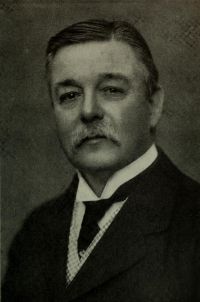 Chester Sanders Lord,
The Young Man and Journalism
Chester Sanders Lord,
The Young Man and Journalism
“ The newspapers of to-day are better because more study and thought are put into their construction. Not only are the editorial writers men of education, but the sub-editors, the night editors, the revisers of copy and the reporters are mostly educated men—men who have been taught where to seek and how to find information, who have been taught to be confident and self-reliant and original. The proportion of college-bred men on newspaper staffs is much greater than it used to be, and the intelligence of the staffs has increased in the same proportion. ”
 George S. Boutwell,
Thoughts on Educational Topics and Institutions
George S. Boutwell,
Thoughts on Educational Topics and Institutions
“ This fact is an important one, as it furnishes a good test of the standard taste and learning of the people. Our press answers the demand which the people make upon it. The mass of newspaper readers are not, in a scholastic sense, well-educated persons. Newspaper writers do not, therefore, trouble themselves about the colleges with their professors, but they seek rather to gain the attention and secure the support of the great body of the people, who know nothing of colleges except through the newspapers. ”
Various, The Bay State Monthly — Volume 2…
“ It is the popular university to which thousands upon thousands of readers resort daily for intelligent comment on the events of the world—the great wars, the suggestions of science, the achievements of the engineers, home and foreign politics, etc. That such a great newspaper as the Herald, wherein the elucidating comment is kept up from day to day by cultivated writers trained in journalism, must perform many of the functions of a university is clear. The news columns of the Herald are a perfect mirror of the great world's busy life. ”
T. De Witt Talmage, The Abominations of Modern Society
“ The newspaper is the great educator of the nineteenth century. There is no force compared with it. It is book, pulpit, platform, forum, all in one. And there is not an interest—religious, literary, commercial, scientific, agricultural, or mechanical—that is not within its grasp. All our churches, and schools, and colleges, and asylums, and art-galleries feel the quaking of the printing-press. ”
W. C. Bartlett, A Breeze from the Woods, 2nd Ed
“ It has absorbed monthly magazines or forced publishers to resort to illustrations—to a sort of picture-book literature for grown-up children. It has driven the lumbering quarterlies into smaller fields and diminished their relative importance. The average citizen craves the news from a journal having the very dew of the morning and of the evening upon it. It must come to him damp and limp, bringing whatever is best at the smallest possible cost. The newspaper is the herald of the new era. ”
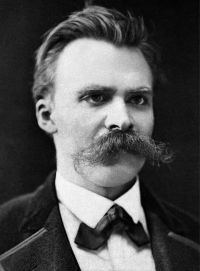 Friedrich Wilhelm Nietzsche,
On the Future of our Educational Institutions
Friedrich Wilhelm Nietzsche,
On the Future of our Educational Institutions
“ It is precisely in journalism that the two tendencies combine and become one. The expansion and the diminution of education here join hands. The newspaper actually steps into the place of culture, and he who, even as a scholar, wishes to voice any claim for education, must avail himself of this viscous stratum of communication which cements the seams between all forms of life, all classes, all arts, and all sciences, and which is as firm and reliable as news paper is, as a rule. ”
Willard Grosvenor Bleyer, Newspaper Writing and Editing
“ That the newspapers are the teachers of the people has been reiterated on the platform, in the pulpit, and in the newspapers themselves. Wendell Phillips, a generation ago, in speaking of the importance of newspapers in this country, said: “It is a momentous, yes, a fearful truth, that millions have no literature, no schools, almost no pulpit but the press. It is parent, school, college, pulpit, theatre, example, counselor, all in one. ”
Willard Grosvenor Bleyer, Newspaper Writing and Editing
“ With the quickening of the public conscience in regard to political and social conditions has come a keener appreciation of the importance of the newspaper as the greatest single source of information in our democracy, and a realization of the dangers of abuse of this power by editors and publishers. Whatever opinions may be held as to present-day standards in journalism, every one will grant that it is the duty of those who enjoy the advantages of university training in preparation for this profession to maintain the highest ideals in their own work. ”
“ So necessary has the profession of journalism become to the progress and education of our country, that the matter of establishing schools where young men may be fitted for an active newspaper life, has attracted much attention and discussion. ”
Charles Dudley Warner,
The Novel and the Common School
“ Before considering the common school, however, we have to notice a phenomenon in letters—namely, the evolution of the modern newspaper as a vehicle for general reading-matter. Not content with giving the news, or even with creating news and increasing its sensational character, it grasps at the wider field of supplying reading material for the million, usurping the place of books and to a large extent of periodicals. ”
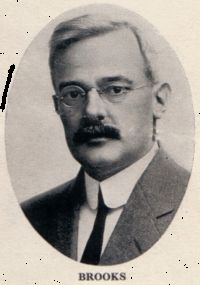 Stratton D. Brooks,
Composition-Rhetoric
Stratton D. Brooks,
Composition-Rhetoric
“ Hence, any school of professional journalism must be presumed to comprise in its scope and detail of instruction the knowledge that is essential to the making and conduct of newspapers. It must have for its aim the ideal newspaper which is ideally perfect in every department. ”
Chester Sanders Lord,
The Young Man and Journalism
“ Almost every kind of writing is used by newspapers. All kinds of literature are printed in them—the scholarly essay, the article of argument, the expository editorial paragraph, the story of fiction, the language of verse, the consideration of art, music, the play, all sorts of description of all kinds of happenings in every part of our old earth—and all are written without uniformity of diction or construction. There is no style that the newspaper rejects. The experienced editor seeks diversity of writing and of topic in every column. ”
G. E. Partridge, The Psychology of Nations
“ We must excite the imagination of the young and prejudice the public mind through educational channels, in favor of sincere and true leaders. The opportunity of the story teller is large, in this work, and we need also to develop to a very high degree of excellence the educational newspaper. One of our great needs in education in this country is a daily newspaper for all schools—one that shall be both informing and influential, appealing by every art to the selective [235] faculties, governed absolutely by ethical, or at least not by political and partisan motives. ”
 Christy Mathewson,
Won in the Ninth
Christy Mathewson,
Won in the Ninth
“ THE “LOWELL REPORTER” The Lowell Reporter was the college paper of the University. It appeared once a week and in it was printed all the news of the college world, and announcements of various kinds. The advertising columns furnished an opportunity for a couple of young hustlers to earn enough money soliciting advertisements to keep them in school.The paper was edited entirely by the students under the watchful eye of the faculty and especially of Professor Bennett, assistant teacher of English and of many years’ experience as a newspaper writer and editor. ”
Robert Clarkson Brooks, Corruption in American politics and life (1910)
“ As compared with the press, universities possess certain great advantages which justify the public in demanding from them higher standards of accuracy and impartiality. The professor enjoys some measure of leisure; the editor is always under the lash of production on the stroke of the event. It is also a very considerable advantage that the editorial “we” and the anonymity of the newspaper are foreign to college practice. ”
Sinclair Lewis, Babbitt (1922)
“ Course the school has its advertising committee, but, Lord, nobody ever really works good—nobody works well just for the love of it. The thing to do is to be practical and up-to-date, and hire a real paid press-agent for the Sunday School-some newspaper fellow who can give part of his time. ”
Chester Sanders Lord,
The Young Man and Journalism
“ Modern devices have bereft life there of much of its old-time drudgery. The people are wide awake. Their general intelligence is quite equal to the general intelligence of city people.Likewise, the newspapers are much improved. Modern printing machinery and facilities have removed irksome processes. Editorial associations and the technical newspaper press have inspired to higher ideals. The business has become standardized on a higher plane of excellence. Many of our high schools and almost all of our colleges have courses in journalism. ”
Charles Dudley Warner,
The Complete Essays of Charles Dudley Warner
“ Has the time come, or is it near at hand, when we can point to a person who is alert, superficial, ready and shallow, self-confident and half-informed, and say, “There is a product of the American newspaper”? The newspaper is not a willful creation, nor an isolated phenomenon, but the legitimate outcome of our age, as much as our system of popular education. And I trust that some competent observer will make, perhaps for this association, a philosophical study of it. ”
George Binney Dibblee, The Newspaper
“ Last of all comes the general reader and he asks nothing more of his newspaper than all the news of everywhere, collected at great cost, transcribed with finished skill and presented to him in just the way which pleases and flatters him most. All of them have on their lips the daily threat of giving up the paper, if they are not scrupulously satisfied. ”
Joseph Devlin, How to Speak and Write Correctly
“ It is a mistake to imagine, as so many do, that an extended education is necessary for newspaper work. Not at all! On the contrary, in some cases, a high-class education is a hindrance, not a help in this direction. The general newspaper does not want learned disquisitions nor philosophical theses; as its name implies, it wants news, current news, interesting news, something to appeal to its readers, to arouse them and rivet their attention. In this respect very often a boy can write a better article than a college professor. ”
Grant Milnor Hyde, Newspaper Reporting and Correspondence
“ Newspaper experience may aid the reporter in learning how to write his stories, but a newspaper apprenticeship is not absolutely necessary. However, whether he is studying the trade of newspaper writing in his home, in a classroom, or in the city room of a daily paper, he needs positive instruction in the English composition of the newspaper office—rather than haphazard criticism and a deluge of "don'ts." Hence this book is concerned primarily with the writing of the news. ”
Paul Klapper, College Teaching
“ Not the least influence which the schools of journalism exert on the active work of the calling is through these associations, particularly in the states west of the Mississippi where, at the present stage of journalism in this region, state universities can through schools of journalism bring newspapers together at a "newspaper week." ”
“ For the same practical reasons the volume omits editorial and copy reading, and makes no attempt to teach the beginner to be a dramatic critic or a city editor. It aims to give him only those details and that instruction which shall make him a competent, reliable reporter for the city editor who first employs his services. The book is written also with the belief, based on practical experience, that news writing as a craft can be taught. It is not contended that schools can produce star reporters. The newspaper office is the only place where they can be developed. ”
Chester Sanders Lord,
The Young Man and Journalism
“ Many young men think of entering journalism, but journalism is to them a maze of mystery. What does it offer as a profession or a vocation? they ask. What is the nature of the business? What are its rewards? Naturally enough they continue to wonder what kind of preparatory study is desirable. How does a young man make a beginning and how does the beginner make progress? What are the recognized standards of newspaper success? How is news collected and prepared for the public? How is a newspaper conducted? What are the duties of each member of a big newspaper staff? ”
Related terms
Authors who wrote about “student newspaper”
Chester Sanders LordPaul KlapperWillard Grosvenor Bleyer Robert Ezra ParkCharles Dudley WarnerGrant Milnor HydeGeorge Binney DibbleeJames Melvin LeeEric W. Allen
 Bill NyeEdwin L. MillerNellie Bowden Pipes MacArthurM. Lyle Spencer
 Upton SinclairW. C. Bartlett
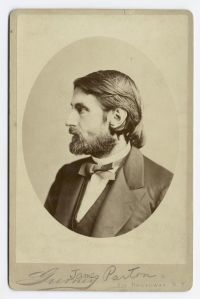 James PartonT. De Witt TalmageJoseph DevlinJames ReesEdward Ziegler Davis