“ As a rule, it is a most unsafe stroke, and, when it can be played without risk, a hard volley will generally be just as good. It is a great satisfaction, both to the gallery and to the player himself, to see a ball smashed through an umbrella or a parasol, but it is an amusement that should be strictly confined to exhibition matches.Do not volley a very low ball if you can possibly help it. For instance, one is coming forward, and meets a slow return that has passed just over the net and is dropping fast. ”
Volley (tennis)
Definition and stakes
The theme of “volley (tennis)” has been addressed by authors such as William T. Tilden, James Dwight, Mrs. Lambert Chambers, Claude Harris Miller and Janet Aldridge. It is often associated with terms like racket, serve, net, golf and court.
Quotes about “volley (tennis)”
“ The moment that a volleyer fails to make a severe or at least a well-placed stroke, he is at a disadvantage, and would be better off in the back of the court than where he is. It is seldom that the two positions can balance, so to speak, and if a volleyer is not distinctly up, he is pretty sure to go down. Of course I do not mean that every ball that is to be volleyed should be smashed; far from it, but I do say that a volley should always be played hard on to the base-line or across the court to the side-line. If neither can be done, it is wrong to volley the ball at all. ”
“ If you do play low, don’t play directly down the middle of the court if your opponent is standing there. It is much better to take a greater risk and play for the side-lines. Remember that it is usually easier to pass a volleyer on his forehand side. Remember, also, that the easiest ball to volley is one hit low and hard, because it comes in nearly a straight line. For this reason, especially when a volleyer is coming forward, the most difficult stroke that you can give him to volley is one hit slowly enough to drop low before he can reach it. ”
Related terms
Authors who wrote about “volley (tennis)”
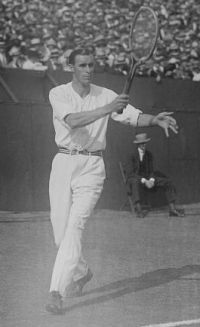 William T. Tilden
 James DwightMrs. Lambert ChambersClaude Harris MillerJanet AldridgeRonald John McNeillVariousRichard C. SquiresAdelia B. Beard| editorvarious contributorsJulian MarshallFrederica Seeger
 Jerome K. JeromeWilliam Hazlitt
 Allan Gibson SteelJames PycroftR. H. Lyttelton
 Ranjitsinhji Vibhaji II
 Blaise Pascal