Working-class clothing

Definition and stakes

Portrait of Friedrich Engels Friedrich Engels,  The Condition of the Working-Class in England in 1844

“ The clothing of the working-people, in the majority of cases, is in a very bad condition. The material used for it is not of the best adapted. Wool and linen have almost vanished from the wardrobe of both sexes, and cotton has taken their place. Shirts are made of bleached or coloured cotton goods; the dresses of the women are chiefly of cotton print goods, and woollen petticoats are rarely to be seen on the washline. The men wear chiefly trousers of fustian or other heavy cotton goods, and jackets or coats of the same. ”
Source: Gutenberg

Helen Campbell,  Prisoners of Poverty: Women Wage-Workers…

“ Clothing in all its multiplied forms takes the first place in the ninety-two trades, and the workers on what is known as “white wear” form the large majority of the always increasing army. For many reasons, the shirt-makers naturally head the list,—the shirt-makers about whom has hung a certain sentimental interest since the day when poor Tom Hood’s impassioned plea in their behalf first saw the light. Yet to-day, in spite of popular belief that they are the class most grossly wronged, the shirt-maker fares far better than the majority of the workers on any other form of clothing. ”
Source: Gutenberg

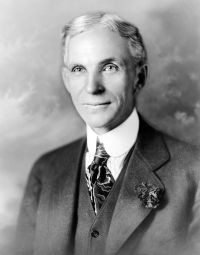
Portrait of Henry Ford Henry Ford,  The International Jew/Volume 3… (1920)

“ In the garment industry, the organizations include every operation in the process of making clothes. There are separate unions for buttonhole makers, vest makers, pants makers, coat cutters, coat operators, coat pressers, coat tailors, coat basters, lapel makers, knee pants makers, clothing turners, overall workers, palm beach workers, shirt makers, vest pressers, and even a washable sailor suit union. These together comprise the Amalgamated Clothing Workers of America. ”
Source: Wikisource

Get perspective with Kwize: daily news enlightened by great literature