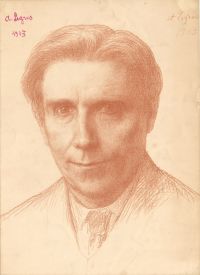
“ It is a gray, dull day; not a breath stirs the air, which is heavy and ominous. Evening is drawing on as one walks down the mountain-path towards home, and a haze is settling on the village; the sun has been feebly trying to shine all day through the thick clouds that cover it. The green pines, with their purple stems, are very beautiful against the deeper purple of the mountains; pretty, too, the homesteads on the hills, with their fields of cabbages and little plantations of flowers. There is a sweet smell of gorse and pine-needles and decaying bracken, and always one hears the caw of rooks. ”
Dorothy Menpes
Biographical details
Dorothy Menpes, a perceptive traveler and writer, is celebrated for her vivid portrayals of landscapes and cultures in Venice, Brittany, and Japan: A Record in Colour. Her work intertwines meticulous observation with poetic description, capturing the quiet resilience of Breton peasants, the atmospheric drama of Venetian lagoons, and the serene elegance of Japanese traditions.
Through evocative prose, she illuminates the interplay between environment and human life, offering readers a lens to appreciate the distinct beauty and rhythms of each region she explores. Her texts remain enduring testaments to the power of place to shape identity and artistic expression.
Quotes by Dorothy Menpes
“ Farther, the ground becomes solid, and the Venetian plain begins, with its villas, poplars, vineyards, and mulberry groves.Nothing is more delightful than to spend a whole long day upon the lagoon when the air is sweet and the breeze is fresh from the Lido. There are fishing-boats coming in from their long night, with spoil for the Rialto market, crossing and recrossing one another as they tack. The bows are painted, and the nets are hung mast-high to be mended and dried in the sun. Their sails are folded close together, like the wings of great vermilion moths. ”
Dorothy Menpes, Japan: A Record in Colour
“ I have never seen a child in Japan cry; nor have I ever seen one smacked, for what mother can have the heart to touch so dainty a blossom as the child flower of this land of flowers? A group of Japanese children is perhaps the prettiest sight on earth, and they themselves are works of art, the beauty of which can scarcely be imagined. Each head and each piquant face is but a field where the ever-present artist can exercise his ingenuity and his skill in colour and design. ”