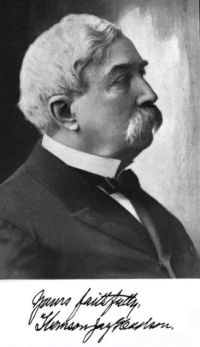
“ In this way, too, the poet is with us still; his presence has a strange reality as we look on some majestic prospect of interwinding lake and mountain which his design has made more beautifully visible to the children's children of those he loved; as we stand, perhaps, in some shadowed garden-ground where his will has had its way,—has framed Helvellyn's far-off summit in an arch of tossing green, and embayed in towering forest-trees the long lawns of a silent Valley,—fit haunt for lofty aspiration and for brooding calm. ”
F. W. H. Myers
Biographical details

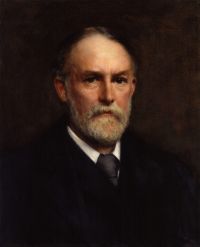
Frederic William Henry Myers (1843–1901), an English poet, classicist, and founder of the Society for Psychical Research, examined themes of the subconscious self and the continuation of human personality beyond death. His literary critiques, such as Wordsworth (1881), and groundbreaking works like Phantasms of the Living (1886) and Human Personality and Its Survival of Bodily Death (1903), combine psychical research with philosophical exploration.
Although his ideas on telepathy and spiritualism were met with doubt, Myers’ thorough examination of consciousness and memory remains essential in the study of parapsychology and the relationship between mind and matter.
Quotes by F. W. H. Myers
 F. W. H. Myers,
Human Personality and Its Survival of Bodily Death
F. W. H. Myers,
Human Personality and Its Survival of Bodily Death
“ Nay, from the law of telepathy it follows that that communion is valid for us here and now. Even now the love of souls departed makes answer to our invocations. Even now our loving memory—love is itself a prayer—supports and strengthens those delivered spirits upon their upward way. No wonder; since we are to them but as fellow-travellers shrouded in a mist; "neither death, nor life, nor height, nor depth, nor any other creature," can bar us from the hearth-fire of the universe, or hide for more than a moment the inconceivable oneness of souls. ”
“ Still from the crag shall lingering winds prolong The half-heard cadence of the woodman's song,— While evermore the doves, thy love and care, Fill the tall elms with sighing in the air.Yet words like these fail to give the solemnity of his last years,— the sense of grave retrospection, of humble self-judgment, of hopeful looking to the end. "It is indeed a deep satisfaction," he writes near the close of life, "to hope and believe that my poetry will be while it lasts, a help to the cause of virtue and truth, especially among the young. ”
F. W. H. Myers,
Human Personality and Its Survival of Bodily Death
“ The higher gifts of genius—poetry, the plastic arts, music, philosophy, pure mathematics—all of these are precisely as much in the central stream of evolution—are perceptions of new truth and powers of new action just as decisively predestined for the race of man—as the aboriginal Australian's faculty for throwing a boomerang or for swarming up a tree for grubs. There is, then, about those loftier interests nothing exotic, nothing accidental; they are an intrinsic part of that ever-evolving response to our surroundings which forms not only the planetary but the cosmic history of all our race. ”
“ We must seek our consolation in the thought that no outrage on Nature is mortal; that the ever-springing affections of men create for themselves continually some fresh abode, and inspire some new landscape with a consecrating history, and as it were with a silent soul. Yet it will be long ere round some other lakes, upon some other hill, shall cluster memories as pure and high as those which hover still around Rydal and Grasmere, and on Helvellyn's windy summit, "and by Glenridding Screes and low Gleneoign." ”
F. W. H. Myers,
Human Personality and Its Survival of Bodily Death
“ The sacred tale of Buddha, developed from its earlier simplicity by the shaping stress of many generations, opens to us the whole range and majesty of human fate. "The destined Buddha has desired to be a Buddha through an almost unimaginable series of worlds." No soul need ever be without that hope. "The spirit-worlds are even now announcing the advent of future Buddhas, in epochs too remote for the computation of men." No obstacles without us can arrest our way. "The rocks that were thrown at Buddha were changed into flowers." Not our own worst misdoings need beget despair. ”
“ This reprobate sits down to his cups while the storm is roaring, and heaven and earth are in confusion; the night is driven on by song and tumultuous noise, laughter and jest thicken as the beverage improves upon the palate—conjugal fidelity archly bends to the service of general benevolence—selfishness is not absent, but wearing the mask of social cordiality; and while these various elements of humanity are blended into one proud and happy composition of elated spirits, the anger of the tempest without doors only heightens and sets off the enjoyment within. ”
F. W. H. Myers,
Human Personality and Its Survival of Bodily Death
“ We need to remember at every point that we have no reason whatever to suppose that we are cognisant of all the trains of consciousness, or chains of memory, which are weaving themselves within us. I shall never attain on earth—perhaps I never shall in any world attain—to any complete conspectus of the variously interwoven streams of vitality which are, in fact, obscurely present in my conception of myself. ”
“ Nay, even when a state far below the Leech-Gatherer's has been reached, and mind and body alike are in their last decay, the life of the Old Cumberland Beggar, at one remove from nothingness, has yet a dignity and a usefulness of its own. His fading days are passed in no sad asylum of vicious or gloomy age, but amid neighbourly kindnesses, and in the sanity of the open air; and a life that is reduced to its barest elements has yet a hold on the liberality of nature and the affections of human hearts. ”
F. W. H. Myers,
Human Personality and Its Survival of Bodily Death
“ Beyond each end of that prismatic ribbon are ether-waves of which our retina takes no cognisance. Beyond the red end come waves whose potency we still recognise, but as heat and not as light. Beyond the violet end are waves still more mysterious; whose very existence man for ages never suspected, and whose ultimate potencies are still but obscurely known. Even thus, I venture to affirm, beyond each end of our conscious spectrum extends a range of faculty and perception, exceeding the known range, but as yet indistinctly guessed. ”
“ That such a meeting as this should have formed so long-remembered an incident in the poet's life will appear, perhaps, equally ridiculous to the philosopher and to the man of the world. The one would have given less, the other would have demanded more. And yet the quest of beauty, like the quest of truth, reaps its surest reward when it is disinterested as well as keen; and the true lover of human-kind will often draw his most exquisite moments from what to most men seems but the shadow of a joy. ”
F. W. H. Myers,
Human Personality and Its Survival of Bodily Death
“ They have felt that uncertainty gave scope to faith and courage in a way which scientific assurance could never do. There has been a stern delight in the choice of virtue,—even though virtue might bring no reward. This joy, like the joy of Columbus sailing westward from Hierro, can hardly recur in precisely the same form. But neither (to descend to a humbler comparison) can we grown men again give ourselves up to learning in the same spirit of pure faith, without prefigurement of result, as when we learnt the alphabet at our mother's knees. ”
“ A thousand times have I asked myself, as your tender sympathy led me to do, 'Why was he taken away?' and I have answered the question as you have done. In fact there is no other answer which can satisfy, and lay the mind at rest. Why have we a choice, and a will, and a notion of justice and injustice, enabling us to be moral agents? Why have we sympathies that make the best of us so afraid of inflicting pain and sorrow, which yet we see dealt about so lavishly by the Supreme Governor? ”
F. W. H. Myers,
Human Personality and Its Survival of Bodily Death
“ For souls not yet perfected but still held on earth I have foretold a growth in holiness. By this I mean no unreal opposition or forced divorcement of sacred and secular, of flesh and spirit. Rather I define holiness as the joy too high as yet for our enjoyment; the wisdom just beyond our learning; the rapture of love which we still strive to attain. Inevitably, as our link with other spirits strengthens, as the life of the organism pours more fully through the individual cell, we shall feel love more ardent, wider wisdom, higher joy ”
“ His body was buried, as he had wished, in Grasmere churchyard. Around him the dalesmen of Grasmere lie beneath the shade of sycamore and yew; and Rotha's murmur mourns the pausing of that "music sweeter than her own." And surely of him, if of any one, we may think as of a man who was so in accord with Nature, so at one with the very soul of things, that there can be no Mansion of the Universe which shall not be to him a home, no Governor who will not accept him among His servants, and satisfy him with love and peace. ”
F. W. H. Myers,
Human Personality and Its Survival of Bodily Death
“ The vast complexity of the Sum of Things need not appal us. "Beneath the bottomless whirlpool of existences, behind the illusion of Form and Name," we, too, like Buddha, may discover and reveal "the perfection of the Eternal Law." Us, too, like Buddha, the cosmic welcome may await; as when "Earth itself and the laws of all worlds" trembled with joy "as Buddha attained the Supreme Intelligence, and entered into the Endless Calm." ”
“ Setting springs for woodcock on the grassy moors at night, at nine years old, he feels himself "a trouble to the peace" that dwells among the moon and stars overhead; and when he has appropriated a woodcock caught by somebody else, "sounds of undistinguishable motion" embody the viewless pursuit of Nemesis among the solitary hills. In the perilous search for the raven's nest, as he hangs on the face of the naked crags of Yewdale, he feels for the first time that sense of detachment from external things which a position of strange unreality will often force on the mind. ”
F. W. H. Myers,
Human Personality and Its Survival of Bodily Death
“ But in genius we can watch at each stage the processes of this celestial nurture. We can imagine the outlook of joyous trustfulness; we can almost seem, with Wordsworth, to remember the child's soul entering into the Kingdom of Heaven. Childhood is genius without capacity; it makes for most of us our best memory of inspiration, and our truest outlook upon the real, which is the ideal, world. ”
“ It was not his lot—as it has been the lot of so many poets—to move amongst mankind at once as an intimate and a stranger; to travel from disillusionment to disillusionment and from regret to regret; to construct around him a world of ideal beings, who crumble into dust at his touch; to hope from them, what they can neither understand nor accomplish, to lavish on them what they can never repay. ”
F. W. H. Myers,
Human Personality and Its Survival of Bodily Death
“ But the idea has done its work below the surface; it has become strong enough to shake the body; and to provoke movements whose origin lies outside the primary consciousness. What is the surprise of a sensible man when he finds himself piteously returning beneath the windows of his charmer, whither his wandering feet have taken him without his knowledge;—or when in the midst of his daily work he hears his lips murmuring perpetually the well-known name!... Such is passion in its reality; not as idealised by fantastic description, but reduced to its essential psychological characteristics. ”
“ It is an awful truth, that there neither is nor can be any genuine enjoyment of poetry among nineteen out of twenty of those persons who live, or wish to live, in the broad light of the world—among those who either are, or are striving to make themselves, people of consideration in society. This is a truth, and an awful one; because to be incapable of a feeling of poetry, in my sense of the word, is to be without love of human nature and reverence for God. ”
F. W. H. Myers,
Human Personality and Its Survival of Bodily Death
“ Sometimes, as with Music, it is worse than useless to press for too close an interpretation. Music marches, and will march for ever, through an ideal and unimaginable world. Her melody may be a mighty symbolism, but it is a symbolism to which man has lost the key. Poetry's material, on the other hand, is the very language which she would fain transcend. But her utterance must be subliminal and symbolic, if it is to be poetry indeed; it must rise (as has been already hinted) from a realm profounder than deliberate speech ”
“ It lay in a life which most men would have found austere and blank indeed; a life from which not Croesus only, but Solon would have turned in scorn, a life of poverty and retirement, of long apparent failure, and honour that came tardily at the close; it was a happiness nourished on no sacrifice of other men, on no eager appropriation of the goods of earth, but springing from, a single eye and a loving spirit, and wrought from those primary emotions which are the innocent birthright of all. ”
F. W. H. Myers,
Human Personality and Its Survival of Bodily Death
“ James' words supply a direct, though perhaps an inadequate answer, while Bernheim's words supply no answer at all.What is this saving faith to be, and how is it to be attained? Can we find any sure way of touching the spring which moves us so potently, at once from without and from within? Can we propose any form of self-suggestion effective for all the human race? any controlling thought on which all alike can fix that long-sought mountain-moving faith? ”
F. W. H. Myers,
Human Personality and Its Survival of Bodily Death
“ I myself hold, as already implied, that the thought and emotion of living persons does largely intervene, as aiding or conditioning the independent action of the departed. I even believe that it is possible that, say, an intense fixation of my own mind on a departed spirit may aid that spirit to manifest at a special moment—and not even to me, but to a percipient more sensitive than myself. In the boundless ocean of mind innumerable currents and tides shift with the shifting emotion of each several soul. ”
“ Sometimes, as for the most part in Thomson, we have mere picturesqueness,—a reproduction of Nature for the mere pleasure of reproducing her,—a kind of stock-taking of her habitual effects. Or sometimes, as in Burns, we have a glowing spirit which looks on Nature with a side glance, and uses her as an accessory to the expression of human love and woe. Cowper sometimes contemplated her as a whole, but only as affording a proof of the wisdom and goodness of a personal Creator. ”
F. W. H. Myers,
Human Personality and Its Survival of Bodily Death
“ Every religion has claimed them in turn; although every religion in turn has so narrowed their application as grievously to narrow the evidence available for their support. But that which religions have claimed for their Founders or for their Saints—and what is sanctity but the genius of the ethical realm?—Psychology must claim for every form of spiritual indrawing, every form of spiritual response; for sleeping vision, for hypnotic rejuvenation, for sensory and motor automatisms, for trance, for ecstasy. ”
“ He was as yet a creature of the lakes and mountains, and love for Nature was only slowly leading him to love and reverence for man. Nay, such attraction as he had hitherto felt for the human race had been interwoven with her influence in a way so strange that to many minds it will seem a childish fancy not worth recounting. The objects of his boyish idealization had been Cumbrian shepherds—a race whose personality seems to melt into Nature's—who are united as intimately with moor and mountain as the petrel with the sea. ”
“ It was on a promontory on Coniston that the sun's last rays, gilding the eastern hills above which he had first appeared, suggested the boy's first impulse of spontaneous poetry, in the resolve that, wherever life should lead him, his last thoughts should fall on the scenes where his childhood was passing now. It was on Esthwaite that the "huge peak" of Wetherlam, following him (as it seemed) as he rowed across the starlit water, suggested the dim conception of "unknown modes of being," and a life that is not ours. ”
F. W. H. Myers,
Human Personality and Its Survival of Bodily Death
“ We have products which, while containing traces of some faculty beyond our common scope, involve, nevertheless, something as random and meaningless as the discharge of the uncontrolled middle-level centres of arms and legs in the epileptic fit. We get, in short, a series of phenomena which the term dream-like seems best to describe.In the realm of genius,—of uprushes of thought and feeling fused beneath the conscious threshold into artistic shape,—we get no longer masterpieces but half-insanities,—not the Sistine Madonna, but Wiertz's Vision of the Guillotined Head ”
F. W. H. Myers,
Human Personality and Its Survival of Bodily Death
“ There is a rush upwards as of a subaqueous spring; an inspiration flashes into the mind for which our conscious effort has not prepared us. This so-called inspiration may in itself be trivial or worthless; but it is the initial stage of a phenomenon to which, when certain rare attributes are also present, the name of genius will be naturally given.I am urging, then, that where life is concerned, and where, therefore, change is normality, we ought to place our norm somewhat ahead of the average man, though on the evolutionary track which our race is pursuing. ”
“ Even Love left desolate may feel with a proud triumph that it could never have rooted itself so immutably amid the joys of a visible return as it can do through the constancies of bereavement, and the lifelong memory which is a lifelong hope. ”
F. W. H. Myers,
Human Personality and Its Survival of Bodily Death
“ Is this supernormal knowledge—we ought now to ask—ever represented in the uprushes to which we give the name of Genius?What is the relation, in short, of the man of Genius to the sensitive?If the man of Genius be, as I have urged, on the whole the completest type of humanity, and if the sensitive's special gift be in itself one of the most advanced forms of human faculty, ought not the inspirations of genius to bring with them flashes of supernormal knowledge as intimate as those which the sensitive—perhaps in other respects a commonplace person—from time to time is privileged to receive? ”
“ From this temper of Wordsworth's mind, it follows that there will be many moods in which we shall not retain him as our companion. Moods which are rebellious, which beat at the bars of fate; moods of passion reckless in its vehemence, and assuming the primacy of all other emotions through the intensity of its delight or pain; moods of mere imaginative phantasy, when we would fain shape from the well-worn materials of our thought some fabric at once beautiful and new; from all such phases of our inward being Wordsworth stands aloof. ”
F. W. H. Myers,
Human Personality and Its Survival of Bodily Death
“ And at the same time the conception which it involves is in itself a kind of avenue and inlet into infinity. Could a proof of our survival be obtained, it would carry us deeper into the true nature of the universe than we should be carried by an even perfect knowledge of the material scheme of things. It would carry us deeper both by achievement and by promise. The discovery that there was a life in man independent of blood and brain would be a cardinal, a dominating fact in all science and in all philosophy. ”
“ We look on a man's life for the most part as forming in itself a completed drama. We love to see the interest maintained to the close, the pathos deepened at the departing hour. To die on the same day is the prayer of lovers, to vanish at Trafalgar is the ideal of heroic souls. ”
F. W. H. Myers,
Human Personality and Its Survival of Bodily Death
“ But the prosaic Swede,—his stiff mind prickly with dogma,—the opaque cell-walls of his intelligence flooded cloudily by the irradiant day,—this man as by the very limitations of his faculty, by the practical humility of a spirit trained to acquire but not to generate truth,—has awkwardly laid the corner-stone, grotesquely sketched the elevation of a temple which our remotest posterity will be upbuilding and adorning still. For he dimly felt that man's true passage and intuition from state to state depends not upon individual ecstasy, but upon comprehensive law ”
“ Left to herself, the mind can expatiate in those kingdoms of the spirit bequeathed to us by past generations and distant men, which to the idle are but a garden of idleness, but to those who choose it become a true possession and an ever widening home. ”
“ Yet there are moods when the heart which deeply feels the inequality of human lots turns towards a humbler ideal. There are moments when the broad park, the halls and towers, seem no longer the fitting frame of human greatness, but rather an isolating solitude, an unfeeling triumph over the poor.In such a mood of mind it will not always satisfy us to dwell, as Wordsworth has so often done, on the virtue and happiness that gather round a cottage hearth,—which we must, after all, judge by a somewhat less exacting standard. ”