“ A storm dissipates it at once, while the cessation of the rain is preceded by the return and increased power of scent. A cold, dry easterly wind condenses and absorbs it, and this is even more speedily and irretrievably done by superabundant moisture. On fallows and beaten roads the scent rarely lies well, for there is nothing to detain it, and it is swept away in a moment; while over a luxuriant pasture, or by the hedge-row, or on the coppice, it lingers, clinging to the grass or the bushes. ”
William Youatt
Biographical details

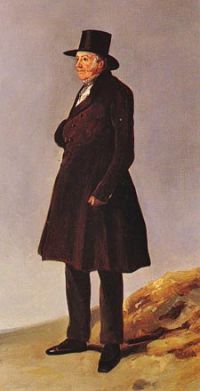
William Youatt (1776–1847) was an English veterinary surgeon and champion of animal welfare, celebrated for his thorough writings on animal husbandry and the humane treatment of livestock. His career encompassed clinical practice, teaching, and authorship, with works such as The Dog (1845) and The Hog (1847) providing in-depth insights into animal physiology, behavior, and care.
Youatt’s focus on kindness toward animals, expressed in The Obligation and Extent of Humanity to Brutes (1839), combined with his scientific approach, influenced contemporaries such as Charles Darwin through his research on artificial selection. His legacy persists as a link between veterinary science and moral philosophy, embodying both empirical accuracy and a deep ethical perspective.
Quotes by William Youatt
 William Youatt,
The Hog
(1855)
William Youatt,
The Hog
(1855)
“ They are the city scavengers, these pigs, ugly brutes they are; having for the most part scanty brown backs, like the lids of old horse-hair trunks, spotted with unwholesome black blotches; they have long, gaunt legs too, and such peaked snouts that if one of them could be persuaded, to sit for his profile, nobody would recognize it for a pig's likeness; they are never attended upon, or fed, or driven, or caught, but are thrown upon their own resources in early life, and become preternaturally knowing in consequence; every pig knows where he lives much better than any body could tell him. ”
“ If he be but with his master, he lies content, indifferent to every surrounding object, seemingly half asleep and half awake, rarely mingling with his kind, rarely courting, and generally shrinking from, the notice of a stranger; but the moment duty calls, his sleepy, listless eye, becomes brightened; he eagerly gazes on his master, inquires and comprehends all he is to do, and, springing up, gives himself to the discharge of his duty with a sagacity, and fidelity, and devotion, too rarely equalled even by man himself. ”
William Youatt,
The Hog
(1855)
“ Every morning I hear the blast of a horn, when, proceeding from almost every door in the street, behold a pig! The pigs generally proceed of their own accord; but shortly after they have passed, there comes a little bare-headed, bare-footed, stunted child about eleven years old. This little attendant of the old pig-driver facetiously called at Langen-Schwalbach the 'Schwein-General, knows every house from which a pig ought to have proceeded: she can tell by the door being open or shut, or even by footmarks, whether the creature has joined the herd, or is still snoring in its sty. ”
“ At length the rabid dog becomes completely exhausted, and slowly reels along the road with his tail depressed, seemingly half unconscious of surrounding objects. His open mouth, and protruding and blackened tongue, and rolling gait sufficiently characterise him. He creeps into some sheltered place and then he sleeps twelve hours or more. It is dangerous to disturb his slumbers, for his desire to do mischief immediately returns, and the slightest touch, or attempt to caress him, is repaid by a fatal wound. ”
“ In the care of sheep, each dog not only supplies the place of two or three men, but, as is seen in the foregoing pages, renders such assistance as cannot be obtained from any other source. The shepherds of Mexico lead a life not unlike the patriarchs of old, shifting about from day to day, watching their immense flocks, attended only by a few dogs, who have the entire control of the sheep, keeping them from straying away, and not only defending them from the blood-thirsty wolf, but even attacking, if necessary, the skulking savage. ”
William Youatt,
The Hog
(1855)
“ It has been too much the custom to regard the hog as a stupid, brutal, rapacious, and filthy animal, grovelling and disgusting in all his habits; intractable and obstinate in temper. But may not much of these evil qualities be attributable to the life he leads? In a native state swine seem by no means destitute of natural affections; they are gregarious, assemble together in defence of each other, herd together for warmth, and appear to have feelings in common; no mother is more tender of her young than the sow, or more resolute in their defence. ”
“ The stag-hound is a beautiful animal. He is distinguished from the fox-hound by the apparent broadness and shortness of his head, his longer cheek, his straighter hock, his wider thigh and deeper chest, and better feathered and more beautifully arched tail. His appearance indicates strength and stoutness, in which indeed he is unequalled, and he has sufficient speed to render it difficult for the best horses long to keep pace with him; while, as is necessary, when the distance between the footmarks of the deer is considered, his scent is most exquisite. ”
William Youatt,
The Hog
(1855)
“ In order to arrive at a proper understanding of the functions of any one part of the body, we must study the whole; there is no other way of obtaining that insight into disease which will furnish us with a clear idea of the precise nature and seat of a malady, and the course of treatment most likely to be attended with success. The uninformed empiric who deals about his nostrums at random, is far more liable to put an end to the life of his patient than to arrest the progress of the disorder. Such men should never be allowed to tamper with the meanest animal. ”
William Youatt,
The Hog
(1855)
“ Then the animal suddenly falls as if struck by lightning, and for a few moments lies perfectly motionless; after which convulsions come on gradually, increasing in intensity until they are fearful to behold; the countenance is distorted, the neck curved in every direction, and the legs alternately drawn up to the body, and extended with momentarily increasing rapidity. ”
“ It is somewhat astonishing that an organ, so delicate and so much exposed as the eye of the hunting dog necessarily is, should not more frequently be attacked with disease, or suffer from the thorns, poisonous briars, and bushes that so constantly oppose their progress while in search of game. Nature, ever wise in her undertakings, while endowing this organ with extreme sensibility, also furnished it with the means of protecting itself in some measure against the many evils that so constantly threaten its destruction. ”
William Youatt,
The Hog
(1855)
“ On entering the pen, these performers, who put you vastly in mind of assassins, make a rush at the hogs, each seizing one by the leg, amid a general yell of horror on the part of the victims. Whilst the hog and the man are struggling on the ground, the latter with the rapidity of thought pushes his skewer betwixt the fore-leg and the body quite into the heart, and then gives it a turn or two. The pig can rise no more, but screams for a minute or so and then expires. ”
“ He is no longer a faithful domesticated animal, faithfully attached to his master, and ever ready to defend him even at the expense of his own life. He is cruel and blood-thirsty, his look is savage, and his appearance revolting; carrion, filth, anything is good enough for him if he can but appease his hunger. They seldom bite one another, but they unite against a stranger who approaches the Arab tents, and would tear him to pieces if he did not seek his safety in flight. ”
William Youatt,
The Hog
(1855)
“ Such instances of sagacity in the dog and the horse scarcely astonish us, because we allow to them a certain degree of reasoning power. But is not the great development of it in them as much arising from their intercourse, if such we may term it, with man?—from their being his companions, educated and ordered by him? "I have observed great sagacity in swine," observes Darwin, in his "Zoonomia," "but the short lives we allow them, and their general confinement, prevent their improvement, which would otherwise probably equal that of the dog." ”
“ In figure, the most high-bred are a prodigy of beauty; their eyes, their hair, their colour, and bodily shape throughout. Such brilliancy of gloss is there about the spottiness of the parti-coloured, and in those of uniform colour, such glistening over the sameness of tint, as to afford a most delightful spectacle to an amateur of coursing. ”
William Youatt,
The Hog
(1855)
“ Annette was very fond of dumb creatures, as she called them; the pig became her darling, and for want of a companion of her own species, Toby became her constant associate; and finding his visits to the kitchen were winked at, he made use of the privilege, and would bask himself at full length before the fire. He even ventured occasionally to follow her into the front lobby; and if, as sometimes was the case, she put him into the yard, he would kick up such a row at the kitchen door to be let in, thumping on it with his snout, that she was fain to admit him to his old quarters. ”
“ It is like a pack of hounds, running breast high, with the game in view. They are then running by sight, and not by scent, almost doubling their usual pace, and sometimes, from an unexpected turning of the fox or hare, thrown out for a little while. The hound soon recovers the track by his exquisite sense of smell. The English greyhound is never taught to scent his game, but, on the contrary, is called off the moment he has lost sight of the hare, the re-starting of which is left to the spaniel. ”
William Youatt,
The Hog
(1855)
“ He bivouacs in some potato-field, which he rarely quits until he has excavated a ditch large enough to bury within it a dozen fellow-commoners of his own weight and size. Nor is the reign of this petty tyrant wholly bloodless; young lambs just dropped often fall victims to his ferocity or thirst for blood. ”
“ These thoughts seem to pass through his mind with wonderful rapidity, and to keep him in a state of the greatest distress, unless he is quickly spoken to or addressed by his name, and, then, in a moment the charm is broken; every phantom of imagination disappears, and at once he begins to talk as calmly and as connectedly as in perfect health. ”
William Youatt,
The Hog
(1855)
“ The German agriculturist, Thaër, does not, however, advocate the forest feeding of swine unless they are kept in the woods day and night and carefully sheltered; as he conceives that the bringing them home at night heats their blood, and nullifies the good effects of the day's feeding. He likewise considers that, although acorns produce good firm flesh, beechmast makes unsound oily fat. But if he is a useful animal in this public point of view, how much more so is he to individuals? Among the poorer classes of society how often is the pig their chief source of profit. ”
“ I have no longer recognised the dog, that friend of man, the attached and faithful companion — the lively and honest courtier. He is here a gloomy egotist, and cut off from all human intercourse without being the less a slave. He does not know him whose house he protects, and devours his corpse without repugnance. ”
William Youatt,
The Hog
(1855)
“ The boys are chosen for the strength of their lungs, and their taste and judgment in delighting the ears and lulling the senses of this amiable harmonic society; they succeed each other in chanting during the whole day, to the great delight and gratification of their bristly audience, who seem fully to appreciate the merits of the performers. ”
“ This account of the French sheep-dog, or of the sheep-dog everywhere, is as true as it is beautiful. One age succeeds to another, we pass from one climate to another, and everything varies and changes, but the shepherd's dog is what he ever was — the guardian of our flocks. ”
William Youatt,
The Hog
(1855)
“ The next thing which we shall claim for our porcine clients is sagacity; nor are we here in want of illustrative evidences of their possession of it. But in general there is nothing in the life of a hog, in his domesticated state at least, which calls for any exercise of reasoning powers. His sole business is to eat, drink, sleep, and get fat; all his wants are anticipated, and his world is limited to the precincts of his sty or of the farm-yard. Yet even in this state of luxurious ease, individuals have shown extraordinary intelligence. ”
“ His voice should be strong and clear, with an eye so quick as to perceive which of his hounds carries the scent when all are running, and an ear so excellent as to distinguish the leading hounds when he does not see them. He should be quiet, patient, and without conceit. Such are the qualities which constitute perfection in a huntsman. He should not, however, be too fond of displaying them until called forth by necessity; it being a peculiar and distinguishing trait in his character to let his hounds alone while they thus hunt, and have genius to assist them when they cannot. ”
William Youatt,
The Hog
(1855)
“ When any thing goes wrong in the piggery, the farmer too often, instead of exercising that shrewd sense which he turns to so good an account in almost every other instance, either sends for the butcher, or consigns the sick tenants of the sty to the care of an ignorant "pig-doctor," whose whole pretensions to leech-craft rest on the possession of some antiquated recipe, which he uses indiscriminately as a grand panacea for "all the ills swine's flesh is heir to," or on the traditionary lore he inherits from some ancestor famous in his day for certain real or supposed wondrous cures. ”
“ If some one calls out that the cows are in the corn or the hens in the garden, the house colley needs no other hint, but runs and turns them out. The shepherd's dog knows not what is astir, and, if he is called out in a hurry for such work, all that he will do is to run to the hill, or rear himself on his haunches to see that no sheep are running away. A well-bred sheep-dog, if coming hungry from the hills, and getting into a milk-house, would likely think of nothing else than filling his belly with the cream. Not so his initiated brother: he is bred at home to far higher principles of honour. ”
William Youatt,
The Hog
(1855)
“ To dwell upon the nutritive qualities of grain in general would be useless. The value of barley-meal, middlings, mill-sweepings, &c., in the feeding of hogs, is well known. It is true that this food is expensive, but then it is not used exclusively till the time for finishing off, or need not be; and, what is more, the expense is repaid by the gain of the animal in weight, and by the great superiority of the meat, which will command its price in the market. The rapid increase in the weight of hogs fed upon barley-meal, peas, steamed potatoes, with whey or butter-milk, is astonishing. ”
“ Bernard, and near one of the most dangerous of these passes, is a convent, in which is preserved a breed of large dogs trained to search for the benighted and frozen wanderer. Every night, and particularly when the wind blows tempestuously, some of these dogs are sent out. They traverse every path about the mountains, and their scent is so exquisite that they can discover the traveller, although he may lie many feet deep in the snow. ”
“ For the dog, with his long, rough, shaggy hair, that covered his whole body, rushed with open mouth, barking terribly, and thundering, as it were, upon the elephant. Soon after he leaps and flies upon him, advancing and retreating, now on one side, now on the other, maintaining an ingenious combat; at one time assailing him with all vigour, at another shunning him. So actively did he continue this artificial warfare, causing the huge beast to turn around so frequently on every side to avoid his attacks, that he ultimately came down with a crash that made the earth tremble with his fall. ”
“ Let not this obedience, however, be purchased by the infliction of a degree of cruelty that disgraces both the master and the menial. A young fox-hound may, possibly, mistake the scent of a hare for that of a fox, and give tongue. In too many hunts he will be unmercifully flogged for this, and some have almost died under the lash. Mercy is a word totally unknown to a great proportion of whippers-in, and even to many who call themselves gentlemen. ”
William Youatt,
The Hog
(1855)
“ To the acute sense of the hog are epicures indebted for the truffles which form such a delicious sauce, for they are the actual finders. A pig is turned into a field and suffered to pursue his own course and watched. He stops and begins to grub up the earth, the man hurries up, drives him away, and secures the truffle, which is invariably growing under that spot, and the poor pig goes off to sniff out another, and another, only now and then being allowed by way of encouragement to reap the fruits of his research. ”
“ On the other hand there are rabid dogs whose ferocity knows no bounds. If they are threatened with a stick, they fly at, and seize it, and furiously shake it. They are incessantly employed in darting to the end of their chain, and attempting to crush it with their teeth, and tearing to pieces their kennel, or the wood work that is within their reach. They are regardless of pain. The canine teeth, the incisor teeth are torn away; yet, unwearied and insensible to suffering, they continue their efforts to escape. A dog was chained near a kitchen fire. ”
William Youatt,
The Hog
(1855)
“ To a certain extent, indeed, the hog is omnivorous, and may be reared on the refuse of the butchers' slaughter-houses; but such food is not wholesome, nor is it natural; for though this animal be omnivorous, it is not essentially carnivorous. Vegetable productions, as roots and grain, beech-mast, and acorns, constitute the staple of its natural diet; hence, the refuse of the dairy farm is more congenial to the health of the animal, to say nothing of the quality of its flesh. All animals eat with a keen relish the hog amongst the rest ”
“ The dog is the only animal that is capable of disinterested affection. He is the only one that regards the human being as his companion, and follows him as his friend; the only one that seems to possess a natural desire to be useful to him, or from a spontaneous impulse attaches himself to man. We take the bridle from the mouth of the horse, and turn him free into the pasture, and he testifies his joy in his partially recovered liberty. We exact from the dog the service that is required of him, and he still follows us. ”
William Youatt,
The Hog
(1855)
“ However, if the charge of gluttony be proved against the pig fattening in his sty, it may be equally proved against the ox fattening in his stall. When old, or when oppressed by fat, the hog, it must be confessed, is sluggish and indolent; when young, however, it is lively and energetic, and disposed to indulge in sportive gambols, which, for any thing we can see, are quite as amusing as those of lambs. Many extraordinary examples of the docility and intelligence of the too much despised hog are on record. ”
“ The power of keeping the mind steadily bent upon one purpose, is the great secret of individual and moral improvement. We see the habit of attention carried in the dog to a very considerable extent. The terrier eagerly watching for vermin — the sporting dog standing staunch to his point, however he may be annoyed by the blunders of his companion or the unskilfulness of his master — the foxhound, insensible to a thousand scents, and deaf to every other sound, while he anxiously and perseveringly searches out the track of his prey — these are striking illustrations of the power of attention. ”
William Youatt,
The Hog
(1855)
“ The senses of smell, taste, and hearing, are possessed by the hog in great perfection. It is a common saying that pigs can smell the coming storm; certain it is that they are very sensitive of approaching changes of weather. They become agitated, hurry under shelter, and during the continuance of the storm utter screams, run about with straw in their mouths, or carry it to their sty as if to add to their comfort and defence. ”
“ Nothing can be more absurd. A disease attacking so many organs, and presenting so many and such different symptoms, must require a mode of treatment varying with the organ attacked and the symptom prevailing. The faith in these boasted specifics is principally founded on two circumstances — atmospheric influence and peculiarity of breed. There are some seasons when we can scarcely save a dog; there are others when we must almost wilfully destroy him in order to lose him. ”
William Youatt,
The Hog
(1855)
“ He may allow the sty or the yard to be covered with filth of every description, as disgraceful to himself as it is injurious to the animals. In this case the hog is the sufferer, for naturally it delights in clean straw, luxuriating in it with evident pleasure, its twinkling little eyes and low grunt expressing its feelings of contentment. In fact, the hog, so far from being the filthiest, is one of the cleanliest of our domestic quadrupeds, and is unwilling to soil the straw bed of his domicile if any thing like liberty be allowed him. ”
“ The dog being kept in motion, the ducks will not arrest their progress until within a few feet of the water's edge, and oftentimes will stand on the shore staring, as it were, in mute and silly astonishment at the playful motions of the dog. If well trained the dog takes no notice whatever of the duck, but continues his fascination until the quick report of the battery announces to him that his services are now wanted in another quarter, and he immediately rushes into the water to arrest the flight of the maimed and wounded, who, struggling on every side, dye the water with their rich blood. ”
