Summary

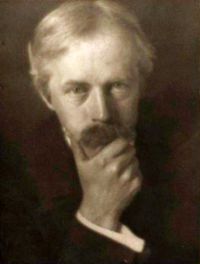
Portrait of Arthur Symons Arthur Symons Plays, Acting and Music: A Book Of Theory

Irving's acting is almost a science, and it is a science founded on tradition. [54] It is in one sense his personality that makes him what he is, the only actor on the English stage who has a touch of genius. But he has not gone to himself to invent an art wholly personal, wholly new; his acting is no interruption of an intense inner life, but a craftsmanship into which he has put all he has to give. It is an art wholly of rhetoric, that is to say wholly external; his emotion moves to slow music, crystallises into an attitude, dies upon a long-drawn-out word.
Source: Gutenberg

Portrait of Arthur Symons Arthur Symons Plays, Acting and Music: A Book Of Theory

Pachmann is the Verlaine of pianists, and when I hear him I think of Verlaine reading his own verse, in a faint, reluctant voice, which you overheard. Other players have mastered the piano, Pachmann absorbs its soul, and it is only when he touches it that it really speaks its own voice.
The art of the pianist, after all, lies mainly in one thing, touch. It is by the skill, precision, and beauty of his touch that he makes music at all; it is by the quality of his touch that he evokes a more or less miraculous vision of sound for us.
Source: Gutenberg

Portrait of Arthur Symons Arthur Symons Plays, Acting and Music: A Book Of Theory

Sarah Bernhardt's acting always reminds me of a musical performance. Her voice is itself an instrument of music, and she plays upon it as a conductor plays upon an orchestra. [27] One seems to see the expression marks: piano, pianissimo, largamente, and just where the tempo rubato comes in. She never forgets that art is not nature, and that when one is speaking verse one is not talking prose. She speaks with a liquid articulation of every syllable, like one who loves the savour of words on the tongue, giving them a beauty and an expressiveness often not in them themselves.
Source: Gutenberg

Get perspective with Kwize: daily news enlightened by great literature