“ The Gothic carvers loved snakes, but hardly with the strange passion of Blake. They carved the flames of hell and of earthly punishment with delight in the beauty of their soaring and twisting lines; but no one has ever made of fire such a plaything and ecstasy as Blake has made of it. In his paintings he invents new colors to show forth the very soul of fire, a soul angrier and more variable than opals; and in his drawings he shows us lines and nooses of fire rushing upward out of the ground, and fire drifting across the air like vapor, and fire consuming the world in the last chaos. ”
Summary
Arthur Symons’ William Blake (1907) is a critical examination of the poet-artist’s visionary body of work, analyzing his integration of poetry, engraving, and imaginative philosophy. Centering on Blake’s distinctive blending of art and thought, Symons emphasizes his fascination with enduring themes—imagination, genius, and the sublime—through interpretations of his designs, symbolic visuals, and prophetic revelations.
The text highlights Blake’s opposition to materialism, his spiritual intensity, and his capacity to transform abstract concepts into striking, often disordered forms, as evident in his portrayals of fire and mythological figures. Symons presents Blake not only as a poet but as a prophet whose work surpasses time, encapsulating the “eternity” of unfiltered creative insight.
Quotes from William Blake (Arthur Symons)
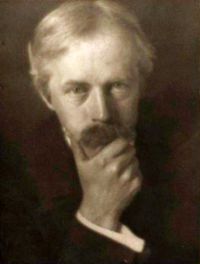 Arthur Symons,
William Blake
(1907)
Arthur Symons,
William Blake
(1907)
“ Yet imagination is the life and spirit of all great works of genius and taste; and, indeed, without it, the head thinks and the hand labours in vain. Ten thousand authors and artists rise to the proper, the graceful, and the beautiful, for ten who ascend into 'the heaven of invention.' A work—whether from poet or painter—conceived in the fiery ecstasy of imagination, lives through every limb; while one elaborated out by skill and taste only will look, in comparison, like a withered and sapless tree beside one green and flourishing. ”
“ In the vision of 'Fire' there is grandeur and, along with it, something inadequately seen, inadequately rendered. Flame and smoke embrace, coil, spire, swell in bellying clouds, divide into lacerating tongues, tangle and whirl ecstatically upward and onward, like a venomous joy in action, painting the air with all the color of all the flowers of evil. But the figures in the foreground are partly academic studies, partly archaic dolls, in which only the intention is admirable. In 'Job Confessing his Presumption to God' one sees all that is great and all that is childish in Blake's genius. ”
“ Other poets find ecstasy in nature, but Blake only in imagination. He addresses the Prophetic Book of The Ghost of Abel 'to Lord Byron in the wilderness,' and asks: 'What doest thou here, Elijah? Can a poet doubt of the visions of Jehovah? Nature has no outline, but Imagination has. Nature has no time, but Imagination has. Nature has no supernatural, and dissolves. Imagination is eternity.' The poetry of Blake is a poetry of the mind, abstract in substance, concrete in form; its passion is the passion of the imagination, its emotion is the emotion of thought, its beauty is the beauty of idea. ”
Arthur Symons,
William Blake
(1907)
“ Not a flower or beast has reality, as our eyes see it, yet every flower and beast is informed by an almost human soul, not the mere vitality of animal or vegetable, but a consciousness of its own lovely or evil shape. His snakes are not only wonderful in their coils and colours, but each has his individual soul, visible in his eyes, and interpreting those coils and colours. And every leaf, unnatural yet alive, and always a piece of decoration, peers with some meaning of its own out of every corner, not content to be forgotten, and so uneasily alive that it draws the eye to follow it. ”
Arthur Symons,
William Blake
(1907)
“ It was wonderful that he could thus, month after month, and year after year, lay down his graver after it had won him his daily wages, and retire from the battle for bread, to disport his fancy amid scenes of more than earthly splendour, and creatures pure as unfallen dew. In this lay the weakness and the strength of Blake, and those who desire to feel the character of his compositions, must be familiar with his history and the peculiarities of his mind. He was by nature a poet, a dreamer, and an enthusiast. ”
Arthur Symons,
William Blake
(1907)
“ There are no men and women in the world of Blake's poetry, only primal instincts and the energies of the imagination. His work begins in the garden of Eden, or of the childhood of the world, and there is something in it of the naîveté of beasts: the lines gambol awkwardly, like young lambs. His utterance of the state of innocence has in it something of the grotesqueness of babies, and enchants the grown man, as they do. Humour exists unconscious of itself, in a kind of awed and open-eyed solemnity. He stammers into a speech of angels, as if just awakening out of Paradise. ”
Arthur Symons,
William Blake
(1907)
“ The voice of desire is not in it, nor the voice of passion, nor the cry of the heart, nor the cry of the sinner to God, nor of the lover of nature to nature. It neither seeks nor aspires nor laments nor questions. It is like the voice of wisdom in a child, who has not yet forgotten the world out of which the soul came. It is as spontaneous as the note of a bird, it is an affirmation of life; in its song, which seems mere music, it is the mind which sings; it is lyric thought. ”
“ The spirit said to him, 'Blake, be an artist and nothing else.' In this there is felicity. His eye glistened while he spoke of the joy of devoting himself solely to divine art. 'Art is inspiration. When Michael Angelo or Raphael or Mr. Flaxman does any of his fine things, he does them in the spirit.' Blake said, 'I should be sorry if I had any earthly fame, for whatever natural glory a man has is so much detracted from his spiritual glory. I wish to do nothing for profit. I wish to live for art. ”
Arthur Symons,
William Blake
(1907)
“ In Blake's work a great fundamental conception is rarely lacking, and the conception is not, as it has often been asserted, a literary, but always a pictorial, one. At times imagination and execution are wholly untired, as in the splendid water-colour of 'Death on the Pale Horse,' in which not only every line and colour is alive with passionate idea, the implacable and eternal joy of destruction, but also with a realised beauty, a fully grasped invention. ”
Arthur Symons,
William Blake
(1907)
“ And he asserted the truth of his own genius, its truth in the spiritual sense, its divine origin, as directly and as emphatically as he asserted everything which he had apprehended as truth. He is merely stating what seems to him an obvious but over-looked fact when he says: 'In Mr. B.'s Britons the blood is seen to circulate in their limbs: he defies competition in colouring'; and again: 'I am, like other men, just equal in invention and execution of my work.' All art, he had realised, which is true art, is equal, as every diamond is a diamond. There is only true and false art. ”
Arthur Symons,
William Blake
(1907)
“ He who does not know Truth at sight is unworthy of her notice.' And he said: 'Error is created, truth is eternal. Error or creation will be burned up, and then, not till then, truth or eternity will appear. It is burned up the moment men cease to behold it.' It was this private certainty in regard to truth and all things that Blake shared with the greatest minds of the world, and men doubted him partly because he was content to possess that certainty and had no desire to use it for any practical purpose, least of all to convince others. ”
“ The philosophy of Nietzsche was made out of his nerves and was suffering, but to Blake it entered like sunlight into the eyes. Nietzsche's mind is the most sleepless of minds; with him every sensation turns instantly into the stuff of thought; he is terribly alert, the more so because he never stops to systematize; he must be for ever apprehending. He darts out feelers in every direction, relentlessly touching the whole substance of the world. His apprehension is minute rather than broad; he is content to seize one thing at a time, and he is content if each separate thing remains separate ”
Arthur Symons,
William Blake
(1907)
“ Blake's was the voice of the awakening angel. What he cried was that only eternal and invisible things were true, and that visible temporal things were a veil and a delusion. In this he knew himself to be on the side of Wesley and Whitefield, and that Voltaire and Rousseau, the voices of the passing age, were against him. He called them 'frozen sons of the feminine Tabernacle of Bacon, Newton, and Locke.' Wesley and Whitefield he calls the 'two servants' of God, his 'two witnesses.' But it seemed to him that he could go deeper into the Bible than they, in their practical eagerness, had gone. ”
“ Blake has, too, the same love of pattern for its own sake, the same exuberance of ornament, always living and organic, growing out of the structure of the design or out of the form of the page, not added to it from without. Gothic art taught him his hatred of vacant space, his love of twining and trailing foliage and flame and water; and his invention of ornament is as unlimited as theirs. A page of one of his illuminated books is like the carving on a Gothic capital. ”
“ What resemblance do you suppose is there between your spirit and the spirit of Socrates? 'The same as between our countenance.' He paused and added—'I was Socrates.' And then, as if correcting himself, 'A sort of brother. I must have had conversations with him. So I had with Jesus Christ. I have an obscure recollection of having been with both of them.'It was before this, that I had suggested on very obvious philosophical grounds the impossibility of supposing an immortal being created—an eternity a parte post without an eternity a parte ante. ”
“ Blake thus continues:—'And now begins a new life, because another covering of earth is shaken off. I am more famed in heaven for my works than I could well conceive. In my brain are studies and chambers filled with books and pictures of old, which I wrote and painted in ages of eternity before my mortal life, and those works are the delight and study of archangels. Why then should I be anxious about the riches or fame of mortality? You, O dear Flaxman, are a sublime archangel, my friend and companion from eternity. ”
“ And to Blake, to be 'myself alone, shut up in myself,' was to be in no merely individual but in a universal world, that world of imagination whose gates seemed to him to be open to every human being. No less than Nietzsche he says to every man: Be yourself, nothing else matters or exists; but to be myself, to him, was to enter by the imagination into eternity. ”
“ It is all as unreal as you like, made up of elements not combined into any faultless pattern; art has gone back further than Giotto, and is careless of human individuality; but it is seen as it were with faith, and it conveys to you precisely what the painter meant to convey. So, in a lovely water-color of the creation of Eve, this blue-haired doll of obviously rounded flesh has in her something which is more as well as less than the appeal of bodily beauty, some suggestion to the imagination which the actual technical skill of Blake has put there. ”
“ In common with Swedenborg, Blake is a mystic who enters into no tradition, such as that tradition of the Catholic Church which has a liturgy awaiting dreams. For Saint John of the Cross and for Saint Teresa the words of the vision are already there, perfectly translating ecstasy into familiar speech; they have but to look and to speak. But to Blake, as to Swedenborg, no tradition is sufficiently a matter of literal belief to be at hand with its forms; new forms have to be made, and something of the crudity of Swedenborg comes over him in his rejection of the compromise of mortal imagery. ”
Arthur Symons,
William Blake
(1907)
“ To define the poetry of Blake one must find new definitions for poetry; but, these definitions once found, he will seem to be the only poet who is a poet in essence; the only poet who could, in his own words, 'enter into Noah's rainbow, and make a friend and companion of one of these images of wonder, which always entreat him to leave mortal things.' In this verse there is, if it is to be found in any verse, the 'lyrical cry'; and yet, what voice is it that cries in this disembodied ecstasy? ”
Arthur Symons,
William Blake
(1907)
“ Now, to the critic this is not more important to remember than it is for him to remember that the result, the end, must be judged, not by the impulse which brought it into being, nor by the purpose which it sought to serve, but by its success or failure in one thing: the creation of beauty. To the artist himself this precise consciousness of what he has done is not always given, any more than a precise consciousness of what he is doing. Only in the greatest do we find vision and the correction of vision equally powerful and equally constant. ”
“ They are those of Michael Angelo, Rafael and the Antique, and of the best living Models. I perceive that your Eye is perverted by Caricature Prints, which ought not to abound so much as they do. Fun I love, but too much Fun is of all things the most loathsome. Mirth is better than Fun, and Happiness is better than Mirth. I feel that a Man may be happy in This World, and I know that This World is a World of Imagination and Vision. I see Everything I paint In This World: but Every body does not see alike. ”
“ Blake is the only poet who sees all temporal things under the form of eternity. To him reality is merely a symbol, and he catches at its terms, hastily and faultily, as he catches at the lines of the drawing-master, to represent, as in a faint image, the clear and shining outlines of what he sees with the imagination ”
Arthur Symons,
William Blake
(1907)
“ Colour in Blake is never shaded, or, as he would have said, blotted and blurred; it is always pure energy. In the faint colouring of the Book of Thel there is the very essence of gentleness; the colour is a faultless interpretation of the faint and lovely monotony of the verse, and of its exquisite detail. Several of the plates recur in the Book of Designs, coloured at a different and, no doubt, much later time; and while every line is the same the whole atmosphere and mood of the designs is changed. Bright rich colour is built up in all the vacant spaces ”
Arthur Symons,
William Blake
(1907)
“ With less delicacy of colour, and with drawing in parts actually misleading, there is a strange intensity of appeal, of realisation not so much to the eyes as through them to the imagination, in another water-colour of the raising of Lazarus, where the corpse swathed in grave-clothes floats sidelong upward from the grave, the weight of mortality as if taken off, and an unearthly lightness in its disemprisoned limbs, that have forgotten the laws of mortal gravity. ”
“ The green hills appear beneath; with the graves of the blessed, which are seen bursting with their births of immortality; parents and children embrace and arise together, and in exulting attitudes tell each other that the New Jerusalem is ready to descend upon earth; they arise upon the air rejoicing; others newly awaked from the graves, stand upon the earth embracing and shouting to the Lamb, who cometh in the clouds with power and great glory. ”
Arthur Symons,
William Blake
(1907)
“ He was thus compelled more than ever to retire to worlds of his own creating, and seek solace in visions of paradise for the joys which the earth denied him. By frequent indulgence in these imaginings, he gradually began to believe in the reality of what dreaming fancy painted—the pictured forms which swarmed before his eyes, assumed, in his apprehension, the stability of positive revelations, and he mistook the vivid figures, which his professional imagination shaped, for the poets, and heroes, and princes of old. ”
“ Blake's passion for detail, and his refusal to subordinate any detail for any purpose, is to be seen in all his figures, of which the bodies seem to be copied from living statues, and in which the faces are wrung into masks of moods which they are too urgent to interpret. A world of conventional patterns, in which all natural things are artificial and yet expressive, is peopled by giants and dolls, muscular and foolish, in whom strength becomes an insane gesture and beauty a formal prettiness. ”
Arthur Symons,
William Blake
(1907)
“ A man does not beg at the gate of dreams when he is the master for whose entrance the gate stands open. Of the definite reality of Blake's visions there can be no question; no question that, as he once wrote, 'nothing can withstand the fury of my course among the stars of God, and in the abysses of the accuser.' But imagination is not one, but manifold; and the metaphor, professing to be no more than metaphor, of the poet, may be vision as essential as the thing actually seen by the visionary. ”
“ Despair, a statue of greenish bronze, is the Scofield of Jerusalem; the limbs and faces rigid with agony are types of strength and symbols of pain. Yet even here there is creation, there is the energy of life, there is a spiritual awe. And wherever Blake works freely, as in the regions of the Prophetic Books, wholly outside time and space, appropriate form multiplies under his creating hand, as it weaves a new creation of worlds and of spirits, monstrous and angelical. ”
Arthur Symons,
William Blake
(1907)
“ A spirit and a vision are not, as the modern philosophy supposes, a cloudy vapour, or a nothing. They are organised and minutely articulated beyond all that the mortal and perishing nature can produce. He who does not imagine in stronger and better lineaments and in stronger and better light than his perishing and mortal eye can see, does not imagine at all. ”
Arthur Symons,
William Blake
(1907)
“ Blake was too humble towards vision to allow himself to compose or arrange what he saw, and he saw in detail, with an unparalleled fixity and clearness. Every picture of Blake, quite apart from its meaning to the intelligence, is built up in detail like a piece of decoration; and, widely remote as are both intention and result, I am inclined to think he composed as Japanese artists compose, bit by bit, as he saw his picture come piece by piece before him. In every picture there is a mental idea, and there is also a pictorial conception, working visually and apart from the mental idea. ”
Arthur Symons,
William Blake
(1907)
“ Though Blake lost himself a little in the enchanted region of song, he seems not to have neglected to make himself master of the graver, or to have forgotten his love of designs and sketches. He was a dutiful servant to Basire, and he studied occasionally under Flaxman and Fuseli; but it was his chief delight to retire to the solitude of his chamber, and there make drawings, and illustrate these with verses, to be hung up together in his mother's chamber. He was always at work; he called amusement idleness, sight-seeing vanity, and money-making the ruin of all high aspirations. ”
“ But to the Eyes of the Man of Imagination, Nature is Imagination itself. As a Man is, so he sees. As the Eye is formed, such are its Powers. You certainly Mistake when you say that the Visions of Fancy are not to be found in This World. To Me This World is all One continued Vision of Fancy or Imagination, and I feel Flattered when I am told so. What is it sets Homer, Virgil, and Milton in so high a rank of Art? Why is the Bible more Entertaining and Instructive than any other book? ”
Arthur Symons,
William Blake
(1907)
“ The crosses which genius is heir to had been wholly unforeseen—and they befell him early; he wanted the skill of hand, and fine tact of fancy and taste, to impress upon the offspring of his thoughts that popular shape, which gives such productions immediate circulation. His works were looked coldly on by the world, and were only esteemed by men of poetic minds, or those who were fond of things out of the common way. He earned a little fame, but no money by these speculations, and had to depend for bread on the labours of the graver. ”
“ I could not help contrasting this humble artist with the great and powerful Sir Thomas Lawrence, and thinking that the one was fully if not more worthy of the distinction and the fame to which the other has attained, but from which he is far removed. Mr. Blake, however, though he may have as much right, from talent and merit, to the advantages of which Sir Thomas is possessed, evidently lacks that worldly wisdom and that grace of manner which make a man gain an eminence in his profession, and succeed in society. ”
Common terms
Similar works
William Blake: A Study of His Life and Art Work…Life of William Blake (Anne Gilchrist…William Blake, the Man (Charles Gardner…The letters of William Blake (William Blake…William Blake, a critical essay…William Blake, painter and poet…Ideas of Good and Evil (W. B. Yeats…William Blake (G. K. Chesterton…The Collected Works in Verse and Prose of William Butler Yeats…Life of William Blake (William Blake…
