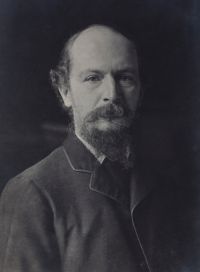
Algernon Charles Swinburne

Algernon Charles Swinburne

Summary

Portrait of Algernon Charles Swinburne Algernon Charles Swinburne William Blake, a critical essay

We may see again as various a power as was his, may feel again as fiery a sympathy, may hear again as strange a murmur of revelation, as sad a whisper of knowledge, as mysterious a music of emotion; we shall never find so keen, so delicate, so deep an unison of sense and spirit. What verse he could make, how he loved all fair and felt all strange things, with what infallible taste he knew at once the limit and the licence of his art, all may see at a glance. He could give beauty to the form, expression to the feeling, most horrible and most obscure to the senses or souls of lesser men.
Source: Gutenberg

Portrait of Algernon Charles Swinburne Algernon Charles Swinburne William Blake, a critical essay (1868)

Urizen, God of cloud and star, "Father of jealousy," clothed with a splendour of shadow, strong and sad and cruel; his planet faintly glimmers and slowly revolves, a horror in heaven; the night is a part of his thought, rain and wind are in the passage of his feet; sorrow is in all his works; he is the maker of mortal things, of the elements and sexes; in him are incarnate that jealousy which the Hebrews acknowledged and that envy which the Greeks recognized in the divine nature; in his worship faith remains one with fear.
Source: Wikisource

Portrait of Algernon Charles Swinburne Algernon Charles Swinburne William Blake, a critical essay

The complete and exalted figure of Blake cannot be seen in full by those who avert their eyes, smarting and blinking, from the frequent smoke and sudden flame. Others will see more clearly, as they look more sharply, the radical sanity and coherence of the mind which put forth its shoots of thought and faith in ways so strange, at such strange times. Faith incredible and love invisible to most men were alone the springs of this turbid and sonorous stream. In Blake, above all other men, the moral and the imaginative senses were so fused together as to compose the final artistic form.
Source: Gutenberg

Get perspective with Kwize: daily news enlightened by great literature