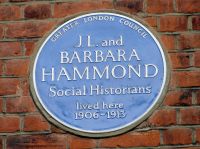
Barbara Bradby Hammond

Barbara Bradby Hammond

Summary

Portrait of Barbara Bradby Hammond Barbara Bradby Hammond The village labourer, 1760-1832 (1912)

All his auxiliary resources had been taken from him, and he was now a wage earner and nothing more. Enclosure had robbed him of the strip that he tilled, of the cow that he kept on the village pasture, of the fuel that he picked up in the woods, and of the turf that he tore from the common. And while a social revolution had swept away his possessions, an industrial revolution had swept away his family’s earnings. To families living on the scale of the village poor, each of these losses was a crippling blow, and the total effect of the changes was to destroy their economic independence.
Source: Gutenberg

Portrait of Barbara Bradby Hammond Barbara Bradby Hammond The village labourer, 1760-1832 (1912)

The life of the husbandman cannot be that of a gentleman without injury to society at large. When farmers become gentlemen their labourers become slaves. A Virginian farmer, as he is called, very much resembles a great farmer in England; but then, the Virginian’s work is done by slaves. It is in those States of America, where the farmer is only the first labourer that all the domestic virtues are to be found, and all that public-spirit and that valour, which are the safeguards of American independence, freedom, and happiness. You, Sir, with others, complain of the increase of the poor-rates.
Source: Gutenberg

Portrait of Barbara Bradby Hammond Barbara Bradby Hammond The village labourer, 1760-1832 (1912)

At no time in English history have sordid motives been so conspicuous in politics as during the days when power was most a monopoly of the aristocracy. No politicians have sacrificed so much of their time, ability, and principles to the pursuit of gain as the politicians of the age when poor men could only squeeze into politics by twos or threes in a generation, when the aristocracy put whole families into the House of Commons as a matter of course, and Burke boasted that the House of Lords was wholly, and the House of Commons was mainly, composed for the defence of hereditary property.
Source: Gutenberg

Get perspective with Kwize: daily news enlightened by great literature