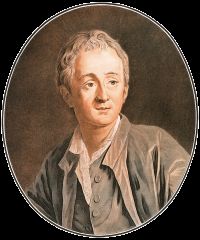
Denis Diderot

Definition and stakes

Benjamin Ellis Martin The Stones of Paris in History and Letters…

Some of them read their still unpublished works. The patron enjoys it all, and the waiters are the most depressed in all Paris.
Denis Diderot gives the effect in his work, as Gambetta did in the flesh, of a living force of nature. When, at that same table, Diderot opened the long-locked gate, the full and impetuous outflow swept all before it, submerged and breathless. In his personality, as vivid as that of Mirabeau, we see a fiery soul, a stormy nature, a daring thinker, a prodigious worker.
Source: Gutenberg

Evelyn Beatrice Hall The Friends of Voltaire

If the studious poverty of the life in the glazier’s attic spared d’Alembert acquaintances, it did not deprive him of friends.
Then living in Paris, some six-and-thirty years old, the author of the ‘Philosophical Thoughts,’ and the most fascinating scoundrel in France, was Denis Diderot. With the quiet d’Alembert, of morals almost austere and of hidden, frugal life, what could a Diderot have in common? Something more than the attraction of opposites drew them together. The vehement and all-embracing imagination of the one fired the calm reason of the other.
Source: Gutenberg

Evelyn Beatrice Hall The Friends of Voltaire

But it is as the father of the Encyclopædia that Denis Diderot merits eternal recognition. Guilty as he was in almost every relation of life towards the individual, for mankind, in the teeth of danger and of infidelity, at the ill-paid sacrifice of the best years of his exuberant life, he produced that book which first levelled a free path to knowledge and enfranchised the soul of his generation.{62}
III
GALIANI:
Source: Gutenberg

Get perspective with Kwize: daily news enlightened by great literature