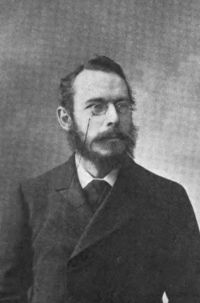
Brander Matthews

Brander Matthews

Summary

Portrait of Brander Matthews Brander Matthews A Book About the Theater

But, of course, we do not apply a moral standard to the sayings and doings of Mr. Punch, for the plain and sufficient reason that he is not a human being. He is not a man and a brother, upon whom we may be tempted to pattern ourselves. He is but a six-inch puppet, a thing of shreds and patches, a wooden-headed doll, vitalized for a moment only by the hand concealed inside his flimsy body with its flaunting colors. He is too fantastic, too impossible, too unreal, too unrelated to any possible world, for us to feel called upon to frown upon his misdeeds or to take them seriously.
Source: Gutenberg

Portrait of Brander Matthews Brander Matthews A Book About the Theater

If a performance by puppets deprived 'Salome' of its vulgar grossness by removing it outside the arena of humanity, so to speak, and by relegating it to an unreal world beyond the strict diocese of the conscience, so a performance by puppets of a passion-play or of any other drama in which the Deity has perforce to appear as a character, is thereby relieved of any tincture of irreverence. We no longer see a divine being interpreted by a human being. We cannot help feeling that all the persons in the play, whether they dwell in heaven or on earth, are equally remote from our common humanity.
Source: Gutenberg

Portrait of Brander Matthews Brander Matthews A Book About the Theater

If, therefore, we accept the Unity of Action as a general rule, binding upon all artists, we can hardly deny that the most obviously natural arrangement for the story is to set it forth in one act, without any intermission or subdivision whatsoever—a single action in a single act. Yet it is the play in three acts which we are bound to recognize at once as possessing the ideal form, since it enables the dramatist to set apart the three divisions, which Aristotle declared to be essential to a well-constructed tragedy—the beginning, the middle, and the end—each presented in an act of its own.
Source: Gutenberg

Get perspective with Kwize: daily news enlightened by great literature