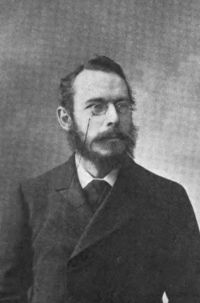
Brander Matthews

Brander Matthews

Summary

Portrait of Brander Matthews Brander Matthews Inquiries and Opinions

This is the mainspring of that action without which a drama is a thing of naught; and perhaps the most obvious backbone for a play is the tense contest of two human beings, each knowing clearly what he wants and each straining to attain it, at whatever cost to his adversary, to all others, and even to himself. Rivals fighting to the death, a hero at war with the world, a single soul striving to wrench itself free from the fell clutch of fate,—such is the stuff out of which the serious drama must be compounded.
Source: Gutenberg

Portrait of Brander Matthews Brander Matthews Inquiries and Opinions

Did any novelist of the seventeenth century lay bare the palpitations of the female heart more delicately than Racine? Did any novelist of the eighteenth century reveal a subtler insight into the hidden recesses of feminine psychology than Marivaux? It may be true enough that, in the nineteenth century, prose-fiction has been more fortunate than the drama and that the novelists have achieved triumphs of insight and of subtlety denied to the dramatists. But who shall say that this immediate inferiority of the play to the novel is inherent in the form itself?
Source: Gutenberg

Portrait of Brander Matthews Brander Matthews Inquiries and Opinions

Books are not made by style alone. Even lyric poetry is estimated by its fervor and by its sincerity rather than by the dulcet phrases in which the lyrist has voiced his emotion of the moment. If verbal felicity alone is all that the poet needs, if he is to be judged only by the compelling melody of the words he has chosen to set in array, then is Poe the foremost of lyrists. Even the essay, the most narrowly literary of all prose-forms, is valued for its wisdom rather than for its phrasing.
Source: Gutenberg

Get perspective with Kwize: daily news enlightened by great literature