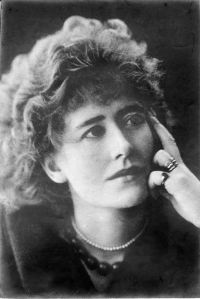
Ellen Terry

Ellen Terry

Summary

Portrait of Ellen Terry Ellen Terry,  The Russian Ballet

“ Its deep expectant breathing increases one's sensation that we are all dreaming—dancers and audience too. Tamar Karsavina, who in other roles shows a nervous force, a tragic power, a strange and luring grace which account even better than her dancing for her triumphant prominence, is so gentle, so modest, so suppliant in the "Spectre de la Rose," that she becomes the incarnation of snow-white youth, dreaming of a heavenly lover. And Nijinsky becomes the spirit of that dream. ”
Source: Gutenberg

Portrait of Ellen Terry Ellen Terry,  The Russian Ballet

“ Perhaps the rhythm of the music has never been better perceived than through these well-ordered movements designed by Fokine. The appearance of Nijinsky as a kind of dream Alfred de Musset in a romantic fair wig, and dressed in black and white, among the impalpable Sylphides was both inexplicable and inevitable. When he danced he seemed almost to play Chopin with his feet, so perfect was his time. His steps seemed to be the symmetry of the music—in fact its rhythm, for the rhythm of music is symmetry in motion. ”
Source: Gutenberg

Portrait of Ellen Terry Ellen Terry,  The Russian Ballet

“ Whatever his role, the young Russian dancer projects an interior emotion which has in it all the force of spontaneity, but is at the same time conscious and considered. As an actress, that has always been my ideal of expression. But actors express emotions; it is generally their duty to realise, in fact, to recall a man. Nijinsky never recalls human experience, never suggests the passions of mankind. He is always the dancer. Now the miming of ordinary ballet-dancers has often in the past seemed to be more than a little ridiculous. ”
Source: Gutenberg

Get perspective with Kwize: daily news enlightened by great literature